SUBSCRIBE TO OUR FREE NEWSLETTER
Daily news & progressive opinion—funded by the people, not the corporations—delivered straight to your inbox.
5
#000000
#FFFFFF
To donate by check, phone, or other method, see our More Ways to Give page.
Daily news & progressive opinion—funded by the people, not the corporations—delivered straight to your inbox.
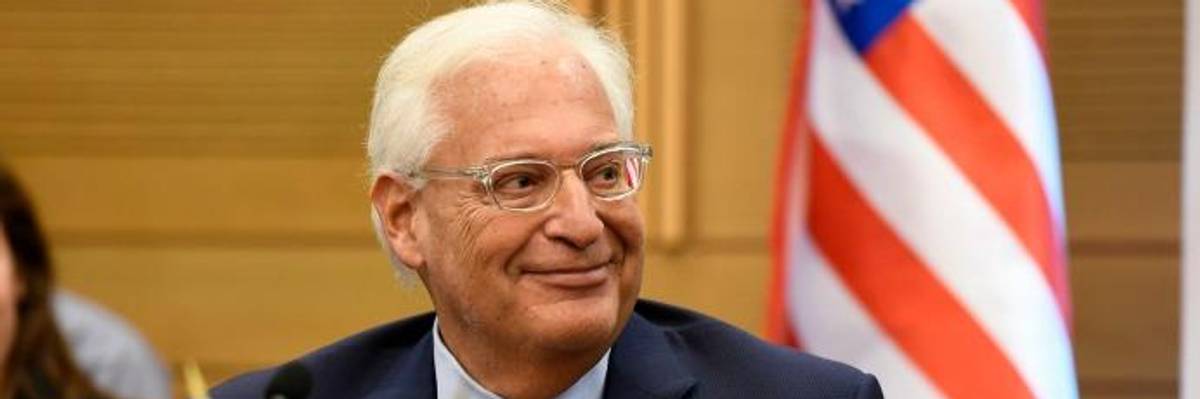
U.S. Ambassador David Friedman spoke on July 25, 2017 at a special meeting in the Knesset, organized by the Knesset Caucus for U.S. (Photo: Matty Stern/U.S. Embassy Tel Aviv/flickr/cc)
The U.S. officially closed its consulate general in Jerusalem, which had served as the de facto diplomatic mission for Palestinians.
While the State Department framed the move as a "merger" with its embassy in the city, critics say it's another setback for peace that puts Israeli interests over Palestinian rights
As Haaretz reported,
The consulate had primarily served the capital's Palestinians and was the main channel of communication over the years between the U.S. administration and the Palestinian leadership. The move means that the consulate will stop acting as an independent diplomatic mission and the Palestinians will be forced to work with an entity that is subordinate to U.S. Ambassador to Israel David Friedman.
Friedman's appointment to that post, it should be noted, was strongly condemned at the time given his far-right positions. Jewish Voice for Peace executive director Rebecca Vilkomerson, for example, said that his appointment was "a distressing signal that the [Trump] administration will give the Israeli government a free hand to deepen its fundamentally undemocratic and abusive control over Palestinian land, resources, and rights."
The move, argued State Department deputy spokesperson Robert Palladino in a statement on Sunday, is "to increase the efficiency and effectiveness."
"U.S. Consulate General Jerusalem will merge into U.S. Embassy Jerusalem to form a single diplomatic mission," he stated, and added, "We will continue to conduct all of the diplomatic and consular functions previously performed by U.S. Embassy Jerusalem."
Jerusalem expert Daniel Seidemann took issue with the government's use of the term "merge" to describe the shift--a word choice repeated in corporate media--and argued that the consulate "will be subsumed into the Embassy to Israel. This is no mere technicality, and precisely reflects current U.S. policies: all things Palestinian are subservient to Israeli interests."
The development also drew outrage from the PLO, with spokesperson Hanan Ashrawi saying, "Merging the U.S. Consulate in Jerusalem with the U.S. Embassy to Israel, which is now illegally located in Jerusalem, is not an administrative decision. It is an act of political assault on Palestinian rights and identity and a negation of the consulate's historic status and function, dating back nearly two hundred years."
"The U.S. administration is subsuming Palestine under Israel and aligning itself with the racist Israeli right, which negates Palestinian identity, history, narrative, and national rights," he said.
Malaysia chimed in as well. Its Ministry of Foreign Affairs called the shift "the latest unfortunate step taken by the U.S. against Palestine and its people."
"Though the U.S. justifies the merger as a means of bureaucratic efficiency, Malaysia views that it is nothing more than a smokescreen trying to camouflage what is essentially an opening of American embassy in Jerusalem; a move that will sound the death knell of the two-state solution that enjoys the support of the vast majority of the international community."
Former U.S. ambassadors expressed criticism as well:
"At this point we are saying to the Palestinians and the world--we do not see the Palestinians as a people to engage directly," added Lara Friedman, a former U.S. foreign service officer in Jerusalem and president of the Foundation for Middle East Peace. "They are now a minority and a subset to our relationship with Israel."
Dear Common Dreams reader, It’s been nearly 30 years since I co-founded Common Dreams with my late wife, Lina Newhouser. We had the radical notion that journalism should serve the public good, not corporate profits. It was clear to us from the outset what it would take to build such a project. No paid advertisements. No corporate sponsors. No millionaire publisher telling us what to think or do. Many people said we wouldn't last a year, but we proved those doubters wrong. Together with a tremendous team of journalists and dedicated staff, we built an independent media outlet free from the constraints of profits and corporate control. Our mission has always been simple: To inform. To inspire. To ignite change for the common good. Building Common Dreams was not easy. Our survival was never guaranteed. When you take on the most powerful forces—Wall Street greed, fossil fuel industry destruction, Big Tech lobbyists, and uber-rich oligarchs who have spent billions upon billions rigging the economy and democracy in their favor—the only bulwark you have is supporters who believe in your work. But here’s the urgent message from me today. It's never been this bad out there. And it's never been this hard to keep us going. At the very moment Common Dreams is most needed, the threats we face are intensifying. We need your support now more than ever. We don't accept corporate advertising and never will. We don't have a paywall because we don't think people should be blocked from critical news based on their ability to pay. Everything we do is funded by the donations of readers like you. When everyone does the little they can afford, we are strong. But if that support retreats or dries up, so do we. Will you donate now to make sure Common Dreams not only survives but thrives? —Craig Brown, Co-founder |
The U.S. officially closed its consulate general in Jerusalem, which had served as the de facto diplomatic mission for Palestinians.
While the State Department framed the move as a "merger" with its embassy in the city, critics say it's another setback for peace that puts Israeli interests over Palestinian rights
As Haaretz reported,
The consulate had primarily served the capital's Palestinians and was the main channel of communication over the years between the U.S. administration and the Palestinian leadership. The move means that the consulate will stop acting as an independent diplomatic mission and the Palestinians will be forced to work with an entity that is subordinate to U.S. Ambassador to Israel David Friedman.
Friedman's appointment to that post, it should be noted, was strongly condemned at the time given his far-right positions. Jewish Voice for Peace executive director Rebecca Vilkomerson, for example, said that his appointment was "a distressing signal that the [Trump] administration will give the Israeli government a free hand to deepen its fundamentally undemocratic and abusive control over Palestinian land, resources, and rights."
The move, argued State Department deputy spokesperson Robert Palladino in a statement on Sunday, is "to increase the efficiency and effectiveness."
"U.S. Consulate General Jerusalem will merge into U.S. Embassy Jerusalem to form a single diplomatic mission," he stated, and added, "We will continue to conduct all of the diplomatic and consular functions previously performed by U.S. Embassy Jerusalem."
Jerusalem expert Daniel Seidemann took issue with the government's use of the term "merge" to describe the shift--a word choice repeated in corporate media--and argued that the consulate "will be subsumed into the Embassy to Israel. This is no mere technicality, and precisely reflects current U.S. policies: all things Palestinian are subservient to Israeli interests."
The development also drew outrage from the PLO, with spokesperson Hanan Ashrawi saying, "Merging the U.S. Consulate in Jerusalem with the U.S. Embassy to Israel, which is now illegally located in Jerusalem, is not an administrative decision. It is an act of political assault on Palestinian rights and identity and a negation of the consulate's historic status and function, dating back nearly two hundred years."
"The U.S. administration is subsuming Palestine under Israel and aligning itself with the racist Israeli right, which negates Palestinian identity, history, narrative, and national rights," he said.
Malaysia chimed in as well. Its Ministry of Foreign Affairs called the shift "the latest unfortunate step taken by the U.S. against Palestine and its people."
"Though the U.S. justifies the merger as a means of bureaucratic efficiency, Malaysia views that it is nothing more than a smokescreen trying to camouflage what is essentially an opening of American embassy in Jerusalem; a move that will sound the death knell of the two-state solution that enjoys the support of the vast majority of the international community."
Former U.S. ambassadors expressed criticism as well:
"At this point we are saying to the Palestinians and the world--we do not see the Palestinians as a people to engage directly," added Lara Friedman, a former U.S. foreign service officer in Jerusalem and president of the Foundation for Middle East Peace. "They are now a minority and a subset to our relationship with Israel."
The U.S. officially closed its consulate general in Jerusalem, which had served as the de facto diplomatic mission for Palestinians.
While the State Department framed the move as a "merger" with its embassy in the city, critics say it's another setback for peace that puts Israeli interests over Palestinian rights
As Haaretz reported,
The consulate had primarily served the capital's Palestinians and was the main channel of communication over the years between the U.S. administration and the Palestinian leadership. The move means that the consulate will stop acting as an independent diplomatic mission and the Palestinians will be forced to work with an entity that is subordinate to U.S. Ambassador to Israel David Friedman.
Friedman's appointment to that post, it should be noted, was strongly condemned at the time given his far-right positions. Jewish Voice for Peace executive director Rebecca Vilkomerson, for example, said that his appointment was "a distressing signal that the [Trump] administration will give the Israeli government a free hand to deepen its fundamentally undemocratic and abusive control over Palestinian land, resources, and rights."
The move, argued State Department deputy spokesperson Robert Palladino in a statement on Sunday, is "to increase the efficiency and effectiveness."
"U.S. Consulate General Jerusalem will merge into U.S. Embassy Jerusalem to form a single diplomatic mission," he stated, and added, "We will continue to conduct all of the diplomatic and consular functions previously performed by U.S. Embassy Jerusalem."
Jerusalem expert Daniel Seidemann took issue with the government's use of the term "merge" to describe the shift--a word choice repeated in corporate media--and argued that the consulate "will be subsumed into the Embassy to Israel. This is no mere technicality, and precisely reflects current U.S. policies: all things Palestinian are subservient to Israeli interests."
The development also drew outrage from the PLO, with spokesperson Hanan Ashrawi saying, "Merging the U.S. Consulate in Jerusalem with the U.S. Embassy to Israel, which is now illegally located in Jerusalem, is not an administrative decision. It is an act of political assault on Palestinian rights and identity and a negation of the consulate's historic status and function, dating back nearly two hundred years."
"The U.S. administration is subsuming Palestine under Israel and aligning itself with the racist Israeli right, which negates Palestinian identity, history, narrative, and national rights," he said.
Malaysia chimed in as well. Its Ministry of Foreign Affairs called the shift "the latest unfortunate step taken by the U.S. against Palestine and its people."
"Though the U.S. justifies the merger as a means of bureaucratic efficiency, Malaysia views that it is nothing more than a smokescreen trying to camouflage what is essentially an opening of American embassy in Jerusalem; a move that will sound the death knell of the two-state solution that enjoys the support of the vast majority of the international community."
Former U.S. ambassadors expressed criticism as well:
"At this point we are saying to the Palestinians and the world--we do not see the Palestinians as a people to engage directly," added Lara Friedman, a former U.S. foreign service officer in Jerusalem and president of the Foundation for Middle East Peace. "They are now a minority and a subset to our relationship with Israel."