SUBSCRIBE TO OUR FREE NEWSLETTER
Daily news & progressive opinion—funded by the people, not the corporations—delivered straight to your inbox.
5
#000000
#FFFFFF
To donate by check, phone, or other method, see our More Ways to Give page.
Daily news & progressive opinion—funded by the people, not the corporations—delivered straight to your inbox.
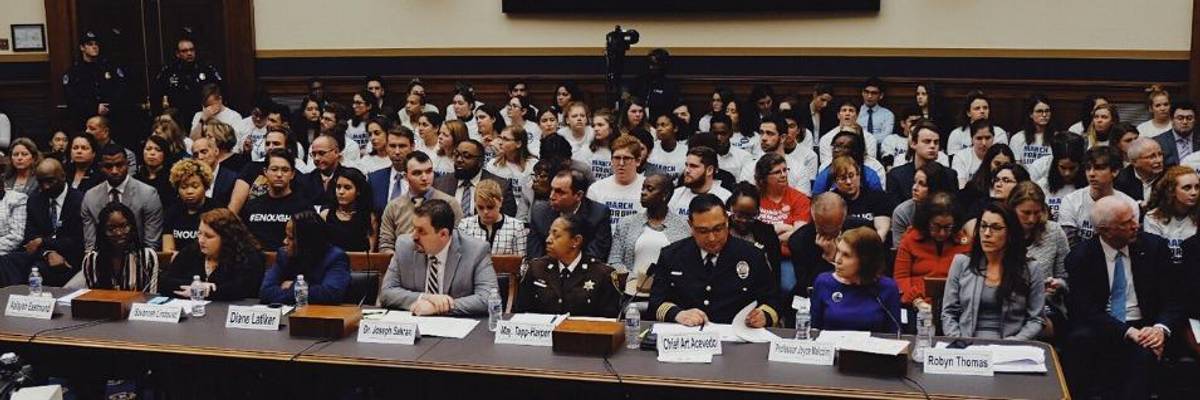
Young people with the March for Our Lives, the gun control advocacy group that grew out of the Parkland, Florida shooting last year, dressed in white as they attended last week's hearing on universal background checks. (Photo: @AMarch4OurLives/Twitter)
Hours before Marjory Stoneman Douglas High School in Parkland, Florida was to mark the one-year anniversary of its deadly shooting, gun control groups applauded as major gun control legislation was advanced to the House floor for the first time in years--the latest stride in a renewed push for meaningful reform which has been led largely by Parkland survivors.
The House Judiciary Committee voted 21 to 14, along party lines, to send the Bipartisan Background Checks Act (H.R. 8) to the House Wednesday night after nine hours of debate. The bill would require background checks for all gun sales in the U.S. The committee also passed a bill to close a loophole in the current, weaker background checks law that allows a gun purchase to move ahead if the check is not conducted within three days.
Along with the Judiciary Committee's hearing last week--the first on gun control in more than a decade--the votes were the first significant anti-gun actions taken by the Democratic Party since it won control of the House in November.
Members of the national gun control group Moms Demand Action looked on as the committee debated the bill, with Democrats shooting down Republican attempts to amend the legislation and adjourn the debate.
The bill is expected to pass in the House, with at least five Republicans expected to vote with Democrats in favor of the legislation. It has virtually no chance of passing in the GOP-controlled Senate, but advocates celebrated its advancement to the House as the latest sign that students who turned to activism after surviving the Parkland shooting, which killed 17 people and injured 17 more, have made a difference in the United States' gun control debate.
The aftermath of the Parkland shooting was marked by the immediate activism of students including David Hogg and Emma Gonzalez, who set to work directly confronting members of Congress to demand that they stop taking donations from the NRA and other pro-gun groups; organizing nationwide student walkouts and the largest single-day protest in Washington, D.C. history, with an estimated 800,000 people joining the March for Our Lives; and organizing a nationwide push to register young people to vote--helping to bring about a historic surge in youth voter turnout and the election of vocally pro-gun control Democrats across the country.
"It remains to be seen whether the shift on guns will hold in the coming years. But if it does, it would amount to a significant change in America's politics--one that can be pinpointed back to Parkland." --German Lopez, Vox.comThe momentum the students caused also helped push gun control reforms at the state level, with 26 states passing a total of 67 gun control measures.
Eight states and Washington, D.C. passed red flag laws over the past year, enabling law enforcement agencies to take firearms away from those who pose a threat to themselves or others, while nine states passed funding for gun violence prevention programs to help prevent shootings that take place every day in U.S. cities.
"Beyond 2019, the midterm elections showed that candidates can support stronger gun laws--and even focus a campaign on the issue--and still win elections, even in states that have been resistant to stronger gun laws in the past," wrote German Lopez at Vox.com in December. "This is a shift: Since 1994, when stricter gun laws were partly blamed for electoral losses, Democrats have often shied away from the issue."
"It remains to be seen whether the shift on guns will hold in the coming years," he added. "But if it does, it would amount to a significant change in America's politics--one that can be pinpointed back to Parkland."
Dear Common Dreams reader, It’s been nearly 30 years since I co-founded Common Dreams with my late wife, Lina Newhouser. We had the radical notion that journalism should serve the public good, not corporate profits. It was clear to us from the outset what it would take to build such a project. No paid advertisements. No corporate sponsors. No millionaire publisher telling us what to think or do. Many people said we wouldn't last a year, but we proved those doubters wrong. Together with a tremendous team of journalists and dedicated staff, we built an independent media outlet free from the constraints of profits and corporate control. Our mission has always been simple: To inform. To inspire. To ignite change for the common good. Building Common Dreams was not easy. Our survival was never guaranteed. When you take on the most powerful forces—Wall Street greed, fossil fuel industry destruction, Big Tech lobbyists, and uber-rich oligarchs who have spent billions upon billions rigging the economy and democracy in their favor—the only bulwark you have is supporters who believe in your work. But here’s the urgent message from me today. It's never been this bad out there. And it's never been this hard to keep us going. At the very moment Common Dreams is most needed, the threats we face are intensifying. We need your support now more than ever. We don't accept corporate advertising and never will. We don't have a paywall because we don't think people should be blocked from critical news based on their ability to pay. Everything we do is funded by the donations of readers like you. When everyone does the little they can afford, we are strong. But if that support retreats or dries up, so do we. Will you donate now to make sure Common Dreams not only survives but thrives? —Craig Brown, Co-founder |
Hours before Marjory Stoneman Douglas High School in Parkland, Florida was to mark the one-year anniversary of its deadly shooting, gun control groups applauded as major gun control legislation was advanced to the House floor for the first time in years--the latest stride in a renewed push for meaningful reform which has been led largely by Parkland survivors.
The House Judiciary Committee voted 21 to 14, along party lines, to send the Bipartisan Background Checks Act (H.R. 8) to the House Wednesday night after nine hours of debate. The bill would require background checks for all gun sales in the U.S. The committee also passed a bill to close a loophole in the current, weaker background checks law that allows a gun purchase to move ahead if the check is not conducted within three days.
Along with the Judiciary Committee's hearing last week--the first on gun control in more than a decade--the votes were the first significant anti-gun actions taken by the Democratic Party since it won control of the House in November.
Members of the national gun control group Moms Demand Action looked on as the committee debated the bill, with Democrats shooting down Republican attempts to amend the legislation and adjourn the debate.
The bill is expected to pass in the House, with at least five Republicans expected to vote with Democrats in favor of the legislation. It has virtually no chance of passing in the GOP-controlled Senate, but advocates celebrated its advancement to the House as the latest sign that students who turned to activism after surviving the Parkland shooting, which killed 17 people and injured 17 more, have made a difference in the United States' gun control debate.
The aftermath of the Parkland shooting was marked by the immediate activism of students including David Hogg and Emma Gonzalez, who set to work directly confronting members of Congress to demand that they stop taking donations from the NRA and other pro-gun groups; organizing nationwide student walkouts and the largest single-day protest in Washington, D.C. history, with an estimated 800,000 people joining the March for Our Lives; and organizing a nationwide push to register young people to vote--helping to bring about a historic surge in youth voter turnout and the election of vocally pro-gun control Democrats across the country.
"It remains to be seen whether the shift on guns will hold in the coming years. But if it does, it would amount to a significant change in America's politics--one that can be pinpointed back to Parkland." --German Lopez, Vox.comThe momentum the students caused also helped push gun control reforms at the state level, with 26 states passing a total of 67 gun control measures.
Eight states and Washington, D.C. passed red flag laws over the past year, enabling law enforcement agencies to take firearms away from those who pose a threat to themselves or others, while nine states passed funding for gun violence prevention programs to help prevent shootings that take place every day in U.S. cities.
"Beyond 2019, the midterm elections showed that candidates can support stronger gun laws--and even focus a campaign on the issue--and still win elections, even in states that have been resistant to stronger gun laws in the past," wrote German Lopez at Vox.com in December. "This is a shift: Since 1994, when stricter gun laws were partly blamed for electoral losses, Democrats have often shied away from the issue."
"It remains to be seen whether the shift on guns will hold in the coming years," he added. "But if it does, it would amount to a significant change in America's politics--one that can be pinpointed back to Parkland."
Hours before Marjory Stoneman Douglas High School in Parkland, Florida was to mark the one-year anniversary of its deadly shooting, gun control groups applauded as major gun control legislation was advanced to the House floor for the first time in years--the latest stride in a renewed push for meaningful reform which has been led largely by Parkland survivors.
The House Judiciary Committee voted 21 to 14, along party lines, to send the Bipartisan Background Checks Act (H.R. 8) to the House Wednesday night after nine hours of debate. The bill would require background checks for all gun sales in the U.S. The committee also passed a bill to close a loophole in the current, weaker background checks law that allows a gun purchase to move ahead if the check is not conducted within three days.
Along with the Judiciary Committee's hearing last week--the first on gun control in more than a decade--the votes were the first significant anti-gun actions taken by the Democratic Party since it won control of the House in November.
Members of the national gun control group Moms Demand Action looked on as the committee debated the bill, with Democrats shooting down Republican attempts to amend the legislation and adjourn the debate.
The bill is expected to pass in the House, with at least five Republicans expected to vote with Democrats in favor of the legislation. It has virtually no chance of passing in the GOP-controlled Senate, but advocates celebrated its advancement to the House as the latest sign that students who turned to activism after surviving the Parkland shooting, which killed 17 people and injured 17 more, have made a difference in the United States' gun control debate.
The aftermath of the Parkland shooting was marked by the immediate activism of students including David Hogg and Emma Gonzalez, who set to work directly confronting members of Congress to demand that they stop taking donations from the NRA and other pro-gun groups; organizing nationwide student walkouts and the largest single-day protest in Washington, D.C. history, with an estimated 800,000 people joining the March for Our Lives; and organizing a nationwide push to register young people to vote--helping to bring about a historic surge in youth voter turnout and the election of vocally pro-gun control Democrats across the country.
"It remains to be seen whether the shift on guns will hold in the coming years. But if it does, it would amount to a significant change in America's politics--one that can be pinpointed back to Parkland." --German Lopez, Vox.comThe momentum the students caused also helped push gun control reforms at the state level, with 26 states passing a total of 67 gun control measures.
Eight states and Washington, D.C. passed red flag laws over the past year, enabling law enforcement agencies to take firearms away from those who pose a threat to themselves or others, while nine states passed funding for gun violence prevention programs to help prevent shootings that take place every day in U.S. cities.
"Beyond 2019, the midterm elections showed that candidates can support stronger gun laws--and even focus a campaign on the issue--and still win elections, even in states that have been resistant to stronger gun laws in the past," wrote German Lopez at Vox.com in December. "This is a shift: Since 1994, when stricter gun laws were partly blamed for electoral losses, Democrats have often shied away from the issue."
"It remains to be seen whether the shift on guns will hold in the coming years," he added. "But if it does, it would amount to a significant change in America's politics--one that can be pinpointed back to Parkland."