SUBSCRIBE TO OUR FREE NEWSLETTER
Daily news & progressive opinion—funded by the people, not the corporations—delivered straight to your inbox.
5
#000000
#FFFFFF
To donate by check, phone, or other method, see our More Ways to Give page.
Daily news & progressive opinion—funded by the people, not the corporations—delivered straight to your inbox.
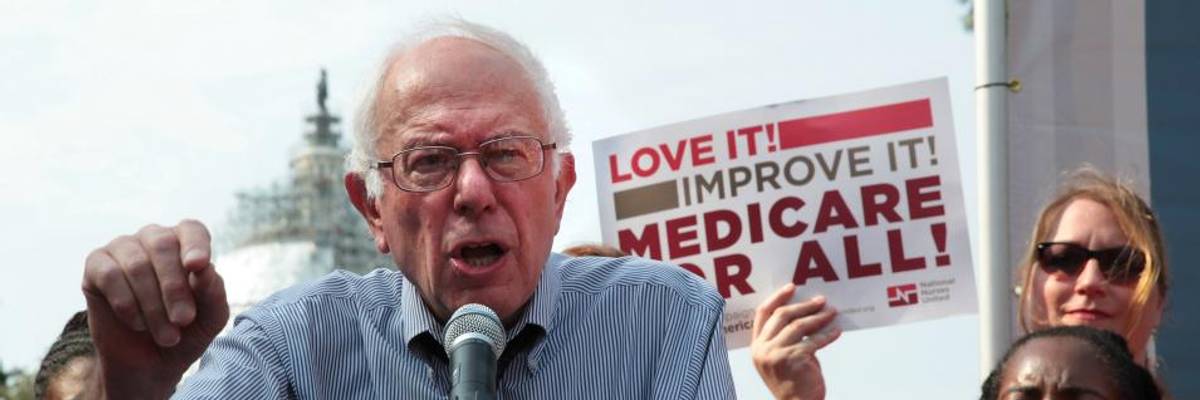
Sen. Bernie Sanders (I-Vt.) attends a National Nurses United (NNU) rally marking the 50th Anniversary of Medicare in 2015 at the Upper Senate Park in Washington, D.C. (Photo: Rick Reinhard/NNU/Flickr)
Sen. Bernie Sanders (I-Vt.), who has strongly advocated for a massive overhaul of the nation's healthcare system, is calling out a pharmaceutical company for hiking the annual list price of a medication used to treat a rare neuromuscular disease by hundreds of thousands of dollars, putting American lives in jeopardy.
In a letter (pdf) sent Monday to Patrick McEnany, president and CEO of Catalyst Pharmaceuticals, Sanders demanded answers to several inquiries regarding the company's decision to set the price of Firdapse--prescribed to patients with Lambert-Eaton myasthenic syndrome (LEMS)--at $375,000 per year after securing exclusive rights to market the medication for the next seven years.
"The egregious price set by Catalyst cannot be allowed to stand. Patients in America should not be allowed to suffer or die because of the greed of a drug company."
--Sen. Bernie Sanders
For the past two decades, Sanders' office noted in a statement, patients with the disease have been able to access a version of the drug--known as 3,4-DAP--for free from Jacobus Pharmaceutical through the Food and Drug Administration's (FDA) compassionate use program. However, due Catalyst's licensing rights, that's no longer possible.
Chemist Derek Lowe criticized the regulatory loophole that allows for this type of behavior in a December blog post. "Although I have contempt for Catalyst Pharmaceuticals and all the other little fly-by-night outfits who are taking advantage of this same process," Lowe wrote, "let's put the blame where it belongs: on the FDA."
In his letter to McEnany on Monday, Sanders charged that "by setting such a high price and forcing production and distribution of the older, inexpensive version to cease, you are threatening access that patients had to a cheap version of this product, and handing a completely unwarranted bill to American taxpayers."
The move--which the senator decried as "a blatant fleecing of American taxpayers" and "an immoral exploitation of patients who need this medication"--was announced on an investor call in December. Sanders requested that Catalyst respond by Feb. 18 to his list of questions, which aim to shed light on the consequences of the price hike that sparked concern from more than 100 doctors.
"The egregious price set by Catalyst cannot be allowed to stand. Patients in America should not be allowed to suffer or die because of the greed of a drug company," Sanders declared in a statement. "If Catalyst does not substantially lower the price of this medication, Congress must act to ensure it is affordable for every patient."
The senator sent the letter after speaking with a patient who uses the medication--Rebecca Hovde of Wellman, Iowa--by Skype last week.
Sanders' letter also comes amid a broader national discussion about transforming the nation's for-profit health insurance system. The senator has long advocated for a single-payer scheme that his recent legislative proposals have called Medicare for All, but there are mounting concerns that Democratic lawmakers and 2020 presidential candidates are simply using it as a buzzword to push "diluted" versions.
While the Independent from Vermont has not yet said whether he will seek the Democratic nomination for president, other potential and declared candidates are facing pressure from progressives to pledge to eliminate private health insurance.
"When people tell us the only thing that we can get is incremental healthcare change, we will tell them 'no thanks.' We're thinking big and demanding fundamental change on this issue."
--Sanders
Meanwhile, Sanders emailed supporters on Monday urging them to sign a petition to federal lawmakers stating that they "support healthcare as a right for every man, woman, and child in the United States," and that they "are more committed than ever to fight for, and to win, Medicare for All."
"As support for Medicare for All grows, it should not surprise you that the medical-industrial complex, the corporate media, the financial elite, and the political establishment are fighting back," Sanders wrote, pointing to outcry from billionaire politicians and corporate efforts to block the kind of radical transformation he envisions.
"Now is not the time to think small about healthcare. Now is not the time to compromise and suggest support for half-measures," he concluded. "When people tell us the only thing that we can get is incremental healthcare change, we will tell them 'no thanks.' We're thinking big and demanding fundamental change on this issue."
Dear Common Dreams reader, It’s been nearly 30 years since I co-founded Common Dreams with my late wife, Lina Newhouser. We had the radical notion that journalism should serve the public good, not corporate profits. It was clear to us from the outset what it would take to build such a project. No paid advertisements. No corporate sponsors. No millionaire publisher telling us what to think or do. Many people said we wouldn't last a year, but we proved those doubters wrong. Together with a tremendous team of journalists and dedicated staff, we built an independent media outlet free from the constraints of profits and corporate control. Our mission has always been simple: To inform. To inspire. To ignite change for the common good. Building Common Dreams was not easy. Our survival was never guaranteed. When you take on the most powerful forces—Wall Street greed, fossil fuel industry destruction, Big Tech lobbyists, and uber-rich oligarchs who have spent billions upon billions rigging the economy and democracy in their favor—the only bulwark you have is supporters who believe in your work. But here’s the urgent message from me today. It's never been this bad out there. And it's never been this hard to keep us going. At the very moment Common Dreams is most needed, the threats we face are intensifying. We need your support now more than ever. We don't accept corporate advertising and never will. We don't have a paywall because we don't think people should be blocked from critical news based on their ability to pay. Everything we do is funded by the donations of readers like you. When everyone does the little they can afford, we are strong. But if that support retreats or dries up, so do we. Will you donate now to make sure Common Dreams not only survives but thrives? —Craig Brown, Co-founder |
Sen. Bernie Sanders (I-Vt.), who has strongly advocated for a massive overhaul of the nation's healthcare system, is calling out a pharmaceutical company for hiking the annual list price of a medication used to treat a rare neuromuscular disease by hundreds of thousands of dollars, putting American lives in jeopardy.
In a letter (pdf) sent Monday to Patrick McEnany, president and CEO of Catalyst Pharmaceuticals, Sanders demanded answers to several inquiries regarding the company's decision to set the price of Firdapse--prescribed to patients with Lambert-Eaton myasthenic syndrome (LEMS)--at $375,000 per year after securing exclusive rights to market the medication for the next seven years.
"The egregious price set by Catalyst cannot be allowed to stand. Patients in America should not be allowed to suffer or die because of the greed of a drug company."
--Sen. Bernie Sanders
For the past two decades, Sanders' office noted in a statement, patients with the disease have been able to access a version of the drug--known as 3,4-DAP--for free from Jacobus Pharmaceutical through the Food and Drug Administration's (FDA) compassionate use program. However, due Catalyst's licensing rights, that's no longer possible.
Chemist Derek Lowe criticized the regulatory loophole that allows for this type of behavior in a December blog post. "Although I have contempt for Catalyst Pharmaceuticals and all the other little fly-by-night outfits who are taking advantage of this same process," Lowe wrote, "let's put the blame where it belongs: on the FDA."
In his letter to McEnany on Monday, Sanders charged that "by setting such a high price and forcing production and distribution of the older, inexpensive version to cease, you are threatening access that patients had to a cheap version of this product, and handing a completely unwarranted bill to American taxpayers."
The move--which the senator decried as "a blatant fleecing of American taxpayers" and "an immoral exploitation of patients who need this medication"--was announced on an investor call in December. Sanders requested that Catalyst respond by Feb. 18 to his list of questions, which aim to shed light on the consequences of the price hike that sparked concern from more than 100 doctors.
"The egregious price set by Catalyst cannot be allowed to stand. Patients in America should not be allowed to suffer or die because of the greed of a drug company," Sanders declared in a statement. "If Catalyst does not substantially lower the price of this medication, Congress must act to ensure it is affordable for every patient."
The senator sent the letter after speaking with a patient who uses the medication--Rebecca Hovde of Wellman, Iowa--by Skype last week.
Sanders' letter also comes amid a broader national discussion about transforming the nation's for-profit health insurance system. The senator has long advocated for a single-payer scheme that his recent legislative proposals have called Medicare for All, but there are mounting concerns that Democratic lawmakers and 2020 presidential candidates are simply using it as a buzzword to push "diluted" versions.
While the Independent from Vermont has not yet said whether he will seek the Democratic nomination for president, other potential and declared candidates are facing pressure from progressives to pledge to eliminate private health insurance.
"When people tell us the only thing that we can get is incremental healthcare change, we will tell them 'no thanks.' We're thinking big and demanding fundamental change on this issue."
--Sanders
Meanwhile, Sanders emailed supporters on Monday urging them to sign a petition to federal lawmakers stating that they "support healthcare as a right for every man, woman, and child in the United States," and that they "are more committed than ever to fight for, and to win, Medicare for All."
"As support for Medicare for All grows, it should not surprise you that the medical-industrial complex, the corporate media, the financial elite, and the political establishment are fighting back," Sanders wrote, pointing to outcry from billionaire politicians and corporate efforts to block the kind of radical transformation he envisions.
"Now is not the time to think small about healthcare. Now is not the time to compromise and suggest support for half-measures," he concluded. "When people tell us the only thing that we can get is incremental healthcare change, we will tell them 'no thanks.' We're thinking big and demanding fundamental change on this issue."
Sen. Bernie Sanders (I-Vt.), who has strongly advocated for a massive overhaul of the nation's healthcare system, is calling out a pharmaceutical company for hiking the annual list price of a medication used to treat a rare neuromuscular disease by hundreds of thousands of dollars, putting American lives in jeopardy.
In a letter (pdf) sent Monday to Patrick McEnany, president and CEO of Catalyst Pharmaceuticals, Sanders demanded answers to several inquiries regarding the company's decision to set the price of Firdapse--prescribed to patients with Lambert-Eaton myasthenic syndrome (LEMS)--at $375,000 per year after securing exclusive rights to market the medication for the next seven years.
"The egregious price set by Catalyst cannot be allowed to stand. Patients in America should not be allowed to suffer or die because of the greed of a drug company."
--Sen. Bernie Sanders
For the past two decades, Sanders' office noted in a statement, patients with the disease have been able to access a version of the drug--known as 3,4-DAP--for free from Jacobus Pharmaceutical through the Food and Drug Administration's (FDA) compassionate use program. However, due Catalyst's licensing rights, that's no longer possible.
Chemist Derek Lowe criticized the regulatory loophole that allows for this type of behavior in a December blog post. "Although I have contempt for Catalyst Pharmaceuticals and all the other little fly-by-night outfits who are taking advantage of this same process," Lowe wrote, "let's put the blame where it belongs: on the FDA."
In his letter to McEnany on Monday, Sanders charged that "by setting such a high price and forcing production and distribution of the older, inexpensive version to cease, you are threatening access that patients had to a cheap version of this product, and handing a completely unwarranted bill to American taxpayers."
The move--which the senator decried as "a blatant fleecing of American taxpayers" and "an immoral exploitation of patients who need this medication"--was announced on an investor call in December. Sanders requested that Catalyst respond by Feb. 18 to his list of questions, which aim to shed light on the consequences of the price hike that sparked concern from more than 100 doctors.
"The egregious price set by Catalyst cannot be allowed to stand. Patients in America should not be allowed to suffer or die because of the greed of a drug company," Sanders declared in a statement. "If Catalyst does not substantially lower the price of this medication, Congress must act to ensure it is affordable for every patient."
The senator sent the letter after speaking with a patient who uses the medication--Rebecca Hovde of Wellman, Iowa--by Skype last week.
Sanders' letter also comes amid a broader national discussion about transforming the nation's for-profit health insurance system. The senator has long advocated for a single-payer scheme that his recent legislative proposals have called Medicare for All, but there are mounting concerns that Democratic lawmakers and 2020 presidential candidates are simply using it as a buzzword to push "diluted" versions.
While the Independent from Vermont has not yet said whether he will seek the Democratic nomination for president, other potential and declared candidates are facing pressure from progressives to pledge to eliminate private health insurance.
"When people tell us the only thing that we can get is incremental healthcare change, we will tell them 'no thanks.' We're thinking big and demanding fundamental change on this issue."
--Sanders
Meanwhile, Sanders emailed supporters on Monday urging them to sign a petition to federal lawmakers stating that they "support healthcare as a right for every man, woman, and child in the United States," and that they "are more committed than ever to fight for, and to win, Medicare for All."
"As support for Medicare for All grows, it should not surprise you that the medical-industrial complex, the corporate media, the financial elite, and the political establishment are fighting back," Sanders wrote, pointing to outcry from billionaire politicians and corporate efforts to block the kind of radical transformation he envisions.
"Now is not the time to think small about healthcare. Now is not the time to compromise and suggest support for half-measures," he concluded. "When people tell us the only thing that we can get is incremental healthcare change, we will tell them 'no thanks.' We're thinking big and demanding fundamental change on this issue."