SUBSCRIBE TO OUR FREE NEWSLETTER
Daily news & progressive opinion—funded by the people, not the corporations—delivered straight to your inbox.
5
#000000
#FFFFFF
To donate by check, phone, or other method, see our More Ways to Give page.
Daily news & progressive opinion—funded by the people, not the corporations—delivered straight to your inbox.
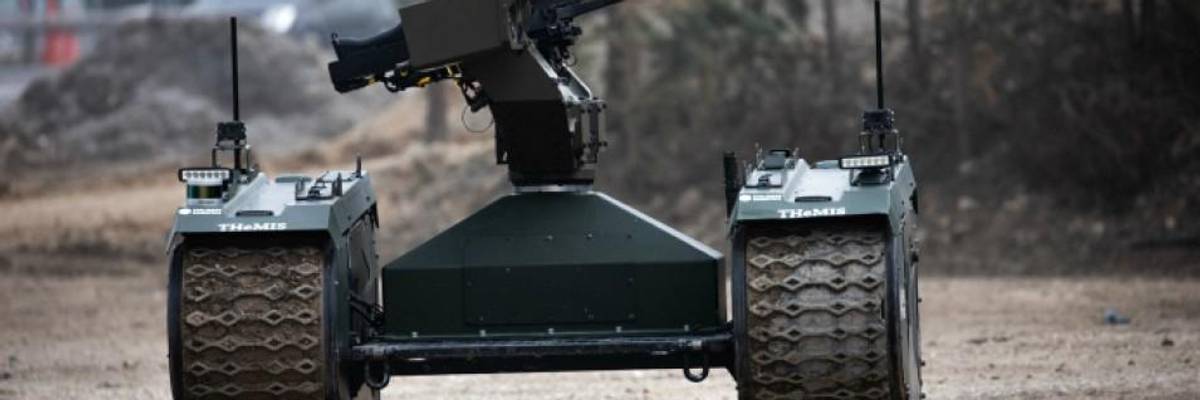
A developer demonstrates an autonomous tank at the Eurosatory 2018 Show, on June 10, 2018 in Villepinte, France. (Photo: Christophe Morin/IP3/Getty Images)
World leaders have shown little leadership in moving to ban autonomous weapons that would require no human involvement when selecting and killing targets, but a new survey shows that the global population overwhelmingly opposes the development of such "killer robots."
Commissioned by the Campaign to Ban Killer Robots, a new poll released Tuesday by Ipsos MORI asked between 500 and 1,000 people in each of the 26 countries it surveyed whether they approved of autonomous weapons, and found that three in five respondents were vehemently against the proposal.
"This poll shows that the states blocking a ban on killer robots are totally out of step with public opinion. Governments should be protecting people from the myriad risks that killer robots pose." --Rasha Abdul Rahim, Amnesty Tech
The survey showed that public opposition has grown considerably since January 2017, when just 56 percent of respondents to a similar poll opposed the development of killer robots.
In the new poll, people in countries around the world objected to autonomous killing machines due to concerns that they would be "unaccountable" for their actions, while two-thirds of respondents also said they opposed the development of weapons which they believe would "cross a moral line."
But as noted by Amnesty International, which has joined with the Campaign to Stop Killer Robots to push for an international ban on autonomous weapons, world leaders are not listening.
"This poll shows that the states blocking a ban on killer robots are totally out of step with public opinion. Governments should be protecting people from the myriad risks that killer robots pose," said Rasha Abdul Rahim, acting deputy director of Amnesty Tech.
Instead, Abdul Rahim added, "governments should take note of this poll and urgently begin negotiating a new treaty to prohibit these horrifying weapons."
Twenty-eight countries, including Costa Rica, Palestine, and Pakistan, support a ban on killer robots; Brazil, Chile, and Austria have formally proposed a legally-binding agreement to prohibit their use. The document would require "meaningful human control over critical functions in lethal autonomous weapon systems."
But such agreements have been thwarted by global powers including the U.S., Russia, and South Korea, which all indicated at the annual Convention on Conventional Weapons last year that they would not support the proposed treaty.
In doing so, Amnesty International noted, world leaders are undermining "the right to life and other human rights," as well as defying the wishes of the populations they represent.
Fifty-two percent of Americans who were surveyed opposed the development of killer robots, along with 59 percent of Russians and nearly three-quarters of South Koreans.
"We still have time to halt the development and proliferation of fully autonomous weapons, but we won't have that luxury for long," Abdul Rahim said.
Only a full ban on such machines "can help ensure respect for international law and address ethical and security concerns regarding delegating the power to make life-and-death decisions to machines," she added.
Dear Common Dreams reader, It’s been nearly 30 years since I co-founded Common Dreams with my late wife, Lina Newhouser. We had the radical notion that journalism should serve the public good, not corporate profits. It was clear to us from the outset what it would take to build such a project. No paid advertisements. No corporate sponsors. No millionaire publisher telling us what to think or do. Many people said we wouldn't last a year, but we proved those doubters wrong. Together with a tremendous team of journalists and dedicated staff, we built an independent media outlet free from the constraints of profits and corporate control. Our mission has always been simple: To inform. To inspire. To ignite change for the common good. Building Common Dreams was not easy. Our survival was never guaranteed. When you take on the most powerful forces—Wall Street greed, fossil fuel industry destruction, Big Tech lobbyists, and uber-rich oligarchs who have spent billions upon billions rigging the economy and democracy in their favor—the only bulwark you have is supporters who believe in your work. But here’s the urgent message from me today. It's never been this bad out there. And it's never been this hard to keep us going. At the very moment Common Dreams is most needed, the threats we face are intensifying. We need your support now more than ever. We don't accept corporate advertising and never will. We don't have a paywall because we don't think people should be blocked from critical news based on their ability to pay. Everything we do is funded by the donations of readers like you. When everyone does the little they can afford, we are strong. But if that support retreats or dries up, so do we. Will you donate now to make sure Common Dreams not only survives but thrives? —Craig Brown, Co-founder |
World leaders have shown little leadership in moving to ban autonomous weapons that would require no human involvement when selecting and killing targets, but a new survey shows that the global population overwhelmingly opposes the development of such "killer robots."
Commissioned by the Campaign to Ban Killer Robots, a new poll released Tuesday by Ipsos MORI asked between 500 and 1,000 people in each of the 26 countries it surveyed whether they approved of autonomous weapons, and found that three in five respondents were vehemently against the proposal.
"This poll shows that the states blocking a ban on killer robots are totally out of step with public opinion. Governments should be protecting people from the myriad risks that killer robots pose." --Rasha Abdul Rahim, Amnesty Tech
The survey showed that public opposition has grown considerably since January 2017, when just 56 percent of respondents to a similar poll opposed the development of killer robots.
In the new poll, people in countries around the world objected to autonomous killing machines due to concerns that they would be "unaccountable" for their actions, while two-thirds of respondents also said they opposed the development of weapons which they believe would "cross a moral line."
But as noted by Amnesty International, which has joined with the Campaign to Stop Killer Robots to push for an international ban on autonomous weapons, world leaders are not listening.
"This poll shows that the states blocking a ban on killer robots are totally out of step with public opinion. Governments should be protecting people from the myriad risks that killer robots pose," said Rasha Abdul Rahim, acting deputy director of Amnesty Tech.
Instead, Abdul Rahim added, "governments should take note of this poll and urgently begin negotiating a new treaty to prohibit these horrifying weapons."
Twenty-eight countries, including Costa Rica, Palestine, and Pakistan, support a ban on killer robots; Brazil, Chile, and Austria have formally proposed a legally-binding agreement to prohibit their use. The document would require "meaningful human control over critical functions in lethal autonomous weapon systems."
But such agreements have been thwarted by global powers including the U.S., Russia, and South Korea, which all indicated at the annual Convention on Conventional Weapons last year that they would not support the proposed treaty.
In doing so, Amnesty International noted, world leaders are undermining "the right to life and other human rights," as well as defying the wishes of the populations they represent.
Fifty-two percent of Americans who were surveyed opposed the development of killer robots, along with 59 percent of Russians and nearly three-quarters of South Koreans.
"We still have time to halt the development and proliferation of fully autonomous weapons, but we won't have that luxury for long," Abdul Rahim said.
Only a full ban on such machines "can help ensure respect for international law and address ethical and security concerns regarding delegating the power to make life-and-death decisions to machines," she added.
World leaders have shown little leadership in moving to ban autonomous weapons that would require no human involvement when selecting and killing targets, but a new survey shows that the global population overwhelmingly opposes the development of such "killer robots."
Commissioned by the Campaign to Ban Killer Robots, a new poll released Tuesday by Ipsos MORI asked between 500 and 1,000 people in each of the 26 countries it surveyed whether they approved of autonomous weapons, and found that three in five respondents were vehemently against the proposal.
"This poll shows that the states blocking a ban on killer robots are totally out of step with public opinion. Governments should be protecting people from the myriad risks that killer robots pose." --Rasha Abdul Rahim, Amnesty Tech
The survey showed that public opposition has grown considerably since January 2017, when just 56 percent of respondents to a similar poll opposed the development of killer robots.
In the new poll, people in countries around the world objected to autonomous killing machines due to concerns that they would be "unaccountable" for their actions, while two-thirds of respondents also said they opposed the development of weapons which they believe would "cross a moral line."
But as noted by Amnesty International, which has joined with the Campaign to Stop Killer Robots to push for an international ban on autonomous weapons, world leaders are not listening.
"This poll shows that the states blocking a ban on killer robots are totally out of step with public opinion. Governments should be protecting people from the myriad risks that killer robots pose," said Rasha Abdul Rahim, acting deputy director of Amnesty Tech.
Instead, Abdul Rahim added, "governments should take note of this poll and urgently begin negotiating a new treaty to prohibit these horrifying weapons."
Twenty-eight countries, including Costa Rica, Palestine, and Pakistan, support a ban on killer robots; Brazil, Chile, and Austria have formally proposed a legally-binding agreement to prohibit their use. The document would require "meaningful human control over critical functions in lethal autonomous weapon systems."
But such agreements have been thwarted by global powers including the U.S., Russia, and South Korea, which all indicated at the annual Convention on Conventional Weapons last year that they would not support the proposed treaty.
In doing so, Amnesty International noted, world leaders are undermining "the right to life and other human rights," as well as defying the wishes of the populations they represent.
Fifty-two percent of Americans who were surveyed opposed the development of killer robots, along with 59 percent of Russians and nearly three-quarters of South Koreans.
"We still have time to halt the development and proliferation of fully autonomous weapons, but we won't have that luxury for long," Abdul Rahim said.
Only a full ban on such machines "can help ensure respect for international law and address ethical and security concerns regarding delegating the power to make life-and-death decisions to machines," she added.