SUBSCRIBE TO OUR FREE NEWSLETTER
Daily news & progressive opinion—funded by the people, not the corporations—delivered straight to your inbox.
5
#000000
#FFFFFF
To donate by check, phone, or other method, see our More Ways to Give page.
Daily news & progressive opinion—funded by the people, not the corporations—delivered straight to your inbox.
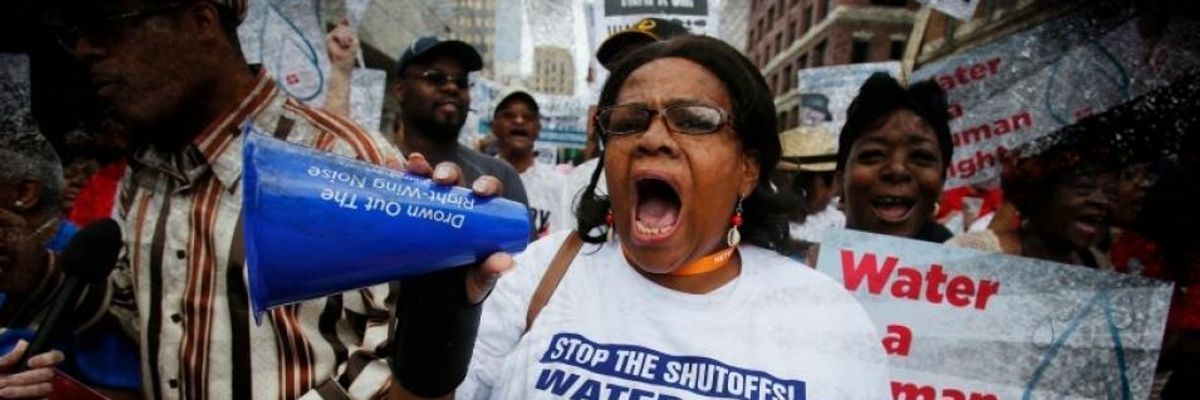
"The more we learn about various issues affecting the human right to water in the U.S., including millions of residents having their water shut off because they can't pay their bills, the more there is to be deeply concerned about," said Maude Barlow, board chair of Food & Water Watch. (Photo: Detroit Water Brigade)
When it comes to ensuring the human right to clean water, the United States has a long way to go.
That's the thrust of a new letter (pdf) to the United Nations Human Rights Committee as the body gets ready to review how the U.S. is faring in its implementation of the International Covenant on Civil and Political Rights, a treaty seen as part of the "International Bill of Human Rights."
"Since the U.N. recognized the human right to water in 2010, things have not become substantially better for people struggling in the U.S. with unsafe water, high bills, or the effects of industrial pollution from fracking and factory farms," said Wenonah Hauter, executive director of Food & Water Watch. "Civil and political rights must encompass the human right to water, which is increasingly under threat by corporations that seek to use and abuse our water supplies for profit."
The letter, submitted by Food & Water Watch and co-signed by the Environmental Justice Coalition for Water, Alabama Center for Rural Enterprise, and In the Public Interest, was sent Monday, the deadline for organizations to send to the committee areas they feel should be included on the "List of Issues Prior to Reporting." As the ACLU has explained, "In 2017, the U.S. agreed to receive a List of Issues Prior to Reporting from the U.N. Human Rights Committee which will form the basis for the U.S. government's periodic report to the committee. "
The groups' letter outlines five main issues, the first of which is the growing privatization of public water and sewer services. These efforts, the groups say, pose "a threat to water affordability and access for low-income neighborhood." At the same time, increases in water costs are driving water shutoffs, which in turn can lead to evictions or even child protective agencies taking parents' children away.
Another water related issue outlined in the letter is racial discrimination, seen in how polluting facilities are disproportionately located within communities where the majority of residents are people of color. Native communities are also facing this affront to their civil rights, as "tribal public water systems are twice as likely to violate health-based water quality regulations as non-tribal systems," the letter states.
In addition, the letter asserts the U.S. government has failed to take the necessary measures to improve infrastructure in line with ongoing, and soon to be worsening, effects of climate change. The groups say a fair taxation system should be ensured to fund the improvements, because forcing "cities to shoulder all the costs is a subsidy to the industrial and agricultural polluters."
Lastly, the letter warns of fracking's threat to water, both in terms of sucking up the valuable public good and also polluting it. "While the U.N.recognizes access to clean drinking water as a fundamental human right, enshrined before its use by agriculture and industry, the U.S. federal government and its states have prioritized water use for oil and gas drilling and livestock, resulting in contaminated waterways and groundwaters," the letter declares.
Among the groups' recommendations are for the U.S. authorities to ban all fracking; create a national water trust fund, ensure restrictions on facilities upstream of tribal waters; enact a ban on concentrated animal feeding operations (CAFOs); transition to 100 percent renewable energy by 2035; make states put forth voter referendums on possible sales or leases of publicly owned water or sewer system to for-profit corporations.
"The more we learn about various issues affecting the human right to water in the U.S., including millions of residents having their water shut off because they can't pay their bills, the more there is to be deeply concerned about," said Maude Barlow, board chair of Food & Water Watch and former senior advisor to the U.N. on water issues.
Dear Common Dreams reader, It’s been nearly 30 years since I co-founded Common Dreams with my late wife, Lina Newhouser. We had the radical notion that journalism should serve the public good, not corporate profits. It was clear to us from the outset what it would take to build such a project. No paid advertisements. No corporate sponsors. No millionaire publisher telling us what to think or do. Many people said we wouldn't last a year, but we proved those doubters wrong. Together with a tremendous team of journalists and dedicated staff, we built an independent media outlet free from the constraints of profits and corporate control. Our mission has always been simple: To inform. To inspire. To ignite change for the common good. Building Common Dreams was not easy. Our survival was never guaranteed. When you take on the most powerful forces—Wall Street greed, fossil fuel industry destruction, Big Tech lobbyists, and uber-rich oligarchs who have spent billions upon billions rigging the economy and democracy in their favor—the only bulwark you have is supporters who believe in your work. But here’s the urgent message from me today. It's never been this bad out there. And it's never been this hard to keep us going. At the very moment Common Dreams is most needed, the threats we face are intensifying. We need your support now more than ever. We don't accept corporate advertising and never will. We don't have a paywall because we don't think people should be blocked from critical news based on their ability to pay. Everything we do is funded by the donations of readers like you. When everyone does the little they can afford, we are strong. But if that support retreats or dries up, so do we. Will you donate now to make sure Common Dreams not only survives but thrives? —Craig Brown, Co-founder |
When it comes to ensuring the human right to clean water, the United States has a long way to go.
That's the thrust of a new letter (pdf) to the United Nations Human Rights Committee as the body gets ready to review how the U.S. is faring in its implementation of the International Covenant on Civil and Political Rights, a treaty seen as part of the "International Bill of Human Rights."
"Since the U.N. recognized the human right to water in 2010, things have not become substantially better for people struggling in the U.S. with unsafe water, high bills, or the effects of industrial pollution from fracking and factory farms," said Wenonah Hauter, executive director of Food & Water Watch. "Civil and political rights must encompass the human right to water, which is increasingly under threat by corporations that seek to use and abuse our water supplies for profit."
The letter, submitted by Food & Water Watch and co-signed by the Environmental Justice Coalition for Water, Alabama Center for Rural Enterprise, and In the Public Interest, was sent Monday, the deadline for organizations to send to the committee areas they feel should be included on the "List of Issues Prior to Reporting." As the ACLU has explained, "In 2017, the U.S. agreed to receive a List of Issues Prior to Reporting from the U.N. Human Rights Committee which will form the basis for the U.S. government's periodic report to the committee. "
The groups' letter outlines five main issues, the first of which is the growing privatization of public water and sewer services. These efforts, the groups say, pose "a threat to water affordability and access for low-income neighborhood." At the same time, increases in water costs are driving water shutoffs, which in turn can lead to evictions or even child protective agencies taking parents' children away.
Another water related issue outlined in the letter is racial discrimination, seen in how polluting facilities are disproportionately located within communities where the majority of residents are people of color. Native communities are also facing this affront to their civil rights, as "tribal public water systems are twice as likely to violate health-based water quality regulations as non-tribal systems," the letter states.
In addition, the letter asserts the U.S. government has failed to take the necessary measures to improve infrastructure in line with ongoing, and soon to be worsening, effects of climate change. The groups say a fair taxation system should be ensured to fund the improvements, because forcing "cities to shoulder all the costs is a subsidy to the industrial and agricultural polluters."
Lastly, the letter warns of fracking's threat to water, both in terms of sucking up the valuable public good and also polluting it. "While the U.N.recognizes access to clean drinking water as a fundamental human right, enshrined before its use by agriculture and industry, the U.S. federal government and its states have prioritized water use for oil and gas drilling and livestock, resulting in contaminated waterways and groundwaters," the letter declares.
Among the groups' recommendations are for the U.S. authorities to ban all fracking; create a national water trust fund, ensure restrictions on facilities upstream of tribal waters; enact a ban on concentrated animal feeding operations (CAFOs); transition to 100 percent renewable energy by 2035; make states put forth voter referendums on possible sales or leases of publicly owned water or sewer system to for-profit corporations.
"The more we learn about various issues affecting the human right to water in the U.S., including millions of residents having their water shut off because they can't pay their bills, the more there is to be deeply concerned about," said Maude Barlow, board chair of Food & Water Watch and former senior advisor to the U.N. on water issues.
When it comes to ensuring the human right to clean water, the United States has a long way to go.
That's the thrust of a new letter (pdf) to the United Nations Human Rights Committee as the body gets ready to review how the U.S. is faring in its implementation of the International Covenant on Civil and Political Rights, a treaty seen as part of the "International Bill of Human Rights."
"Since the U.N. recognized the human right to water in 2010, things have not become substantially better for people struggling in the U.S. with unsafe water, high bills, or the effects of industrial pollution from fracking and factory farms," said Wenonah Hauter, executive director of Food & Water Watch. "Civil and political rights must encompass the human right to water, which is increasingly under threat by corporations that seek to use and abuse our water supplies for profit."
The letter, submitted by Food & Water Watch and co-signed by the Environmental Justice Coalition for Water, Alabama Center for Rural Enterprise, and In the Public Interest, was sent Monday, the deadline for organizations to send to the committee areas they feel should be included on the "List of Issues Prior to Reporting." As the ACLU has explained, "In 2017, the U.S. agreed to receive a List of Issues Prior to Reporting from the U.N. Human Rights Committee which will form the basis for the U.S. government's periodic report to the committee. "
The groups' letter outlines five main issues, the first of which is the growing privatization of public water and sewer services. These efforts, the groups say, pose "a threat to water affordability and access for low-income neighborhood." At the same time, increases in water costs are driving water shutoffs, which in turn can lead to evictions or even child protective agencies taking parents' children away.
Another water related issue outlined in the letter is racial discrimination, seen in how polluting facilities are disproportionately located within communities where the majority of residents are people of color. Native communities are also facing this affront to their civil rights, as "tribal public water systems are twice as likely to violate health-based water quality regulations as non-tribal systems," the letter states.
In addition, the letter asserts the U.S. government has failed to take the necessary measures to improve infrastructure in line with ongoing, and soon to be worsening, effects of climate change. The groups say a fair taxation system should be ensured to fund the improvements, because forcing "cities to shoulder all the costs is a subsidy to the industrial and agricultural polluters."
Lastly, the letter warns of fracking's threat to water, both in terms of sucking up the valuable public good and also polluting it. "While the U.N.recognizes access to clean drinking water as a fundamental human right, enshrined before its use by agriculture and industry, the U.S. federal government and its states have prioritized water use for oil and gas drilling and livestock, resulting in contaminated waterways and groundwaters," the letter declares.
Among the groups' recommendations are for the U.S. authorities to ban all fracking; create a national water trust fund, ensure restrictions on facilities upstream of tribal waters; enact a ban on concentrated animal feeding operations (CAFOs); transition to 100 percent renewable energy by 2035; make states put forth voter referendums on possible sales or leases of publicly owned water or sewer system to for-profit corporations.
"The more we learn about various issues affecting the human right to water in the U.S., including millions of residents having their water shut off because they can't pay their bills, the more there is to be deeply concerned about," said Maude Barlow, board chair of Food & Water Watch and former senior advisor to the U.N. on water issues.