SUBSCRIBE TO OUR FREE NEWSLETTER
Daily news & progressive opinion—funded by the people, not the corporations—delivered straight to your inbox.
5
#000000
#FFFFFF
To donate by check, phone, or other method, see our More Ways to Give page.
Daily news & progressive opinion—funded by the people, not the corporations—delivered straight to your inbox.
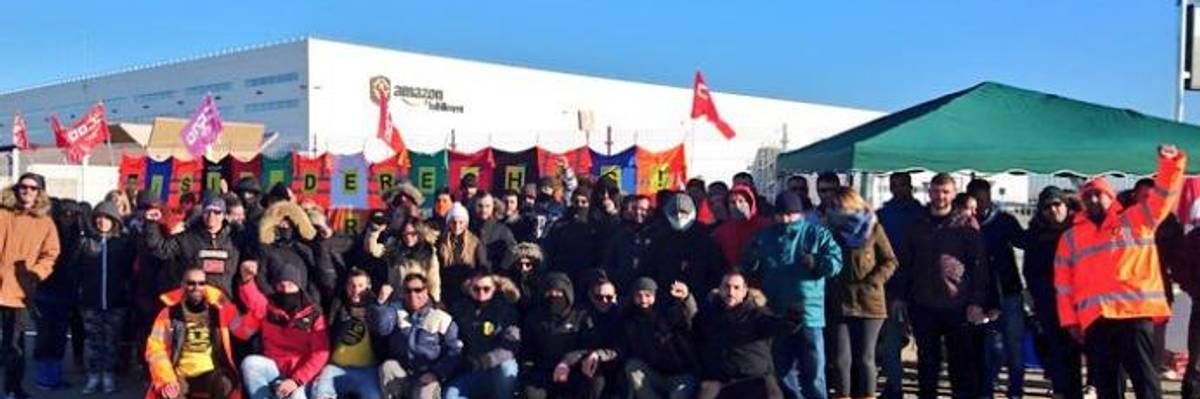
Striking workers outside Amazon's San Fernando de Henares warehouse in Spain. (Photo: Twitter/@cubero_alberto)
Amazon workers in Spain took part in the second of a two-day strike on Friday demanding improved job conditions from the online behemoth.
The strikers, said Isabel Serra, a member of the Podemos political party in the regional parliament, "are becoming an example and hope for workers across the globe."
Organizers say about 60 percent of the San Fernando de Henares warehouse took part--though Amazon refutes the figure. The timing of this latest strike by the Spanish Amazon workers is noteworthy, as it comes just ahead of a major gift-giving holiday for Spaniards, Three Kings Day, celebrated on January 6.
"We have been protesting for a year. This is the richest company in the world and they want to keep profiting by taking away workers' rights," said David Matarraz, an Amazon worker outside the Madrid-area warehouse.
Reuters also reports that the action is a joint effort of Spain's two main unions, CCOO and UGT.
Ahead of the action, the @AmazonEnLucha account, which is tweeting in support of the strike, said that for Three Kings Day, boycotting Amazon "is a good gift against precariousness."
Meanwhile, Amazon workers in the United States have been agitating for better conditions as well, with U.S. fulfillment center warehouse workers engaged in a union push--a point noted by the Spanish organizers, who praised the American workers for following in their footsteps and having decided "to denouce the precariousness they suffer."
The Guardian recently reported on the unionization push, which kicked off shortly after the opening of a new Amazon warehouse in Staten Island. "We are not robots. We are human beings," said worker Rashad Long.
"We cannot come into work after only four hours of sleep and be expected to be fully energized and ready to work. That's impossible," said Long. "I feel like all the company cares about is getting their products out to the customers as quickly humanly as possible, no matter what that means for us workers in the end."
Dear Common Dreams reader, It’s been nearly 30 years since I co-founded Common Dreams with my late wife, Lina Newhouser. We had the radical notion that journalism should serve the public good, not corporate profits. It was clear to us from the outset what it would take to build such a project. No paid advertisements. No corporate sponsors. No millionaire publisher telling us what to think or do. Many people said we wouldn't last a year, but we proved those doubters wrong. Together with a tremendous team of journalists and dedicated staff, we built an independent media outlet free from the constraints of profits and corporate control. Our mission has always been simple: To inform. To inspire. To ignite change for the common good. Building Common Dreams was not easy. Our survival was never guaranteed. When you take on the most powerful forces—Wall Street greed, fossil fuel industry destruction, Big Tech lobbyists, and uber-rich oligarchs who have spent billions upon billions rigging the economy and democracy in their favor—the only bulwark you have is supporters who believe in your work. But here’s the urgent message from me today. It's never been this bad out there. And it's never been this hard to keep us going. At the very moment Common Dreams is most needed, the threats we face are intensifying. We need your support now more than ever. We don't accept corporate advertising and never will. We don't have a paywall because we don't think people should be blocked from critical news based on their ability to pay. Everything we do is funded by the donations of readers like you. When everyone does the little they can afford, we are strong. But if that support retreats or dries up, so do we. Will you donate now to make sure Common Dreams not only survives but thrives? —Craig Brown, Co-founder |
Amazon workers in Spain took part in the second of a two-day strike on Friday demanding improved job conditions from the online behemoth.
The strikers, said Isabel Serra, a member of the Podemos political party in the regional parliament, "are becoming an example and hope for workers across the globe."
Organizers say about 60 percent of the San Fernando de Henares warehouse took part--though Amazon refutes the figure. The timing of this latest strike by the Spanish Amazon workers is noteworthy, as it comes just ahead of a major gift-giving holiday for Spaniards, Three Kings Day, celebrated on January 6.
"We have been protesting for a year. This is the richest company in the world and they want to keep profiting by taking away workers' rights," said David Matarraz, an Amazon worker outside the Madrid-area warehouse.
Reuters also reports that the action is a joint effort of Spain's two main unions, CCOO and UGT.
Ahead of the action, the @AmazonEnLucha account, which is tweeting in support of the strike, said that for Three Kings Day, boycotting Amazon "is a good gift against precariousness."
Meanwhile, Amazon workers in the United States have been agitating for better conditions as well, with U.S. fulfillment center warehouse workers engaged in a union push--a point noted by the Spanish organizers, who praised the American workers for following in their footsteps and having decided "to denouce the precariousness they suffer."
The Guardian recently reported on the unionization push, which kicked off shortly after the opening of a new Amazon warehouse in Staten Island. "We are not robots. We are human beings," said worker Rashad Long.
"We cannot come into work after only four hours of sleep and be expected to be fully energized and ready to work. That's impossible," said Long. "I feel like all the company cares about is getting their products out to the customers as quickly humanly as possible, no matter what that means for us workers in the end."
Amazon workers in Spain took part in the second of a two-day strike on Friday demanding improved job conditions from the online behemoth.
The strikers, said Isabel Serra, a member of the Podemos political party in the regional parliament, "are becoming an example and hope for workers across the globe."
Organizers say about 60 percent of the San Fernando de Henares warehouse took part--though Amazon refutes the figure. The timing of this latest strike by the Spanish Amazon workers is noteworthy, as it comes just ahead of a major gift-giving holiday for Spaniards, Three Kings Day, celebrated on January 6.
"We have been protesting for a year. This is the richest company in the world and they want to keep profiting by taking away workers' rights," said David Matarraz, an Amazon worker outside the Madrid-area warehouse.
Reuters also reports that the action is a joint effort of Spain's two main unions, CCOO and UGT.
Ahead of the action, the @AmazonEnLucha account, which is tweeting in support of the strike, said that for Three Kings Day, boycotting Amazon "is a good gift against precariousness."
Meanwhile, Amazon workers in the United States have been agitating for better conditions as well, with U.S. fulfillment center warehouse workers engaged in a union push--a point noted by the Spanish organizers, who praised the American workers for following in their footsteps and having decided "to denouce the precariousness they suffer."
The Guardian recently reported on the unionization push, which kicked off shortly after the opening of a new Amazon warehouse in Staten Island. "We are not robots. We are human beings," said worker Rashad Long.
"We cannot come into work after only four hours of sleep and be expected to be fully energized and ready to work. That's impossible," said Long. "I feel like all the company cares about is getting their products out to the customers as quickly humanly as possible, no matter what that means for us workers in the end."