
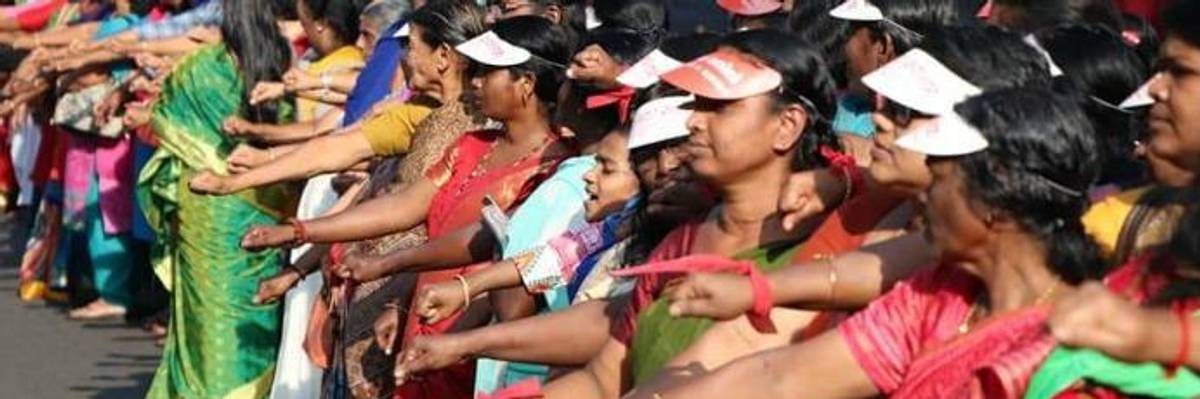
Some of the women taking part in the "Women's Wall" New Year's Day event in the state of Kerala in southern India. (Photo: Twitter/@ShubhaShamim )
Historic Moment for Equality in India as Millions Link Arms to Form 400-Mile "Women's Wall"
Massive event preceded history-making day when two women defied protesters to enter Hindu temple
A day after millions of women stood together in the Indian state to form a nearly 400-mile-long human chain to call for equality, two women made history--and sparked protests and a call for a state-wide shutdown--when they entered the Sabarimala temple in the state of Kerala in the early hours Wednesday.
They were the first women to enter the holy Hindu site since a ban on women of menstrual age was lifted just over three months ago, as protests have blocked others from entering previously.
The women were identified as 42-year-old Kanaka Durga and 44-year-old Bindu Ammini, who told India Today TV that the two represented "the society fighting for gender justice." Durga added, "We are not scared at all. We followed our legal right as women. We are 100 percent sure that we didn't hurt people."
Their 3:30am, police-accompanied entrance to the temple follows the New Year's Day action called the "Women's Wall"--a 385-mile (620-kilometer ) human chain. Reuters reports that thousands took part, while other local news outlets put the number at hundreds of thousands, and other local outlets estimated the figure was in the millions.
Organizers had expected as many as five million to take part in the government-sponsored event, which was motivated by ongoing protests carried out by the two opposition parties in the state, Bharatiya Janata Party (BJP) and Congress Party, who are opposed to the high court's ruling from September striking down the ban on 10- to 50-year-old girls and women from entering the temple.
According to India's News Minute, "In what is being seen as a defining moment for feminist politics in Kerala, leaders and members from political parties, socio-political organizations, and progressive Hindu organizations, too, joined the event. There were men, too, who stood up in support and solidarity, affirming their commitment to gender equality."
Kerala Chief Minister Pinarayi Vijayan, for his part, called the Women's Wall a "movement for equality, gender sensitivity, and social awakening," while The Times of India framed the event as a "historic moment for gender equality."
Social media users captured images of the "wall":
We are at a crossroads
This country and this world are at a monumental crossroads. In a few short weeks, US voters will have an opportunity to beat back the forces of fascism and confront the billionaires who are rigging the economy, our media system, and our democracy, making it increasingly impossible for ordinary people to get by. We’re not just talking about the election. We’re talking about what must be done once these fascist elements are vanquished from power. We need a bolder set of solutions than what either major party has so far been willing to offer and a working-class movement ready to fight like hell for it. Trump didn't emerge from nowhere. The conditions that fueled MAGA authoritarianism were created by decades of radical neoliberal economic policies and a corrupt political system dominated by corporate interests. They slashed taxes on the super-rich, promising that the benefits would trickle down. They said giveaways to the corporate titans would make life more affordable for the rest of us. It was all bullshit. And when a bitter, betrayed populace searches for someone to blame, right-wing demagogues have little trouble finding scapegoats. People know when they're being lied to, but you won't hear any of this from the corporate media. Only independent journalism—powered and funded by people who believe in building a better world—can deliver truly trustworthy daily news. Our Fall Campaign is underway, and we need your help. To power our newsroom through the rest of the year, we need to raise $125,000 by midnight on October 31. So if you share our vision, please contribute whatever you can to sustain our work. |
A day after millions of women stood together in the Indian state to form a nearly 400-mile-long human chain to call for equality, two women made history--and sparked protests and a call for a state-wide shutdown--when they entered the Sabarimala temple in the state of Kerala in the early hours Wednesday.
They were the first women to enter the holy Hindu site since a ban on women of menstrual age was lifted just over three months ago, as protests have blocked others from entering previously.
The women were identified as 42-year-old Kanaka Durga and 44-year-old Bindu Ammini, who told India Today TV that the two represented "the society fighting for gender justice." Durga added, "We are not scared at all. We followed our legal right as women. We are 100 percent sure that we didn't hurt people."
Their 3:30am, police-accompanied entrance to the temple follows the New Year's Day action called the "Women's Wall"--a 385-mile (620-kilometer ) human chain. Reuters reports that thousands took part, while other local news outlets put the number at hundreds of thousands, and other local outlets estimated the figure was in the millions.
Organizers had expected as many as five million to take part in the government-sponsored event, which was motivated by ongoing protests carried out by the two opposition parties in the state, Bharatiya Janata Party (BJP) and Congress Party, who are opposed to the high court's ruling from September striking down the ban on 10- to 50-year-old girls and women from entering the temple.
According to India's News Minute, "In what is being seen as a defining moment for feminist politics in Kerala, leaders and members from political parties, socio-political organizations, and progressive Hindu organizations, too, joined the event. There were men, too, who stood up in support and solidarity, affirming their commitment to gender equality."
Kerala Chief Minister Pinarayi Vijayan, for his part, called the Women's Wall a "movement for equality, gender sensitivity, and social awakening," while The Times of India framed the event as a "historic moment for gender equality."
Social media users captured images of the "wall":