SUBSCRIBE TO OUR FREE NEWSLETTER
Daily news & progressive opinion—funded by the people, not the corporations—delivered straight to your inbox.
5
#000000
#FFFFFF
To donate by check, phone, or other method, see our More Ways to Give page.
Daily news & progressive opinion—funded by the people, not the corporations—delivered straight to your inbox.
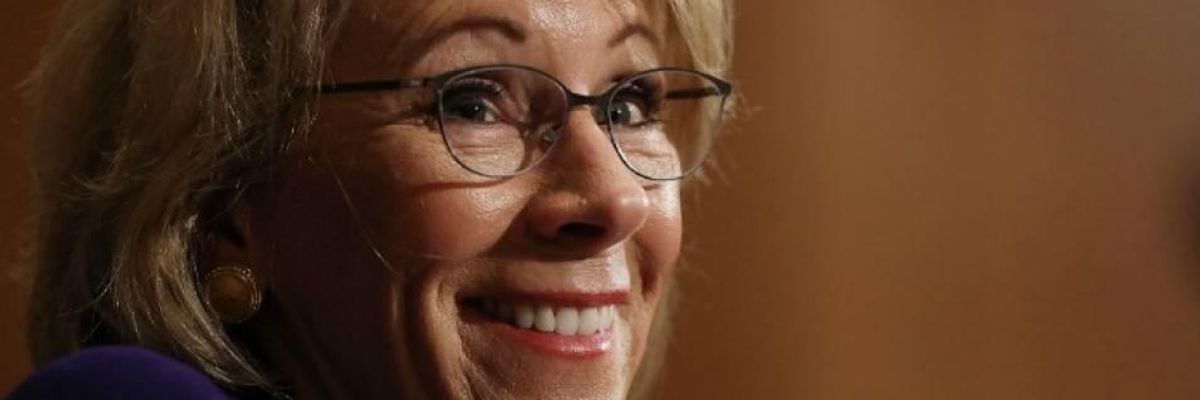
Education Secretary Betsy DeVos reportedly is set to release new rules for how colleges and universities should handle sexual harassment and assault allegations. (Photo: Chip Somodevilla/Getty)
After meeting with "men's rights" groups and scrapping an Obama-era guidance for how colleges and universities should handle sexual harassment and assault allegations last year, Education Secretary Betsy DeVos is reportedly set to release new rules that will "bolster the due process rights of the accused."
"This is horrific," declared Planned Parenthood. "[DeVos] is determined to make it harder than ever for survivors of sexual assault to seek justice on campus."
"The new rules would reduce liability for universities, tighten the definition of sexual harassment, and allow schools to use a higher standard in evaluating claims of sexual harassment and assault," reported the Washington Post. "The most significant change would guarantee the accused the right to cross-examine their accusers, though it would have to be conducted by advisers or attorneys for the people involved, rather than by the person accused of misconduct."
While the Obama guidance defined sexual harassment as "unwelcome conduct of a sexual nature," unnamed sources told the newspaper that DeVos' proposal describes it as "unwelcome conduct on the basis of sex that is so severe, pervasive, and objectively offensive that it denies a person access to the school's education program or activity."
The new rules supposedly strongly resemble a draft leaked earlier this year. As the Post detailed:
The most consequential provisions are unchanged since September.
The biggest may be the standard of proof required in assessing claims. Under the DeVos proposal, schools will be allowed to choose between "preponderance of the evidence" and the higher bar of "clear and convincing" evidence. The Obama guidelines had directed schools to use the "preponderance of the evidence" standard.
The regulation also will require schools to use the same standard in these cases as they use for other complaints, including those against employees and faculty. Many union contracts and other agreements with faculty mandate the use of a higher "clear and convincing" standard, several people said. So as a practical matter, most schools may be forced to apply the same higher bar for student complaints.
With the proposal "set for release before Thanksgiving, possibly this week," according to the Post, some expressed concern that the timing could be a strategic ploy to stay off the public's radar and avoid criticism. Sabrina Joy Stevens wrote for the National Women's Law Center on Wednesday:
DeVos has been launching attacks on student survivors at the behest of sexist extremist groups since last fall, when she rescinded guidance that schools requested during the Obama administration to help them understand their obligations under Title IX. We've been expecting them to propose new Title IX regulations for nearly a year, and leaked drafts--which include chilling provisions that would hurt survivors and make schools more dangerous overall--have been reported on in the press since August. So what's the hold up?
One possible explanation is a rumor that they're planning to include the Title IX regulations in another news dump for either this Friday or next week, right when reporters and key policy experts are checking out for the weekend and preparing to be gone for Thanksgiving. If true, that timing would also ensure that a significant chunk of the notice and comment period would coincide with final exams and winter break, making it harder for students who would be most directly impacted by these regulations to organize against them.
In addition to Stevens' call to action--"We can't let them get away with this," she concluded--the Post article provoked immediate outrage on social media, with critics tweeting: "Re-victimizing the victims seems to be the plan here. Horrible." "Shame on you, Betsy DeVos." "[DeVos] is an enemy to women. #BelieveSurvivors." And simply, "WTF?"
Democratic Sen. Ron Wyden of Oregon tweeted that if President Donald Trump--who has been accused of harassing and assaulting multiple women--and DeVos "actually cared about the well-being of survivors, this is the last thing they would do. We should be empowering survivors to speak up, not stifling them."
DeVos' proposal "encourages victim blaming and blatantly ignores the painful stories of #MeToo," said Democratic Rep. Eric Swalwell of California. "It takes us backward."
Dear Common Dreams reader, It’s been nearly 30 years since I co-founded Common Dreams with my late wife, Lina Newhouser. We had the radical notion that journalism should serve the public good, not corporate profits. It was clear to us from the outset what it would take to build such a project. No paid advertisements. No corporate sponsors. No millionaire publisher telling us what to think or do. Many people said we wouldn't last a year, but we proved those doubters wrong. Together with a tremendous team of journalists and dedicated staff, we built an independent media outlet free from the constraints of profits and corporate control. Our mission has always been simple: To inform. To inspire. To ignite change for the common good. Building Common Dreams was not easy. Our survival was never guaranteed. When you take on the most powerful forces—Wall Street greed, fossil fuel industry destruction, Big Tech lobbyists, and uber-rich oligarchs who have spent billions upon billions rigging the economy and democracy in their favor—the only bulwark you have is supporters who believe in your work. But here’s the urgent message from me today. It's never been this bad out there. And it's never been this hard to keep us going. At the very moment Common Dreams is most needed, the threats we face are intensifying. We need your support now more than ever. We don't accept corporate advertising and never will. We don't have a paywall because we don't think people should be blocked from critical news based on their ability to pay. Everything we do is funded by the donations of readers like you. When everyone does the little they can afford, we are strong. But if that support retreats or dries up, so do we. Will you donate now to make sure Common Dreams not only survives but thrives? —Craig Brown, Co-founder |
After meeting with "men's rights" groups and scrapping an Obama-era guidance for how colleges and universities should handle sexual harassment and assault allegations last year, Education Secretary Betsy DeVos is reportedly set to release new rules that will "bolster the due process rights of the accused."
"This is horrific," declared Planned Parenthood. "[DeVos] is determined to make it harder than ever for survivors of sexual assault to seek justice on campus."
"The new rules would reduce liability for universities, tighten the definition of sexual harassment, and allow schools to use a higher standard in evaluating claims of sexual harassment and assault," reported the Washington Post. "The most significant change would guarantee the accused the right to cross-examine their accusers, though it would have to be conducted by advisers or attorneys for the people involved, rather than by the person accused of misconduct."
While the Obama guidance defined sexual harassment as "unwelcome conduct of a sexual nature," unnamed sources told the newspaper that DeVos' proposal describes it as "unwelcome conduct on the basis of sex that is so severe, pervasive, and objectively offensive that it denies a person access to the school's education program or activity."
The new rules supposedly strongly resemble a draft leaked earlier this year. As the Post detailed:
The most consequential provisions are unchanged since September.
The biggest may be the standard of proof required in assessing claims. Under the DeVos proposal, schools will be allowed to choose between "preponderance of the evidence" and the higher bar of "clear and convincing" evidence. The Obama guidelines had directed schools to use the "preponderance of the evidence" standard.
The regulation also will require schools to use the same standard in these cases as they use for other complaints, including those against employees and faculty. Many union contracts and other agreements with faculty mandate the use of a higher "clear and convincing" standard, several people said. So as a practical matter, most schools may be forced to apply the same higher bar for student complaints.
With the proposal "set for release before Thanksgiving, possibly this week," according to the Post, some expressed concern that the timing could be a strategic ploy to stay off the public's radar and avoid criticism. Sabrina Joy Stevens wrote for the National Women's Law Center on Wednesday:
DeVos has been launching attacks on student survivors at the behest of sexist extremist groups since last fall, when she rescinded guidance that schools requested during the Obama administration to help them understand their obligations under Title IX. We've been expecting them to propose new Title IX regulations for nearly a year, and leaked drafts--which include chilling provisions that would hurt survivors and make schools more dangerous overall--have been reported on in the press since August. So what's the hold up?
One possible explanation is a rumor that they're planning to include the Title IX regulations in another news dump for either this Friday or next week, right when reporters and key policy experts are checking out for the weekend and preparing to be gone for Thanksgiving. If true, that timing would also ensure that a significant chunk of the notice and comment period would coincide with final exams and winter break, making it harder for students who would be most directly impacted by these regulations to organize against them.
In addition to Stevens' call to action--"We can't let them get away with this," she concluded--the Post article provoked immediate outrage on social media, with critics tweeting: "Re-victimizing the victims seems to be the plan here. Horrible." "Shame on you, Betsy DeVos." "[DeVos] is an enemy to women. #BelieveSurvivors." And simply, "WTF?"
Democratic Sen. Ron Wyden of Oregon tweeted that if President Donald Trump--who has been accused of harassing and assaulting multiple women--and DeVos "actually cared about the well-being of survivors, this is the last thing they would do. We should be empowering survivors to speak up, not stifling them."
DeVos' proposal "encourages victim blaming and blatantly ignores the painful stories of #MeToo," said Democratic Rep. Eric Swalwell of California. "It takes us backward."
After meeting with "men's rights" groups and scrapping an Obama-era guidance for how colleges and universities should handle sexual harassment and assault allegations last year, Education Secretary Betsy DeVos is reportedly set to release new rules that will "bolster the due process rights of the accused."
"This is horrific," declared Planned Parenthood. "[DeVos] is determined to make it harder than ever for survivors of sexual assault to seek justice on campus."
"The new rules would reduce liability for universities, tighten the definition of sexual harassment, and allow schools to use a higher standard in evaluating claims of sexual harassment and assault," reported the Washington Post. "The most significant change would guarantee the accused the right to cross-examine their accusers, though it would have to be conducted by advisers or attorneys for the people involved, rather than by the person accused of misconduct."
While the Obama guidance defined sexual harassment as "unwelcome conduct of a sexual nature," unnamed sources told the newspaper that DeVos' proposal describes it as "unwelcome conduct on the basis of sex that is so severe, pervasive, and objectively offensive that it denies a person access to the school's education program or activity."
The new rules supposedly strongly resemble a draft leaked earlier this year. As the Post detailed:
The most consequential provisions are unchanged since September.
The biggest may be the standard of proof required in assessing claims. Under the DeVos proposal, schools will be allowed to choose between "preponderance of the evidence" and the higher bar of "clear and convincing" evidence. The Obama guidelines had directed schools to use the "preponderance of the evidence" standard.
The regulation also will require schools to use the same standard in these cases as they use for other complaints, including those against employees and faculty. Many union contracts and other agreements with faculty mandate the use of a higher "clear and convincing" standard, several people said. So as a practical matter, most schools may be forced to apply the same higher bar for student complaints.
With the proposal "set for release before Thanksgiving, possibly this week," according to the Post, some expressed concern that the timing could be a strategic ploy to stay off the public's radar and avoid criticism. Sabrina Joy Stevens wrote for the National Women's Law Center on Wednesday:
DeVos has been launching attacks on student survivors at the behest of sexist extremist groups since last fall, when she rescinded guidance that schools requested during the Obama administration to help them understand their obligations under Title IX. We've been expecting them to propose new Title IX regulations for nearly a year, and leaked drafts--which include chilling provisions that would hurt survivors and make schools more dangerous overall--have been reported on in the press since August. So what's the hold up?
One possible explanation is a rumor that they're planning to include the Title IX regulations in another news dump for either this Friday or next week, right when reporters and key policy experts are checking out for the weekend and preparing to be gone for Thanksgiving. If true, that timing would also ensure that a significant chunk of the notice and comment period would coincide with final exams and winter break, making it harder for students who would be most directly impacted by these regulations to organize against them.
In addition to Stevens' call to action--"We can't let them get away with this," she concluded--the Post article provoked immediate outrage on social media, with critics tweeting: "Re-victimizing the victims seems to be the plan here. Horrible." "Shame on you, Betsy DeVos." "[DeVos] is an enemy to women. #BelieveSurvivors." And simply, "WTF?"
Democratic Sen. Ron Wyden of Oregon tweeted that if President Donald Trump--who has been accused of harassing and assaulting multiple women--and DeVos "actually cared about the well-being of survivors, this is the last thing they would do. We should be empowering survivors to speak up, not stifling them."
DeVos' proposal "encourages victim blaming and blatantly ignores the painful stories of #MeToo," said Democratic Rep. Eric Swalwell of California. "It takes us backward."