SUBSCRIBE TO OUR FREE NEWSLETTER
Daily news & progressive opinion—funded by the people, not the corporations—delivered straight to your inbox.
5
#000000
#FFFFFF
To donate by check, phone, or other method, see our More Ways to Give page.
Daily news & progressive opinion—funded by the people, not the corporations—delivered straight to your inbox.
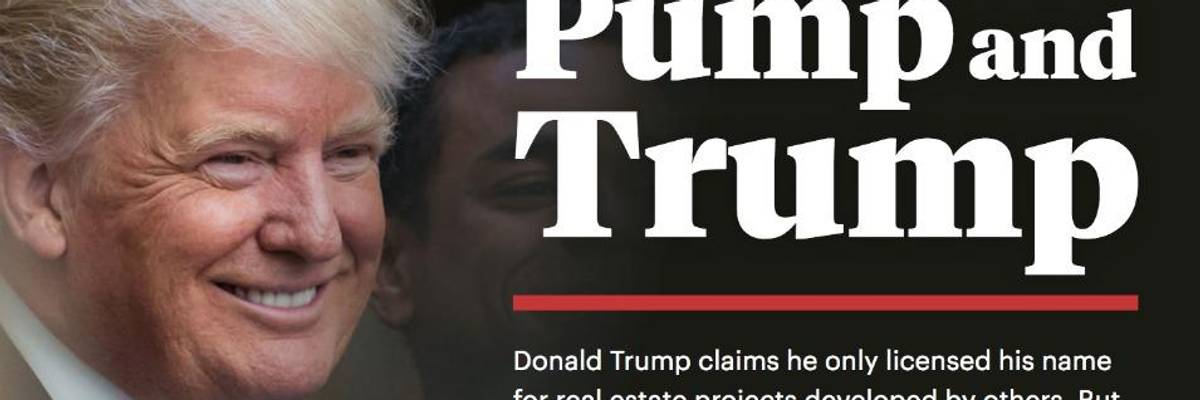
An eight-month investigation by ProPublica and WNYC reveals that the post-millennium Trump business model is different from what has been previously reported. The Trumps were typically way more than mere licensors or bystanders in their often-troubled deals. They were deeply involved in these projects. They helped mislead investors and buyers -- and they profited handsomely from it. (Image: Cover detail/Pro Publica/WNYC)
Since Donald Trump's fortunes came surging back with the success of "The Apprentice" 14 years ago, his deals have often been scrutinized for the large number of his partners who have ventured to the very edges of the law, and sometimes beyond. Those associates have included accused money launderers, alleged funders of Iran's Revolutionary Guard and a felon who slashed someone in the face with a broken margarita glass.
Trump and his company have typically countered by saying they were merely licensing his name on these real estate projects in exchange for a fee. They weren't the developers or in any way responsible.
But an eight-month investigation by ProPublica and WNYC reveals that the post-millennium Trump business model is different from what has been previously reported. The Trumps were typically way more than mere licensors or bystanders in their often-troubled deals. They were deeply involved in these projects. They helped mislead investors and buyers -- and they profited handsomely from it.
Patterns of deceptive practices occurred in a dozen deals across the globe, as the business expanded into international projects, and the Trumps often participated. One common pattern, visible in more than half of those transactions, was a tendency to misstate key sales numbers.
In interviews and press conferences, Ivanka Trump gave false sales figures for projects in Mexico's Baja California; Panama City, Panama; Toronto and New York's SoHo neighborhood. These statements weren't just the legendary Trump hype; they misled potential buyers about the viability of the developments.
Another pattern: Donald Trump repeatedly misled buyers about the amount (or existence) of his ownership in projects in Tampa, Florida; Panama; Baja and elsewhere. For a tower planned in Tampa, for example, Trump told a local paper in 2005 that his ownership would be less than 50 percent: "But it's a substantial stake. I recently said I'd like to increase my stake but when they're selling that well they don't let you do that." In reality, Trump had no ownership stake in the project.
The Trumps often made money even when projects failed. And when they tanked, the Trumps simply ignored their prior claims of close involvement, denied any responsibility and walked away.
The cycle is exemplified in Panama City, where the Trumps were involved in a project to build a massive tower and complex known as the Trump Ocean Club. The project's unfortunate turns included bankruptcy, then, years later, the forcible ejection of the Trump Organization from managing the hotel.
There, as elsewhere, the Trump Organization disclaimed responsibility. It emphasized that it had merely licensed the Trump name to developers who handled everything from construction to marketing. "The Trump Organization was not the owner, developer or seller of the Trump Ocean Club Panama project," it said in a statement last year. "Because of its limited role, the company was not responsible for the financing of the project and had no involvement in the sale of units."
That was false...
Read the full article at Pro Publica.
Dear Common Dreams reader, It’s been nearly 30 years since I co-founded Common Dreams with my late wife, Lina Newhouser. We had the radical notion that journalism should serve the public good, not corporate profits. It was clear to us from the outset what it would take to build such a project. No paid advertisements. No corporate sponsors. No millionaire publisher telling us what to think or do. Many people said we wouldn't last a year, but we proved those doubters wrong. Together with a tremendous team of journalists and dedicated staff, we built an independent media outlet free from the constraints of profits and corporate control. Our mission has always been simple: To inform. To inspire. To ignite change for the common good. Building Common Dreams was not easy. Our survival was never guaranteed. When you take on the most powerful forces—Wall Street greed, fossil fuel industry destruction, Big Tech lobbyists, and uber-rich oligarchs who have spent billions upon billions rigging the economy and democracy in their favor—the only bulwark you have is supporters who believe in your work. But here’s the urgent message from me today. It's never been this bad out there. And it's never been this hard to keep us going. At the very moment Common Dreams is most needed, the threats we face are intensifying. We need your support now more than ever. We don't accept corporate advertising and never will. We don't have a paywall because we don't think people should be blocked from critical news based on their ability to pay. Everything we do is funded by the donations of readers like you. When everyone does the little they can afford, we are strong. But if that support retreats or dries up, so do we. Will you donate now to make sure Common Dreams not only survives but thrives? —Craig Brown, Co-founder |
Since Donald Trump's fortunes came surging back with the success of "The Apprentice" 14 years ago, his deals have often been scrutinized for the large number of his partners who have ventured to the very edges of the law, and sometimes beyond. Those associates have included accused money launderers, alleged funders of Iran's Revolutionary Guard and a felon who slashed someone in the face with a broken margarita glass.
Trump and his company have typically countered by saying they were merely licensing his name on these real estate projects in exchange for a fee. They weren't the developers or in any way responsible.
But an eight-month investigation by ProPublica and WNYC reveals that the post-millennium Trump business model is different from what has been previously reported. The Trumps were typically way more than mere licensors or bystanders in their often-troubled deals. They were deeply involved in these projects. They helped mislead investors and buyers -- and they profited handsomely from it.
Patterns of deceptive practices occurred in a dozen deals across the globe, as the business expanded into international projects, and the Trumps often participated. One common pattern, visible in more than half of those transactions, was a tendency to misstate key sales numbers.
In interviews and press conferences, Ivanka Trump gave false sales figures for projects in Mexico's Baja California; Panama City, Panama; Toronto and New York's SoHo neighborhood. These statements weren't just the legendary Trump hype; they misled potential buyers about the viability of the developments.
Another pattern: Donald Trump repeatedly misled buyers about the amount (or existence) of his ownership in projects in Tampa, Florida; Panama; Baja and elsewhere. For a tower planned in Tampa, for example, Trump told a local paper in 2005 that his ownership would be less than 50 percent: "But it's a substantial stake. I recently said I'd like to increase my stake but when they're selling that well they don't let you do that." In reality, Trump had no ownership stake in the project.
The Trumps often made money even when projects failed. And when they tanked, the Trumps simply ignored their prior claims of close involvement, denied any responsibility and walked away.
The cycle is exemplified in Panama City, where the Trumps were involved in a project to build a massive tower and complex known as the Trump Ocean Club. The project's unfortunate turns included bankruptcy, then, years later, the forcible ejection of the Trump Organization from managing the hotel.
There, as elsewhere, the Trump Organization disclaimed responsibility. It emphasized that it had merely licensed the Trump name to developers who handled everything from construction to marketing. "The Trump Organization was not the owner, developer or seller of the Trump Ocean Club Panama project," it said in a statement last year. "Because of its limited role, the company was not responsible for the financing of the project and had no involvement in the sale of units."
That was false...
Read the full article at Pro Publica.
Since Donald Trump's fortunes came surging back with the success of "The Apprentice" 14 years ago, his deals have often been scrutinized for the large number of his partners who have ventured to the very edges of the law, and sometimes beyond. Those associates have included accused money launderers, alleged funders of Iran's Revolutionary Guard and a felon who slashed someone in the face with a broken margarita glass.
Trump and his company have typically countered by saying they were merely licensing his name on these real estate projects in exchange for a fee. They weren't the developers or in any way responsible.
But an eight-month investigation by ProPublica and WNYC reveals that the post-millennium Trump business model is different from what has been previously reported. The Trumps were typically way more than mere licensors or bystanders in their often-troubled deals. They were deeply involved in these projects. They helped mislead investors and buyers -- and they profited handsomely from it.
Patterns of deceptive practices occurred in a dozen deals across the globe, as the business expanded into international projects, and the Trumps often participated. One common pattern, visible in more than half of those transactions, was a tendency to misstate key sales numbers.
In interviews and press conferences, Ivanka Trump gave false sales figures for projects in Mexico's Baja California; Panama City, Panama; Toronto and New York's SoHo neighborhood. These statements weren't just the legendary Trump hype; they misled potential buyers about the viability of the developments.
Another pattern: Donald Trump repeatedly misled buyers about the amount (or existence) of his ownership in projects in Tampa, Florida; Panama; Baja and elsewhere. For a tower planned in Tampa, for example, Trump told a local paper in 2005 that his ownership would be less than 50 percent: "But it's a substantial stake. I recently said I'd like to increase my stake but when they're selling that well they don't let you do that." In reality, Trump had no ownership stake in the project.
The Trumps often made money even when projects failed. And when they tanked, the Trumps simply ignored their prior claims of close involvement, denied any responsibility and walked away.
The cycle is exemplified in Panama City, where the Trumps were involved in a project to build a massive tower and complex known as the Trump Ocean Club. The project's unfortunate turns included bankruptcy, then, years later, the forcible ejection of the Trump Organization from managing the hotel.
There, as elsewhere, the Trump Organization disclaimed responsibility. It emphasized that it had merely licensed the Trump name to developers who handled everything from construction to marketing. "The Trump Organization was not the owner, developer or seller of the Trump Ocean Club Panama project," it said in a statement last year. "Because of its limited role, the company was not responsible for the financing of the project and had no involvement in the sale of units."
That was false...
Read the full article at Pro Publica.