SUBSCRIBE TO OUR FREE NEWSLETTER
Daily news & progressive opinion—funded by the people, not the corporations—delivered straight to your inbox.
5
#000000
#FFFFFF
To donate by check, phone, or other method, see our More Ways to Give page.
Daily news & progressive opinion—funded by the people, not the corporations—delivered straight to your inbox.
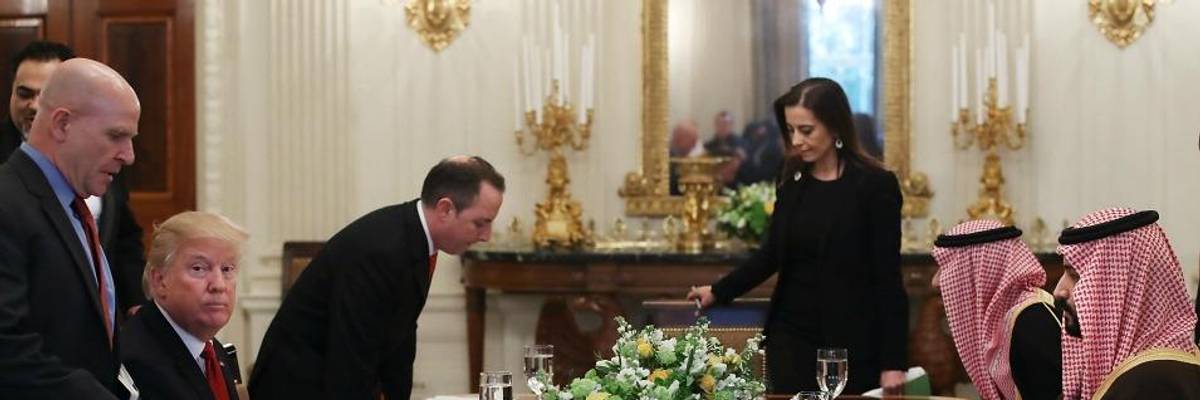
U.S. President Donald Trump and Mohammed bin Salman, Deputy Crown Prince and Minister of Defense of the Kingdom of Saudi Arabia, prepare to have lunch in the State Dining Room, at the White House, March 14, 2017 in Washington, D.C. (Photo: Mark Wilson/Getty Images)
As new evidence emerges that Washington Post correspondent Jamal Khashoggi was tortured and killed inside the Saudi consulate in Istanbul last week, lawmakers and ethics watchdogs said Thursday that President Donald Trump's reluctance to hold the Saudis responsible for Khashoggi's possible murder is exactly what they've warned about when calling attention to Trump's refusal to divest from his businesses--which, according to the president himself, Saudis have invested tens of millions of dollars over the years.
Saudi officials, along with other international political figures, have stayed in Trump's hotels since he took office in 2017, with lobbyists from Saudi Arabia spending $270,000 in the Trump International Hotel in Washington, D.C. last year alone.
"Saudi Arabia, I get along with all of them," Trump said in 2015. "They buy apartments from me. They spend $40 million, $50 million. Am I supposed to dislike them? I like them very much."
The Saudis also have a long history of business dealings with Trump, including a Saudi prince's purchase of a yacht and a hotel from him in the 1990s when the real estate developer was in need of money. But Democrats in Congress and the group Citizens for Responsibility and Ethics in Washington (CREW) have especially expressed concern with his financial entanglements with the kingdom after he took office, saying they blatantly violate the U.S. Constitution's emoluments clause.
On Twitter, CREW suggested that Saudi Arabia's status as a loyal customer to the Trump Organization--from which the president refused to divest after taking office--has likely been on Trump's mind this week as he's told the press that he won't consider sanctioning or condemning the Saudis over Khashoggi's disappearance.
Trump's ongoing business relationship with the Saudis--including Crown Prince Mohammed bin Salman, also known as MbS, whose visit to the president's hotel in New York helped raise its revenues by 13 percent earlier this year--violates the Constitutional clause that forbids the president from receiving gifts or payments from foreign officials.
Sen. Brian Schatz (D-Hawaii) drew attention to Trump's emoluments violations and put it bluntly on Twitter:
Sen. Richard Blumenthal (D-Conn.), the lead plaintiff in a lawsuit filed along with 200 other Democratic lawmakers, demanding information on foreign patrons of Trump's businesses, also suggested that the president is too entangled with the Saudis to condemn them for the journalists disappearance--or any other violations.
Dear Common Dreams reader, It’s been nearly 30 years since I co-founded Common Dreams with my late wife, Lina Newhouser. We had the radical notion that journalism should serve the public good, not corporate profits. It was clear to us from the outset what it would take to build such a project. No paid advertisements. No corporate sponsors. No millionaire publisher telling us what to think or do. Many people said we wouldn't last a year, but we proved those doubters wrong. Together with a tremendous team of journalists and dedicated staff, we built an independent media outlet free from the constraints of profits and corporate control. Our mission has always been simple: To inform. To inspire. To ignite change for the common good. Building Common Dreams was not easy. Our survival was never guaranteed. When you take on the most powerful forces—Wall Street greed, fossil fuel industry destruction, Big Tech lobbyists, and uber-rich oligarchs who have spent billions upon billions rigging the economy and democracy in their favor—the only bulwark you have is supporters who believe in your work. But here’s the urgent message from me today. It's never been this bad out there. And it's never been this hard to keep us going. At the very moment Common Dreams is most needed, the threats we face are intensifying. We need your support now more than ever. We don't accept corporate advertising and never will. We don't have a paywall because we don't think people should be blocked from critical news based on their ability to pay. Everything we do is funded by the donations of readers like you. When everyone does the little they can afford, we are strong. But if that support retreats or dries up, so do we. Will you donate now to make sure Common Dreams not only survives but thrives? —Craig Brown, Co-founder |
As new evidence emerges that Washington Post correspondent Jamal Khashoggi was tortured and killed inside the Saudi consulate in Istanbul last week, lawmakers and ethics watchdogs said Thursday that President Donald Trump's reluctance to hold the Saudis responsible for Khashoggi's possible murder is exactly what they've warned about when calling attention to Trump's refusal to divest from his businesses--which, according to the president himself, Saudis have invested tens of millions of dollars over the years.
Saudi officials, along with other international political figures, have stayed in Trump's hotels since he took office in 2017, with lobbyists from Saudi Arabia spending $270,000 in the Trump International Hotel in Washington, D.C. last year alone.
"Saudi Arabia, I get along with all of them," Trump said in 2015. "They buy apartments from me. They spend $40 million, $50 million. Am I supposed to dislike them? I like them very much."
The Saudis also have a long history of business dealings with Trump, including a Saudi prince's purchase of a yacht and a hotel from him in the 1990s when the real estate developer was in need of money. But Democrats in Congress and the group Citizens for Responsibility and Ethics in Washington (CREW) have especially expressed concern with his financial entanglements with the kingdom after he took office, saying they blatantly violate the U.S. Constitution's emoluments clause.
On Twitter, CREW suggested that Saudi Arabia's status as a loyal customer to the Trump Organization--from which the president refused to divest after taking office--has likely been on Trump's mind this week as he's told the press that he won't consider sanctioning or condemning the Saudis over Khashoggi's disappearance.
Trump's ongoing business relationship with the Saudis--including Crown Prince Mohammed bin Salman, also known as MbS, whose visit to the president's hotel in New York helped raise its revenues by 13 percent earlier this year--violates the Constitutional clause that forbids the president from receiving gifts or payments from foreign officials.
Sen. Brian Schatz (D-Hawaii) drew attention to Trump's emoluments violations and put it bluntly on Twitter:
Sen. Richard Blumenthal (D-Conn.), the lead plaintiff in a lawsuit filed along with 200 other Democratic lawmakers, demanding information on foreign patrons of Trump's businesses, also suggested that the president is too entangled with the Saudis to condemn them for the journalists disappearance--or any other violations.
As new evidence emerges that Washington Post correspondent Jamal Khashoggi was tortured and killed inside the Saudi consulate in Istanbul last week, lawmakers and ethics watchdogs said Thursday that President Donald Trump's reluctance to hold the Saudis responsible for Khashoggi's possible murder is exactly what they've warned about when calling attention to Trump's refusal to divest from his businesses--which, according to the president himself, Saudis have invested tens of millions of dollars over the years.
Saudi officials, along with other international political figures, have stayed in Trump's hotels since he took office in 2017, with lobbyists from Saudi Arabia spending $270,000 in the Trump International Hotel in Washington, D.C. last year alone.
"Saudi Arabia, I get along with all of them," Trump said in 2015. "They buy apartments from me. They spend $40 million, $50 million. Am I supposed to dislike them? I like them very much."
The Saudis also have a long history of business dealings with Trump, including a Saudi prince's purchase of a yacht and a hotel from him in the 1990s when the real estate developer was in need of money. But Democrats in Congress and the group Citizens for Responsibility and Ethics in Washington (CREW) have especially expressed concern with his financial entanglements with the kingdom after he took office, saying they blatantly violate the U.S. Constitution's emoluments clause.
On Twitter, CREW suggested that Saudi Arabia's status as a loyal customer to the Trump Organization--from which the president refused to divest after taking office--has likely been on Trump's mind this week as he's told the press that he won't consider sanctioning or condemning the Saudis over Khashoggi's disappearance.
Trump's ongoing business relationship with the Saudis--including Crown Prince Mohammed bin Salman, also known as MbS, whose visit to the president's hotel in New York helped raise its revenues by 13 percent earlier this year--violates the Constitutional clause that forbids the president from receiving gifts or payments from foreign officials.
Sen. Brian Schatz (D-Hawaii) drew attention to Trump's emoluments violations and put it bluntly on Twitter:
Sen. Richard Blumenthal (D-Conn.), the lead plaintiff in a lawsuit filed along with 200 other Democratic lawmakers, demanding information on foreign patrons of Trump's businesses, also suggested that the president is too entangled with the Saudis to condemn them for the journalists disappearance--or any other violations.