SUBSCRIBE TO OUR FREE NEWSLETTER
Daily news & progressive opinion—funded by the people, not the corporations—delivered straight to your inbox.
5
#000000
#FFFFFF
To donate by check, phone, or other method, see our More Ways to Give page.
Daily news & progressive opinion—funded by the people, not the corporations—delivered straight to your inbox.
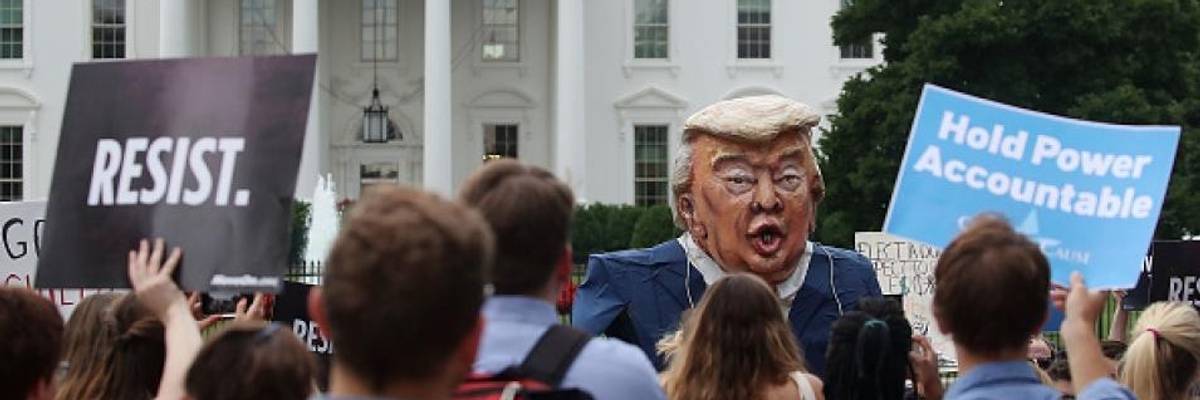
People protest against U.S. President Donald Trump in front of the White House on July 11, 2017 in Washington, DC. (Photo by Mark Wilson/Getty Images)
As the Trump administration and the Republican-controlled Congress face mass protests in Washington, D.C. against their attacks on healthcare, immigrants, women, and the poor--as well as well as their support for white supremacists and men accused of sexual assault--civil liberties advocates are speaking out against an "unconstitutional" National Park Service (NPS) proposal that would severely limit Americans' ability to protest near the White House and on the National Mall.
"While the park service may be strapped for funds, it cannot balance its budget on the backs of people seeking to exercise their constitutional rights."
--Arthur Spitzer, ACLU of D.C.
With the Oct. 15 deadline for public comment on the proposed rule rapidly approaching, the D.C. branch of the American Civil Liberties Union (ACLU) has submitted its 33-page takedown of policy changes that the group warns would violate the First Amendment rights of demonstrators that have been affirmed by "court orders that have stood for decades."
In a blog post published Tuesday, the ACLU of D.C.'s legal co-director Arthur Spitzer noted President Donald Trump's "record of attacking the rights of protesters" and declared, "The heart of the matter is clear: President Trump might not like having protesters on his doorstep, but the First Amendment guarantees their right to be there."
Outlining the ACLU's critiques of the NPS "stealth" proposal, Spitzter highlighted three provisions that civil libertarians have found especially alarming:
The National Mall, as NPS acknowledged in its August proposal, "is a preeminent national landscape that is home to the enduring symbols of our country including various trees and gardens that symbolize cultural and diplomatic exchanges and gifts from others nations" as well as "monuments, memorials, statues, and other commemorative works."
While an NPS spokesman told the Washington Post in August that the idea for charging protesters fees for support and security "came out of just the sheer cost" of past demonstrations, the ACLU says that is no reason to treat demonstrators any differently than the 45 million non-demonstrators who visit the National Mall every year.
"Imposing any more cost on people expressing their First Amendment rights is just going to stop people from doing that, or it's going to increase the number of unpermitted protests, which can be a concern when you want to keep people safe."
--Samantha Miller, D.C. Action Lab
"Managing public lands for the benefit of the American people is what Congress funds the National Park Service to do. That includes demonstrators just as much as tourists or hikers," wrote Spizter. "While the park service may be strapped for funds, it cannot balance its budget on the backs of people seeking to exercise their constitutional rights."
Although demonstrations don't currently incur such fees, the Post reported in August that organizations with small budgets already "can find it cost-prohibitive to comply with park service" rules that "require organizers to provide toilets, on-site emergency medical responders, trash pickup, and more."
Samantha Miller, an organizer with the group D.C. Action Lab, told the newspaper she worries that "imposing any more cost on people expressing their First Amendment rights is just going to stop people from doing that, or it's going to increase the number of unpermitted protests, which can be a concern when you want to keep people safe."
Generally, protest organizers submit permitting requests to NPS at least 48 hours in advance, but current NPS regulations allow for exceptions, recognizing that, as Spitzer noted, "the right to protest now in response to unfolding events is a key part of freedom of speech." In addition to some language changes that suggest an unwillingness from NPS to make necessary resources available for spontaneous demonstrations, the new rule--citing safety concerns--would outlaw small stages or sound systems for such events.
Regarding plans to close off 80 percent of the space presently available for protests directly outside the White House, NPS "didn't offer any justification for closing the sidewalk," Spitzter pointed out--and "even if it were based on security grounds, that wouldn't pass muster because the White House fence is about to be replaced with a new, taller fence with special anti-climbing features, approved last year specifically to 'meet contemporary security standards' while allowing the sidewalk to remain open."
Dear Common Dreams reader, It’s been nearly 30 years since I co-founded Common Dreams with my late wife, Lina Newhouser. We had the radical notion that journalism should serve the public good, not corporate profits. It was clear to us from the outset what it would take to build such a project. No paid advertisements. No corporate sponsors. No millionaire publisher telling us what to think or do. Many people said we wouldn't last a year, but we proved those doubters wrong. Together with a tremendous team of journalists and dedicated staff, we built an independent media outlet free from the constraints of profits and corporate control. Our mission has always been simple: To inform. To inspire. To ignite change for the common good. Building Common Dreams was not easy. Our survival was never guaranteed. When you take on the most powerful forces—Wall Street greed, fossil fuel industry destruction, Big Tech lobbyists, and uber-rich oligarchs who have spent billions upon billions rigging the economy and democracy in their favor—the only bulwark you have is supporters who believe in your work. But here’s the urgent message from me today. It's never been this bad out there. And it's never been this hard to keep us going. At the very moment Common Dreams is most needed, the threats we face are intensifying. We need your support now more than ever. We don't accept corporate advertising and never will. We don't have a paywall because we don't think people should be blocked from critical news based on their ability to pay. Everything we do is funded by the donations of readers like you. When everyone does the little they can afford, we are strong. But if that support retreats or dries up, so do we. Will you donate now to make sure Common Dreams not only survives but thrives? —Craig Brown, Co-founder |
As the Trump administration and the Republican-controlled Congress face mass protests in Washington, D.C. against their attacks on healthcare, immigrants, women, and the poor--as well as well as their support for white supremacists and men accused of sexual assault--civil liberties advocates are speaking out against an "unconstitutional" National Park Service (NPS) proposal that would severely limit Americans' ability to protest near the White House and on the National Mall.
"While the park service may be strapped for funds, it cannot balance its budget on the backs of people seeking to exercise their constitutional rights."
--Arthur Spitzer, ACLU of D.C.
With the Oct. 15 deadline for public comment on the proposed rule rapidly approaching, the D.C. branch of the American Civil Liberties Union (ACLU) has submitted its 33-page takedown of policy changes that the group warns would violate the First Amendment rights of demonstrators that have been affirmed by "court orders that have stood for decades."
In a blog post published Tuesday, the ACLU of D.C.'s legal co-director Arthur Spitzer noted President Donald Trump's "record of attacking the rights of protesters" and declared, "The heart of the matter is clear: President Trump might not like having protesters on his doorstep, but the First Amendment guarantees their right to be there."
Outlining the ACLU's critiques of the NPS "stealth" proposal, Spitzter highlighted three provisions that civil libertarians have found especially alarming:
The National Mall, as NPS acknowledged in its August proposal, "is a preeminent national landscape that is home to the enduring symbols of our country including various trees and gardens that symbolize cultural and diplomatic exchanges and gifts from others nations" as well as "monuments, memorials, statues, and other commemorative works."
While an NPS spokesman told the Washington Post in August that the idea for charging protesters fees for support and security "came out of just the sheer cost" of past demonstrations, the ACLU says that is no reason to treat demonstrators any differently than the 45 million non-demonstrators who visit the National Mall every year.
"Imposing any more cost on people expressing their First Amendment rights is just going to stop people from doing that, or it's going to increase the number of unpermitted protests, which can be a concern when you want to keep people safe."
--Samantha Miller, D.C. Action Lab
"Managing public lands for the benefit of the American people is what Congress funds the National Park Service to do. That includes demonstrators just as much as tourists or hikers," wrote Spizter. "While the park service may be strapped for funds, it cannot balance its budget on the backs of people seeking to exercise their constitutional rights."
Although demonstrations don't currently incur such fees, the Post reported in August that organizations with small budgets already "can find it cost-prohibitive to comply with park service" rules that "require organizers to provide toilets, on-site emergency medical responders, trash pickup, and more."
Samantha Miller, an organizer with the group D.C. Action Lab, told the newspaper she worries that "imposing any more cost on people expressing their First Amendment rights is just going to stop people from doing that, or it's going to increase the number of unpermitted protests, which can be a concern when you want to keep people safe."
Generally, protest organizers submit permitting requests to NPS at least 48 hours in advance, but current NPS regulations allow for exceptions, recognizing that, as Spitzer noted, "the right to protest now in response to unfolding events is a key part of freedom of speech." In addition to some language changes that suggest an unwillingness from NPS to make necessary resources available for spontaneous demonstrations, the new rule--citing safety concerns--would outlaw small stages or sound systems for such events.
Regarding plans to close off 80 percent of the space presently available for protests directly outside the White House, NPS "didn't offer any justification for closing the sidewalk," Spitzter pointed out--and "even if it were based on security grounds, that wouldn't pass muster because the White House fence is about to be replaced with a new, taller fence with special anti-climbing features, approved last year specifically to 'meet contemporary security standards' while allowing the sidewalk to remain open."
As the Trump administration and the Republican-controlled Congress face mass protests in Washington, D.C. against their attacks on healthcare, immigrants, women, and the poor--as well as well as their support for white supremacists and men accused of sexual assault--civil liberties advocates are speaking out against an "unconstitutional" National Park Service (NPS) proposal that would severely limit Americans' ability to protest near the White House and on the National Mall.
"While the park service may be strapped for funds, it cannot balance its budget on the backs of people seeking to exercise their constitutional rights."
--Arthur Spitzer, ACLU of D.C.
With the Oct. 15 deadline for public comment on the proposed rule rapidly approaching, the D.C. branch of the American Civil Liberties Union (ACLU) has submitted its 33-page takedown of policy changes that the group warns would violate the First Amendment rights of demonstrators that have been affirmed by "court orders that have stood for decades."
In a blog post published Tuesday, the ACLU of D.C.'s legal co-director Arthur Spitzer noted President Donald Trump's "record of attacking the rights of protesters" and declared, "The heart of the matter is clear: President Trump might not like having protesters on his doorstep, but the First Amendment guarantees their right to be there."
Outlining the ACLU's critiques of the NPS "stealth" proposal, Spitzter highlighted three provisions that civil libertarians have found especially alarming:
The National Mall, as NPS acknowledged in its August proposal, "is a preeminent national landscape that is home to the enduring symbols of our country including various trees and gardens that symbolize cultural and diplomatic exchanges and gifts from others nations" as well as "monuments, memorials, statues, and other commemorative works."
While an NPS spokesman told the Washington Post in August that the idea for charging protesters fees for support and security "came out of just the sheer cost" of past demonstrations, the ACLU says that is no reason to treat demonstrators any differently than the 45 million non-demonstrators who visit the National Mall every year.
"Imposing any more cost on people expressing their First Amendment rights is just going to stop people from doing that, or it's going to increase the number of unpermitted protests, which can be a concern when you want to keep people safe."
--Samantha Miller, D.C. Action Lab
"Managing public lands for the benefit of the American people is what Congress funds the National Park Service to do. That includes demonstrators just as much as tourists or hikers," wrote Spizter. "While the park service may be strapped for funds, it cannot balance its budget on the backs of people seeking to exercise their constitutional rights."
Although demonstrations don't currently incur such fees, the Post reported in August that organizations with small budgets already "can find it cost-prohibitive to comply with park service" rules that "require organizers to provide toilets, on-site emergency medical responders, trash pickup, and more."
Samantha Miller, an organizer with the group D.C. Action Lab, told the newspaper she worries that "imposing any more cost on people expressing their First Amendment rights is just going to stop people from doing that, or it's going to increase the number of unpermitted protests, which can be a concern when you want to keep people safe."
Generally, protest organizers submit permitting requests to NPS at least 48 hours in advance, but current NPS regulations allow for exceptions, recognizing that, as Spitzer noted, "the right to protest now in response to unfolding events is a key part of freedom of speech." In addition to some language changes that suggest an unwillingness from NPS to make necessary resources available for spontaneous demonstrations, the new rule--citing safety concerns--would outlaw small stages or sound systems for such events.
Regarding plans to close off 80 percent of the space presently available for protests directly outside the White House, NPS "didn't offer any justification for closing the sidewalk," Spitzter pointed out--and "even if it were based on security grounds, that wouldn't pass muster because the White House fence is about to be replaced with a new, taller fence with special anti-climbing features, approved last year specifically to 'meet contemporary security standards' while allowing the sidewalk to remain open."