

SUBSCRIBE TO OUR FREE NEWSLETTER
Daily news & progressive opinion—funded by the people, not the corporations—delivered straight to your inbox.
5
#000000
#FFFFFF
To donate by check, phone, or other method, see our More Ways to Give page.
Daily news & progressive opinion—funded by the people, not the corporations—delivered straight to your inbox.
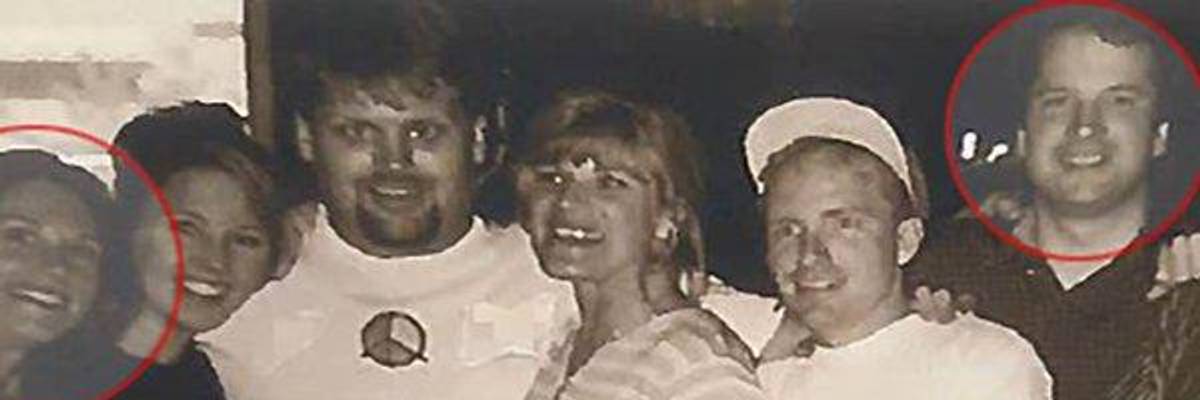
From left, Deborah Ramirez, Kerry E. Berchem, Doug Millet, Karen Yarasavage, Kevin Genda, Brett Kavanaugh and David White pose for a photo at the rehearsal dinner before the wedding of Yarasavage and Genda in 1997. (Photo: Obtained by NBC News)
"If this story is accurate, [Brett] Kavanaugh blatantly lied under oath," declared The Atlantic's Adam Serwer in reaction to reporting by NBC News on Monday evening that Trump's pick for the U.S. Supreme Court, along with his legal team, attempted to gather evidence to discredit allegations by Debbe Ramirez--the Yale University classmate who claimed Kavanaugh assaulted her at a party in the mid-1980s--even before the nominee says he was aware of such accusations.
While Kavanagh told members of the Senate Judiciary Committee during testimony last week that he only learned of Ramirez's allegations when they were reported publicly in The New Yorker the weekend before, NBC News reports that other Yale classmates were contacted prior to that by Kavanaugh's lawyers--and possibly by the nominee himself--trying to obtain preemptive testimony and a photograph of the two at a wedding of mutual friends.
As The Daily Beast summarized the NBC News story:
The network reports that text messages between Kerry Berchem and Karen Yarasavage indicate that Kavanaugh personally asked Yarasavage to "go on the record in his defense." Two other messages reportedly show Kavanaugh's team getting in touch with the nominee's former classmates "in advance" of The New Yorker story being published. Berchem approached Sen. Richard Blumenthal (D-CT) with the texts, and a spokesperson for the senator's office claimed that the Republicans "had not turned [them] over to the FBI." Berchem then reportedly approached the FBI directly with the texts, but has yet to receive a response. Texts between Berchem and Yarasavage also suggest that Ramirez was uncomfortable around Kavanaugh when they attended a 1997 wedding. Berchem wrote that Ramirez "clung" to him, and "never went near" Kavanaugh during the event. In The New Yorker piece, Ramirez accused Kavanaugh of exposing himself to her at a Yale University dorm party. During Thursday's public hearing, Kavanaugh said he had first heard Ramirez's allegations from The New Yorker.
According to NBC, the texts "demonstrate that Kavanaugh and Ramirez were more socially connected than previously understood and that Ramirez was uncomfortable around Kavanaugh when they saw each other at a wedding 10 years after they graduated. Berchem's efforts also show that some potential witnesses have been unable to get important information to the FBI."
Like Sewer, other journalists following the case closely said the reporting puts another big hole in Kavanaugh's credibility. The Intercept's Ryan Grim tweeted:
And independent journalist Marcy Wheeler added:
Dear Common Dreams reader, It’s been nearly 30 years since I co-founded Common Dreams with my late wife, Lina Newhouser. We had the radical notion that journalism should serve the public good, not corporate profits. It was clear to us from the outset what it would take to build such a project. No paid advertisements. No corporate sponsors. No millionaire publisher telling us what to think or do. Many people said we wouldn't last a year, but we proved those doubters wrong. Together with a tremendous team of journalists and dedicated staff, we built an independent media outlet free from the constraints of profits and corporate control. Our mission has always been simple: To inform. To inspire. To ignite change for the common good. Building Common Dreams was not easy. Our survival was never guaranteed. When you take on the most powerful forces—Wall Street greed, fossil fuel industry destruction, Big Tech lobbyists, and uber-rich oligarchs who have spent billions upon billions rigging the economy and democracy in their favor—the only bulwark you have is supporters who believe in your work. But here’s the urgent message from me today. It's never been this bad out there. And it's never been this hard to keep us going. At the very moment Common Dreams is most needed, the threats we face are intensifying. We need your support now more than ever. We don't accept corporate advertising and never will. We don't have a paywall because we don't think people should be blocked from critical news based on their ability to pay. Everything we do is funded by the donations of readers like you. When everyone does the little they can afford, we are strong. But if that support retreats or dries up, so do we. Will you donate now to make sure Common Dreams not only survives but thrives? —Craig Brown, Co-founder |
"If this story is accurate, [Brett] Kavanaugh blatantly lied under oath," declared The Atlantic's Adam Serwer in reaction to reporting by NBC News on Monday evening that Trump's pick for the U.S. Supreme Court, along with his legal team, attempted to gather evidence to discredit allegations by Debbe Ramirez--the Yale University classmate who claimed Kavanaugh assaulted her at a party in the mid-1980s--even before the nominee says he was aware of such accusations.
While Kavanagh told members of the Senate Judiciary Committee during testimony last week that he only learned of Ramirez's allegations when they were reported publicly in The New Yorker the weekend before, NBC News reports that other Yale classmates were contacted prior to that by Kavanaugh's lawyers--and possibly by the nominee himself--trying to obtain preemptive testimony and a photograph of the two at a wedding of mutual friends.
As The Daily Beast summarized the NBC News story:
The network reports that text messages between Kerry Berchem and Karen Yarasavage indicate that Kavanaugh personally asked Yarasavage to "go on the record in his defense." Two other messages reportedly show Kavanaugh's team getting in touch with the nominee's former classmates "in advance" of The New Yorker story being published. Berchem approached Sen. Richard Blumenthal (D-CT) with the texts, and a spokesperson for the senator's office claimed that the Republicans "had not turned [them] over to the FBI." Berchem then reportedly approached the FBI directly with the texts, but has yet to receive a response. Texts between Berchem and Yarasavage also suggest that Ramirez was uncomfortable around Kavanaugh when they attended a 1997 wedding. Berchem wrote that Ramirez "clung" to him, and "never went near" Kavanaugh during the event. In The New Yorker piece, Ramirez accused Kavanaugh of exposing himself to her at a Yale University dorm party. During Thursday's public hearing, Kavanaugh said he had first heard Ramirez's allegations from The New Yorker.
According to NBC, the texts "demonstrate that Kavanaugh and Ramirez were more socially connected than previously understood and that Ramirez was uncomfortable around Kavanaugh when they saw each other at a wedding 10 years after they graduated. Berchem's efforts also show that some potential witnesses have been unable to get important information to the FBI."
Like Sewer, other journalists following the case closely said the reporting puts another big hole in Kavanaugh's credibility. The Intercept's Ryan Grim tweeted:
And independent journalist Marcy Wheeler added:
"If this story is accurate, [Brett] Kavanaugh blatantly lied under oath," declared The Atlantic's Adam Serwer in reaction to reporting by NBC News on Monday evening that Trump's pick for the U.S. Supreme Court, along with his legal team, attempted to gather evidence to discredit allegations by Debbe Ramirez--the Yale University classmate who claimed Kavanaugh assaulted her at a party in the mid-1980s--even before the nominee says he was aware of such accusations.
While Kavanagh told members of the Senate Judiciary Committee during testimony last week that he only learned of Ramirez's allegations when they were reported publicly in The New Yorker the weekend before, NBC News reports that other Yale classmates were contacted prior to that by Kavanaugh's lawyers--and possibly by the nominee himself--trying to obtain preemptive testimony and a photograph of the two at a wedding of mutual friends.
As The Daily Beast summarized the NBC News story:
The network reports that text messages between Kerry Berchem and Karen Yarasavage indicate that Kavanaugh personally asked Yarasavage to "go on the record in his defense." Two other messages reportedly show Kavanaugh's team getting in touch with the nominee's former classmates "in advance" of The New Yorker story being published. Berchem approached Sen. Richard Blumenthal (D-CT) with the texts, and a spokesperson for the senator's office claimed that the Republicans "had not turned [them] over to the FBI." Berchem then reportedly approached the FBI directly with the texts, but has yet to receive a response. Texts between Berchem and Yarasavage also suggest that Ramirez was uncomfortable around Kavanaugh when they attended a 1997 wedding. Berchem wrote that Ramirez "clung" to him, and "never went near" Kavanaugh during the event. In The New Yorker piece, Ramirez accused Kavanaugh of exposing himself to her at a Yale University dorm party. During Thursday's public hearing, Kavanaugh said he had first heard Ramirez's allegations from The New Yorker.
According to NBC, the texts "demonstrate that Kavanaugh and Ramirez were more socially connected than previously understood and that Ramirez was uncomfortable around Kavanaugh when they saw each other at a wedding 10 years after they graduated. Berchem's efforts also show that some potential witnesses have been unable to get important information to the FBI."
Like Sewer, other journalists following the case closely said the reporting puts another big hole in Kavanaugh's credibility. The Intercept's Ryan Grim tweeted:
And independent journalist Marcy Wheeler added:

