SUBSCRIBE TO OUR FREE NEWSLETTER
Daily news & progressive opinion—funded by the people, not the corporations—delivered straight to your inbox.
5
#000000
#FFFFFF
To donate by check, phone, or other method, see our More Ways to Give page.
Daily news & progressive opinion—funded by the people, not the corporations—delivered straight to your inbox.
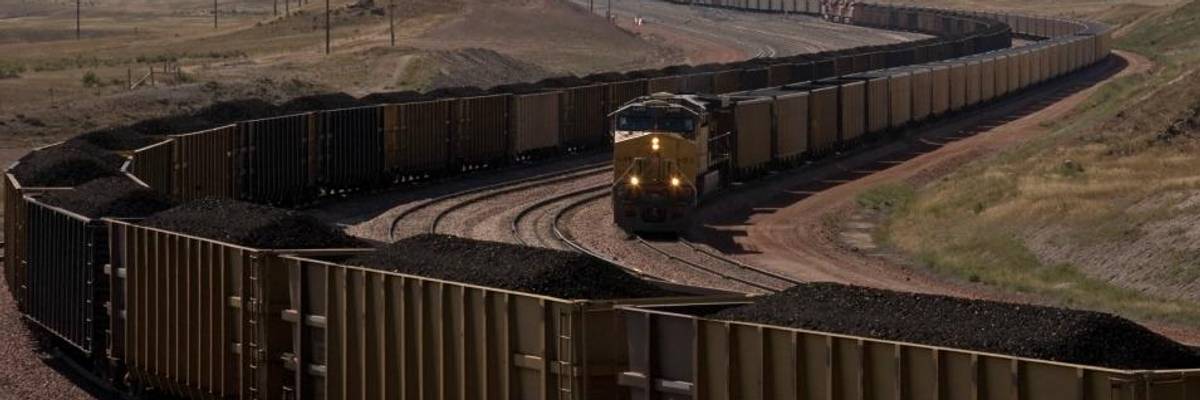
Coal trains near North Antelope Rochelle Mine in Wyoming. (Photo: Kimon Berlin/flickr/cc)
Millions of U.S. energy consumers across multiple are unwittingly propping up a coal industry by paying more than $1 billion annually over recent years for dirty energy that renewable sources could have provided at much cheaper prices.
According to a new study (pdf) published Tuesday by the Union of Concerned Scientists, which looked at consumer and market data from the last three years, residents across four major energy markets spanning large swaths of the country have been forced to pay higher rates for coal-generated electricity when less expensive and cleaner alternatives were available to utility companies in those regions.
"Customers are being ripped off while cleaner and cheaper sources of energy are being crowded out because utilities are forcing customers to subsidize coal plants."
--Joe Daniel, Union of Concerned Scientists"Every month, millions of consumers are unwittingly bailing out coal-fired power plants," said Joe Daniel, study author and senior energy analyst at UCS. "When utilities started selling power on the open market, they did so voluntarily. In fact, some had to jump through hoops to do so. But now they seem unwilling to take advantage of the low prices in the markets they joined."
While regulatory statutes dictate that utilities have a "least cost" obligation to their customers, meaning they provide them energy at the cheapest cost, Daniel says his research shows some are bucking those rules.
"If energy on the market can be purchased at a lower cost than operating the coal plants they own then they should buy that power and resell it to their customers," he said. "But what my analysis found was that utilities are often depriving ratepayers of access to the lower cost, often cleaner power. Instead, they are selling customers electricity from their own, more expensive coal plants instead."
The overall practice--especially given coal's outized negative impacts on water and air water quality as well as its climate impacts--is, according to Daniel, "unacceptable and should not be tolerated.
"Customers are being ripped off while cleaner and cheaper sources of energy are being crowded out because utilities are forcing customers to subsidize coal plants," he concluded. "What this study shows is that, in essence, customers are paying extra to put more global warming emissions into the atmosphere."
Dear Common Dreams reader, It’s been nearly 30 years since I co-founded Common Dreams with my late wife, Lina Newhouser. We had the radical notion that journalism should serve the public good, not corporate profits. It was clear to us from the outset what it would take to build such a project. No paid advertisements. No corporate sponsors. No millionaire publisher telling us what to think or do. Many people said we wouldn't last a year, but we proved those doubters wrong. Together with a tremendous team of journalists and dedicated staff, we built an independent media outlet free from the constraints of profits and corporate control. Our mission has always been simple: To inform. To inspire. To ignite change for the common good. Building Common Dreams was not easy. Our survival was never guaranteed. When you take on the most powerful forces—Wall Street greed, fossil fuel industry destruction, Big Tech lobbyists, and uber-rich oligarchs who have spent billions upon billions rigging the economy and democracy in their favor—the only bulwark you have is supporters who believe in your work. But here’s the urgent message from me today. It's never been this bad out there. And it's never been this hard to keep us going. At the very moment Common Dreams is most needed, the threats we face are intensifying. We need your support now more than ever. We don't accept corporate advertising and never will. We don't have a paywall because we don't think people should be blocked from critical news based on their ability to pay. Everything we do is funded by the donations of readers like you. When everyone does the little they can afford, we are strong. But if that support retreats or dries up, so do we. Will you donate now to make sure Common Dreams not only survives but thrives? —Craig Brown, Co-founder |
Millions of U.S. energy consumers across multiple are unwittingly propping up a coal industry by paying more than $1 billion annually over recent years for dirty energy that renewable sources could have provided at much cheaper prices.
According to a new study (pdf) published Tuesday by the Union of Concerned Scientists, which looked at consumer and market data from the last three years, residents across four major energy markets spanning large swaths of the country have been forced to pay higher rates for coal-generated electricity when less expensive and cleaner alternatives were available to utility companies in those regions.
"Customers are being ripped off while cleaner and cheaper sources of energy are being crowded out because utilities are forcing customers to subsidize coal plants."
--Joe Daniel, Union of Concerned Scientists"Every month, millions of consumers are unwittingly bailing out coal-fired power plants," said Joe Daniel, study author and senior energy analyst at UCS. "When utilities started selling power on the open market, they did so voluntarily. In fact, some had to jump through hoops to do so. But now they seem unwilling to take advantage of the low prices in the markets they joined."
While regulatory statutes dictate that utilities have a "least cost" obligation to their customers, meaning they provide them energy at the cheapest cost, Daniel says his research shows some are bucking those rules.
"If energy on the market can be purchased at a lower cost than operating the coal plants they own then they should buy that power and resell it to their customers," he said. "But what my analysis found was that utilities are often depriving ratepayers of access to the lower cost, often cleaner power. Instead, they are selling customers electricity from their own, more expensive coal plants instead."
The overall practice--especially given coal's outized negative impacts on water and air water quality as well as its climate impacts--is, according to Daniel, "unacceptable and should not be tolerated.
"Customers are being ripped off while cleaner and cheaper sources of energy are being crowded out because utilities are forcing customers to subsidize coal plants," he concluded. "What this study shows is that, in essence, customers are paying extra to put more global warming emissions into the atmosphere."
Millions of U.S. energy consumers across multiple are unwittingly propping up a coal industry by paying more than $1 billion annually over recent years for dirty energy that renewable sources could have provided at much cheaper prices.
According to a new study (pdf) published Tuesday by the Union of Concerned Scientists, which looked at consumer and market data from the last three years, residents across four major energy markets spanning large swaths of the country have been forced to pay higher rates for coal-generated electricity when less expensive and cleaner alternatives were available to utility companies in those regions.
"Customers are being ripped off while cleaner and cheaper sources of energy are being crowded out because utilities are forcing customers to subsidize coal plants."
--Joe Daniel, Union of Concerned Scientists"Every month, millions of consumers are unwittingly bailing out coal-fired power plants," said Joe Daniel, study author and senior energy analyst at UCS. "When utilities started selling power on the open market, they did so voluntarily. In fact, some had to jump through hoops to do so. But now they seem unwilling to take advantage of the low prices in the markets they joined."
While regulatory statutes dictate that utilities have a "least cost" obligation to their customers, meaning they provide them energy at the cheapest cost, Daniel says his research shows some are bucking those rules.
"If energy on the market can be purchased at a lower cost than operating the coal plants they own then they should buy that power and resell it to their customers," he said. "But what my analysis found was that utilities are often depriving ratepayers of access to the lower cost, often cleaner power. Instead, they are selling customers electricity from their own, more expensive coal plants instead."
The overall practice--especially given coal's outized negative impacts on water and air water quality as well as its climate impacts--is, according to Daniel, "unacceptable and should not be tolerated.
"Customers are being ripped off while cleaner and cheaper sources of energy are being crowded out because utilities are forcing customers to subsidize coal plants," he concluded. "What this study shows is that, in essence, customers are paying extra to put more global warming emissions into the atmosphere."