SUBSCRIBE TO OUR FREE NEWSLETTER
Daily news & progressive opinion—funded by the people, not the corporations—delivered straight to your inbox.
5
#000000
#FFFFFF
To donate by check, phone, or other method, see our More Ways to Give page.
Daily news & progressive opinion—funded by the people, not the corporations—delivered straight to your inbox.
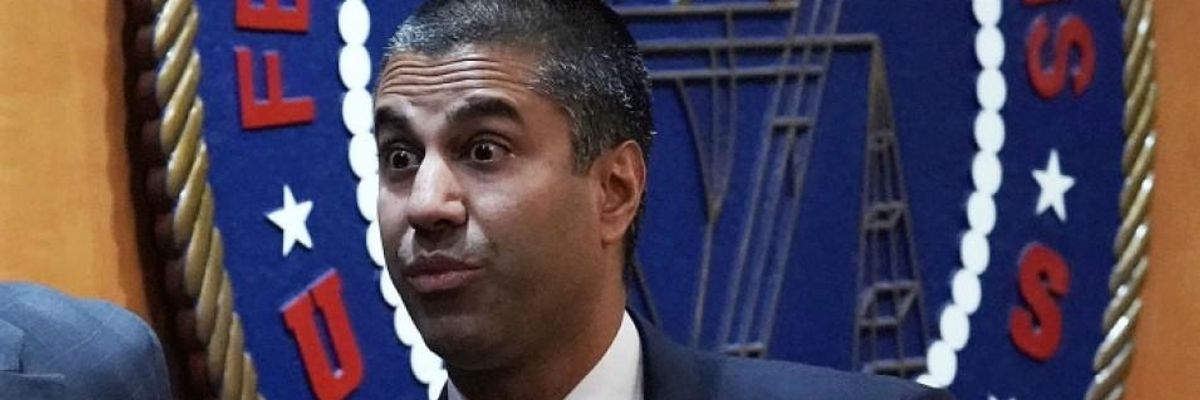
Federal Communications Commission Chairman Ajit Pai leaves a meeting Dec. 14, 2017 in Washington, D.C. (Photo: Alex Wong/Getty Images)
With a new lawsuit this week, the New York Times Co. has joined others in demanding the Federal Communications Commission, led by Republican chairman Ajit Pai, to stop stonewalling and come clean about the failures of the agency's commenting system during last year's fight over net neutrality rules.
The effort to force the FCC to hand over internal documents and data by the suit's plaintiffs, including NYT report Nicholas Confessore and investigations editor Gabriel Dance, was filed in the U.S. District Court for the Southern District of New York under the Freedom of Information Act (FOIA) on Thursday. The lawsuit claims Pai's commission has "thrown up a series of roadblocks" to prevent the newspaper from obtaining records which its journalists first requested in the summer of 2017.
While Pai originally claimed that the commenting system came under attack by a distributed denial of service (DDoS) attack, it was only recently--after an internal report refuted his narrative--that he finally admitted his claims were false.
According to Bloomberg, the New York Times lawsuit is, "seeking data, including IP addresses, time stamps and the FCC's internal web server logs, linked to public comments submitted to the agency."
Last week, responding to a separate FOIA request that ended up in court after the FCC refused to comply, a federal judge ruled on behalf of freelance journalist Jason Prechtel who also wanted access to the information related to the commenting system.
As Ars Technica reported:
Prechtel sought data that would identify people who made bulk comment uploads; many of the uploads contained fraudulent comments submitted in other people's names without their knowledge.
In his ruling in Prechtel's favor, Judge Christopher Cooper of the U.S. District Court for the District of Columbia ordered the FCC to hand over large portions, though not all, of the documents requested, stating, "In addition to enabling scrutiny of how the Commission handled dubious comments during the rulemaking, disclosure would illuminate the Commission's forward-looking efforts to prevent fraud in future processes."
In reaction, Prechtel called Cooper's ruling "a huge victory for transparency over an issue that has gone unanswered by the FCC and its current leadership for too long."
Net neutrality defenders agreed and critics of the FCC's handling of the entire issue called on Pai to immediately comply.
"My first question is: why is the FCC spending taxpayer dollars fighting journalists in court in order to keep this information secret in the first place? What are they hiding? Who are they covering for?" declared Evan Greer, the deputy director of Fight for the Future, following the ruling.
"Let's face it," Greer, "the FCC has lost all credibility since their alleged 'DDoS attack'' turned out to be an outright lie that they used to downplay the overwhelming opposition to their repeal of net neutrality. This court ruling is a solid step forward for the millions of Internet users and small business owners who took the time to submit real comments opposing the FCC's net neutrality repeal."
And, she concluded, "The FCC should comply with this court order immediately and release any and all information they have related to the fraud and abuse that they refused to address during the net neutrality public comment process."
Dear Common Dreams reader, It’s been nearly 30 years since I co-founded Common Dreams with my late wife, Lina Newhouser. We had the radical notion that journalism should serve the public good, not corporate profits. It was clear to us from the outset what it would take to build such a project. No paid advertisements. No corporate sponsors. No millionaire publisher telling us what to think or do. Many people said we wouldn't last a year, but we proved those doubters wrong. Together with a tremendous team of journalists and dedicated staff, we built an independent media outlet free from the constraints of profits and corporate control. Our mission has always been simple: To inform. To inspire. To ignite change for the common good. Building Common Dreams was not easy. Our survival was never guaranteed. When you take on the most powerful forces—Wall Street greed, fossil fuel industry destruction, Big Tech lobbyists, and uber-rich oligarchs who have spent billions upon billions rigging the economy and democracy in their favor—the only bulwark you have is supporters who believe in your work. But here’s the urgent message from me today. It's never been this bad out there. And it's never been this hard to keep us going. At the very moment Common Dreams is most needed, the threats we face are intensifying. We need your support now more than ever. We don't accept corporate advertising and never will. We don't have a paywall because we don't think people should be blocked from critical news based on their ability to pay. Everything we do is funded by the donations of readers like you. When everyone does the little they can afford, we are strong. But if that support retreats or dries up, so do we. Will you donate now to make sure Common Dreams not only survives but thrives? —Craig Brown, Co-founder |
With a new lawsuit this week, the New York Times Co. has joined others in demanding the Federal Communications Commission, led by Republican chairman Ajit Pai, to stop stonewalling and come clean about the failures of the agency's commenting system during last year's fight over net neutrality rules.
The effort to force the FCC to hand over internal documents and data by the suit's plaintiffs, including NYT report Nicholas Confessore and investigations editor Gabriel Dance, was filed in the U.S. District Court for the Southern District of New York under the Freedom of Information Act (FOIA) on Thursday. The lawsuit claims Pai's commission has "thrown up a series of roadblocks" to prevent the newspaper from obtaining records which its journalists first requested in the summer of 2017.
While Pai originally claimed that the commenting system came under attack by a distributed denial of service (DDoS) attack, it was only recently--after an internal report refuted his narrative--that he finally admitted his claims were false.
According to Bloomberg, the New York Times lawsuit is, "seeking data, including IP addresses, time stamps and the FCC's internal web server logs, linked to public comments submitted to the agency."
Last week, responding to a separate FOIA request that ended up in court after the FCC refused to comply, a federal judge ruled on behalf of freelance journalist Jason Prechtel who also wanted access to the information related to the commenting system.
As Ars Technica reported:
Prechtel sought data that would identify people who made bulk comment uploads; many of the uploads contained fraudulent comments submitted in other people's names without their knowledge.
In his ruling in Prechtel's favor, Judge Christopher Cooper of the U.S. District Court for the District of Columbia ordered the FCC to hand over large portions, though not all, of the documents requested, stating, "In addition to enabling scrutiny of how the Commission handled dubious comments during the rulemaking, disclosure would illuminate the Commission's forward-looking efforts to prevent fraud in future processes."
In reaction, Prechtel called Cooper's ruling "a huge victory for transparency over an issue that has gone unanswered by the FCC and its current leadership for too long."
Net neutrality defenders agreed and critics of the FCC's handling of the entire issue called on Pai to immediately comply.
"My first question is: why is the FCC spending taxpayer dollars fighting journalists in court in order to keep this information secret in the first place? What are they hiding? Who are they covering for?" declared Evan Greer, the deputy director of Fight for the Future, following the ruling.
"Let's face it," Greer, "the FCC has lost all credibility since their alleged 'DDoS attack'' turned out to be an outright lie that they used to downplay the overwhelming opposition to their repeal of net neutrality. This court ruling is a solid step forward for the millions of Internet users and small business owners who took the time to submit real comments opposing the FCC's net neutrality repeal."
And, she concluded, "The FCC should comply with this court order immediately and release any and all information they have related to the fraud and abuse that they refused to address during the net neutrality public comment process."
With a new lawsuit this week, the New York Times Co. has joined others in demanding the Federal Communications Commission, led by Republican chairman Ajit Pai, to stop stonewalling and come clean about the failures of the agency's commenting system during last year's fight over net neutrality rules.
The effort to force the FCC to hand over internal documents and data by the suit's plaintiffs, including NYT report Nicholas Confessore and investigations editor Gabriel Dance, was filed in the U.S. District Court for the Southern District of New York under the Freedom of Information Act (FOIA) on Thursday. The lawsuit claims Pai's commission has "thrown up a series of roadblocks" to prevent the newspaper from obtaining records which its journalists first requested in the summer of 2017.
While Pai originally claimed that the commenting system came under attack by a distributed denial of service (DDoS) attack, it was only recently--after an internal report refuted his narrative--that he finally admitted his claims were false.
According to Bloomberg, the New York Times lawsuit is, "seeking data, including IP addresses, time stamps and the FCC's internal web server logs, linked to public comments submitted to the agency."
Last week, responding to a separate FOIA request that ended up in court after the FCC refused to comply, a federal judge ruled on behalf of freelance journalist Jason Prechtel who also wanted access to the information related to the commenting system.
As Ars Technica reported:
Prechtel sought data that would identify people who made bulk comment uploads; many of the uploads contained fraudulent comments submitted in other people's names without their knowledge.
In his ruling in Prechtel's favor, Judge Christopher Cooper of the U.S. District Court for the District of Columbia ordered the FCC to hand over large portions, though not all, of the documents requested, stating, "In addition to enabling scrutiny of how the Commission handled dubious comments during the rulemaking, disclosure would illuminate the Commission's forward-looking efforts to prevent fraud in future processes."
In reaction, Prechtel called Cooper's ruling "a huge victory for transparency over an issue that has gone unanswered by the FCC and its current leadership for too long."
Net neutrality defenders agreed and critics of the FCC's handling of the entire issue called on Pai to immediately comply.
"My first question is: why is the FCC spending taxpayer dollars fighting journalists in court in order to keep this information secret in the first place? What are they hiding? Who are they covering for?" declared Evan Greer, the deputy director of Fight for the Future, following the ruling.
"Let's face it," Greer, "the FCC has lost all credibility since their alleged 'DDoS attack'' turned out to be an outright lie that they used to downplay the overwhelming opposition to their repeal of net neutrality. This court ruling is a solid step forward for the millions of Internet users and small business owners who took the time to submit real comments opposing the FCC's net neutrality repeal."
And, she concluded, "The FCC should comply with this court order immediately and release any and all information they have related to the fraud and abuse that they refused to address during the net neutrality public comment process."