

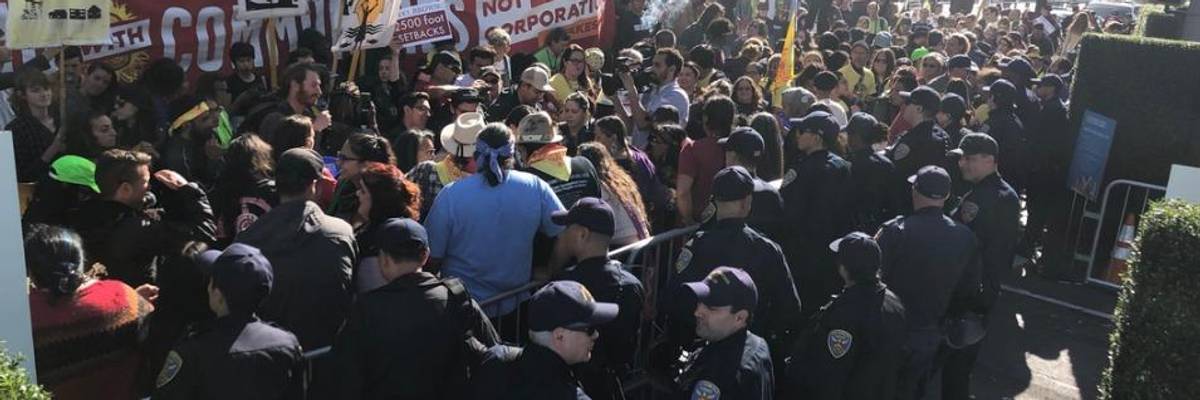
First Nations protesters protested on Thursday at the Global Climate Action Summit in San Francisco, arguing that national and international leaders are not going far enough to combat President Donald Trump's anti-climate agenda. (Photo: @AmyHollyfield/Twitter)
Calling for Genuine Leadership Over 'Climate Capitalism,' Protesters Demand Seat at the Table at Business-Friendly Climate Action Summit
"We are the solutions for this climate crisis, so we're here to protest in front of the summit that's on display for climate capitalism, essentially a trade show."
As political and business leaders convened in San Francisco this week for the Global Climate Action Summit, protesters assembled outside the city's Moscone Center on Thursday to denounce politicians and businesses for pushing an agenda that relies too heavily on corporate power and advances "climate capitalism"--instead of one that will truly solve the planterary crisis while representing the interests of the world's most vulnerable populations.
Chanting, "What do we want? Climate justice," hundreds of demonstrators--led by many indigenous and First Nations tribe members--attempted to stop Gov. Jerry Brown (D-Calif.) from entering the event. Those protesting demanded that he and other attendees work to end California's continued dependence on oil and gas production and end reliance on wealthy corporations for business-friendly solutions to the climate crisis--and turn instead to communities that are facing its effects head-on.
Speakers at the summit include Greenpeace International executive director Jennifer Morgan, Paris Mayor Anne Hidalgo, and National Resources Defense Council president Rhea Suh--but protesters objected to the inclusion of corporate leaders as well, while local community leaders have been left without a seat at the table.
"We have the solutions," Darryl Molina Sarmiento, executive director of California-based Communities for a Better Environment, told Earther. "We are the solutions for this climate crisis, so we're here to protest in front of the summit that's on display for climate capitalism, essentially a trade show. We want to lift up that communities are not for sale."
"Jerry Brown is not our climate leader. What we're doing in California is not genuine climate leadership." --Darryl Molina Sarmiento, Communities for a Better Environment
The summit is being held with the aim of promoting action to reduce carbon and other greenhouse gas emissions, in the face of President Donald Trump's aggressive efforts to roll back regulations the Obama administration imposed on coal companies, other fossil fuel industries, and vehicle manufacturers in order to curb emissions, as well as his withdrawal from the Paris climate agreement.
But while Brown signed a bill this week mandating that California move to 100 percent renewable energy by 2045 and has positioned his state as a leader in climate action, he has also overseen the issuing of tens of thousands of fossil fuel permits and nearly 70 percent of Californians living near oil and gas wells represent black and brown communities. Meanwhile, his solar panel mandate for new buildings largely leaves out those same groups, critics say.
"Jerry Brown is not our climate leader," Molina Sarmiento told Earther. "What we're doing in California is not genuine climate leadership. We have been able to make a lot of advances, but the way in which he's proposing these kinds of solutions is creating an increase in oil infrastructure locally."
Protesters say the summit is leaving out the voices of First Nations and other communities that live on the front lines of the battle to stop the climate crisis, in areas facing rising sea levels, extreme weather events, and the construction of fossil fuel-carrying pipelines that are being built on their land.
Will Tran of KRON reported Thursday morning that at least two protesters had been arrested so far.
"Communities have asked that we put our bodies on the line as a response to the tremendous injustice that's going to be played out for the planet and people on the inside of the Global Climate Action Summit," Angela Adrar, executive director of the Climate Justice Alliance, told Earther.
We are at a crossroads
This country and this world are at a monumental crossroads. In a few short weeks, US voters will have an opportunity to beat back the forces of fascism and confront the billionaires who are rigging the economy, our media system, and our democracy, making it increasingly impossible for ordinary people to get by. We’re not just talking about the election. We’re talking about what must be done once these fascist elements are vanquished from power. We need a bolder set of solutions than what either major party has so far been willing to offer and a working-class movement ready to fight like hell for it. Trump didn't emerge from nowhere. The conditions that fueled MAGA authoritarianism were created by decades of radical neoliberal economic policies and a corrupt political system dominated by corporate interests. They slashed taxes on the super-rich, promising that the benefits would trickle down. They said giveaways to the corporate titans would make life more affordable for the rest of us. It was all bullshit. And when a bitter, betrayed populace searches for someone to blame, right-wing demagogues have little trouble finding scapegoats. People know when they're being lied to, but you won't hear any of this from the corporate media. Only independent journalism—powered and funded by people who believe in building a better world—can deliver truly trustworthy daily news. Our Fall Campaign is underway, and we need your help. To power our newsroom through the rest of the year, we need to raise $125,000 by midnight on October 31. So if you share our vision, please contribute whatever you can to sustain our work. |
As political and business leaders convened in San Francisco this week for the Global Climate Action Summit, protesters assembled outside the city's Moscone Center on Thursday to denounce politicians and businesses for pushing an agenda that relies too heavily on corporate power and advances "climate capitalism"--instead of one that will truly solve the planterary crisis while representing the interests of the world's most vulnerable populations.
Chanting, "What do we want? Climate justice," hundreds of demonstrators--led by many indigenous and First Nations tribe members--attempted to stop Gov. Jerry Brown (D-Calif.) from entering the event. Those protesting demanded that he and other attendees work to end California's continued dependence on oil and gas production and end reliance on wealthy corporations for business-friendly solutions to the climate crisis--and turn instead to communities that are facing its effects head-on.
Speakers at the summit include Greenpeace International executive director Jennifer Morgan, Paris Mayor Anne Hidalgo, and National Resources Defense Council president Rhea Suh--but protesters objected to the inclusion of corporate leaders as well, while local community leaders have been left without a seat at the table.
"We have the solutions," Darryl Molina Sarmiento, executive director of California-based Communities for a Better Environment, told Earther. "We are the solutions for this climate crisis, so we're here to protest in front of the summit that's on display for climate capitalism, essentially a trade show. We want to lift up that communities are not for sale."
"Jerry Brown is not our climate leader. What we're doing in California is not genuine climate leadership." --Darryl Molina Sarmiento, Communities for a Better Environment
The summit is being held with the aim of promoting action to reduce carbon and other greenhouse gas emissions, in the face of President Donald Trump's aggressive efforts to roll back regulations the Obama administration imposed on coal companies, other fossil fuel industries, and vehicle manufacturers in order to curb emissions, as well as his withdrawal from the Paris climate agreement.
But while Brown signed a bill this week mandating that California move to 100 percent renewable energy by 2045 and has positioned his state as a leader in climate action, he has also overseen the issuing of tens of thousands of fossil fuel permits and nearly 70 percent of Californians living near oil and gas wells represent black and brown communities. Meanwhile, his solar panel mandate for new buildings largely leaves out those same groups, critics say.
"Jerry Brown is not our climate leader," Molina Sarmiento told Earther. "What we're doing in California is not genuine climate leadership. We have been able to make a lot of advances, but the way in which he's proposing these kinds of solutions is creating an increase in oil infrastructure locally."
Protesters say the summit is leaving out the voices of First Nations and other communities that live on the front lines of the battle to stop the climate crisis, in areas facing rising sea levels, extreme weather events, and the construction of fossil fuel-carrying pipelines that are being built on their land.
Will Tran of KRON reported Thursday morning that at least two protesters had been arrested so far.
"Communities have asked that we put our bodies on the line as a response to the tremendous injustice that's going to be played out for the planet and people on the inside of the Global Climate Action Summit," Angela Adrar, executive director of the Climate Justice Alliance, told Earther.