SUBSCRIBE TO OUR FREE NEWSLETTER
Daily news & progressive opinion—funded by the people, not the corporations—delivered straight to your inbox.
5
#000000
#FFFFFF
To donate by check, phone, or other method, see our More Ways to Give page.
Daily news & progressive opinion—funded by the people, not the corporations—delivered straight to your inbox.
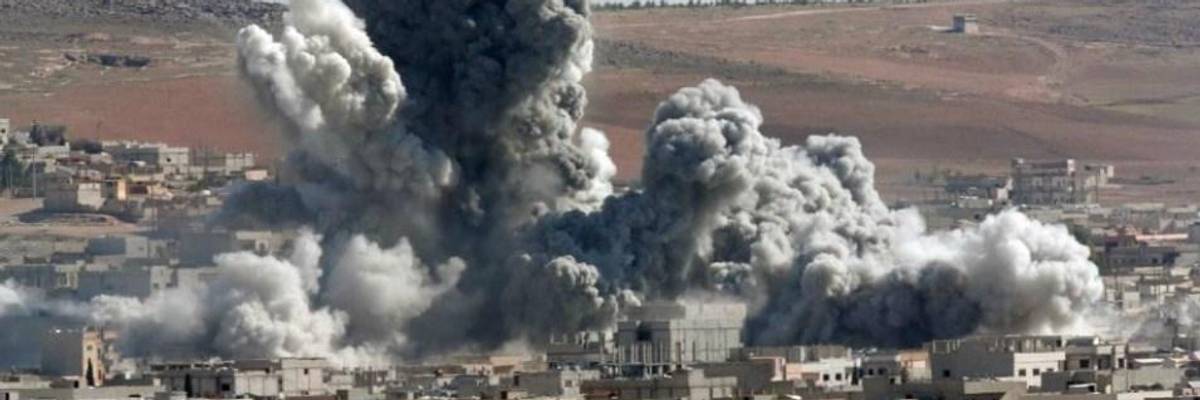
Thick smoke from an airstrike by the U.S.-led coalition rises in Kobani, Syria, as seen from a hilltop on the outskirts of Suruc, at the Turkey-Syria border. (Photo: Lefteris Pitarakis/AP)
Just months after proclaiming to the American public that U.S. soldiers will completely withdraw from Syria "very soon," President Donald Trump has reportedly agreed to a new strategy under which the more than 2,000 troops currently occupying the war-torn nation will remain "indefinitely."
"We have to force the United States to leave."
--Iranian President Hassan Rouhani
"The new policy is we're no longer pulling out by the end of the year," James Jeffrey, Secretary of State Mike Pompeo's representative for Syria engagement, told the Washington Post on Thursday. "That means we are not in a hurry."
To justify keeping American troops in Syria for an "indefinite" period of time, the Trump administration's new strategy redefines U.S. "objectives" in the country from "defeating ISIS" to ejecting all Iranian military forces and proxies from the country--despite the fact that Iran's presence in Syria, unlike America's, is at the invitation of the Syrian government.
In addition to attempting to expel Iranian forces, the Trump administration's new "strategy" in Syria will also consist of the "establishment of a stable, nonthreatening government acceptable to all Syrians and the international community," notes the Post.
While such an objective smacks of regime change, Jeffrey told the Post that U.S. policy is not that Syrian President Bashar al-Assad "must go."
"Assad has no future, but it's not our job to get rid of him," Jeffrey declared.
While Trump has not publicly called for regime change in Syria, Bob Woodward reports in his new book--citing "deep background" interviews with top administration officials--that the president last year ordered Defense Secretary James Mattis to "go in" to Syria and "fucking kill" Assad.
Trump's embrace of endless war in Syria was revealed just hours ahead of a high-stakes summit in Tehran on Friday between the presidents of Iran, Russia, and Turkey.
In remarks at the start of the meeting, Iranian President Hassan Rouhani demanded that American forces immediately withdraw from Syria if lasting peace is to be achieved.
"We have to force the United States to leave," Rouhani declared.
Rouhani's clear demand for American troops to completely exit Syria came just as U.S. Ambassador to the United Nations Nikki Haley warned during a U.N. Security Council meeting on Friday that Assad will face "dire consequences" if he launches an assault on Idlib province, one of the last areas controlled by Syrian rebels.
Further heightening the risk of dangerous escalation, the U.S. carried out a military exercise in southeastern Syria on Friday that, according to the military, included a "live-fire rehearsal" and an "aerial assault."
Progressive anti-war activists and commentators warned throughout the Obama years and during Trump's presidency that the U.S. strategy in Syria was a slippery slope that would inevitably lead to ever-increasing engagement in a complex conflict and fuel perpetual war.
In a Twitter thread breaking down the Trump administration's new Syria objectives on Friday, Emma Ashford--a foreign policy research fellow at the Cato Institute--argued that the White House's plan is "not a strategy."
"It's totally unrealistic. We might as well ask for a pet unicorn," Ashford concluded. "In short, the Trump administration appears poised to commit us to a costly, unnecessary years-long committment in Syria. Only the justification is different: rather than the idea of stabilization, it's the Iranian bogeyman. And the goals are so vague, mission creep is assured."
This country and this world are at a monumental crossroads. US voters have an opportunity to beat back the forces of fascism and confront the billionaires who are rigging the economy, our media system, and our democracy, making it increasingly impossible for ordinary people to get by. We’re not just talking about the election. We’re talking about what must be done once these fascist elements are vanquished from power. We need a bolder set of solutions than what either major party has so far been willing to offer and a working-class movement ready to fight like hell for it. Trump didn't emerge from nowhere. The conditions that fueled MAGA authoritarianism were created by decades of radical neoliberal economic policies and a corrupt political system dominated by corporate interests. They slashed taxes on the super-rich, promising that the benefits would trickle down. They said giveaways to the corporate titans would make life more affordable for the rest of us. It was all bullshit. And when a bitter, betrayed populace searches for someone to blame, right-wing demagogues have little trouble finding scapegoats. People know when they're being lied to, but you won't hear any of this from the corporate media. Only independent journalism—powered and funded by people who believe in building a better world—can deliver truly trustworthy daily news. If you share our vision, please contribute whatever you can to sustain our work. |
Just months after proclaiming to the American public that U.S. soldiers will completely withdraw from Syria "very soon," President Donald Trump has reportedly agreed to a new strategy under which the more than 2,000 troops currently occupying the war-torn nation will remain "indefinitely."
"We have to force the United States to leave."
--Iranian President Hassan Rouhani
"The new policy is we're no longer pulling out by the end of the year," James Jeffrey, Secretary of State Mike Pompeo's representative for Syria engagement, told the Washington Post on Thursday. "That means we are not in a hurry."
To justify keeping American troops in Syria for an "indefinite" period of time, the Trump administration's new strategy redefines U.S. "objectives" in the country from "defeating ISIS" to ejecting all Iranian military forces and proxies from the country--despite the fact that Iran's presence in Syria, unlike America's, is at the invitation of the Syrian government.
In addition to attempting to expel Iranian forces, the Trump administration's new "strategy" in Syria will also consist of the "establishment of a stable, nonthreatening government acceptable to all Syrians and the international community," notes the Post.
While such an objective smacks of regime change, Jeffrey told the Post that U.S. policy is not that Syrian President Bashar al-Assad "must go."
"Assad has no future, but it's not our job to get rid of him," Jeffrey declared.
While Trump has not publicly called for regime change in Syria, Bob Woodward reports in his new book--citing "deep background" interviews with top administration officials--that the president last year ordered Defense Secretary James Mattis to "go in" to Syria and "fucking kill" Assad.
Trump's embrace of endless war in Syria was revealed just hours ahead of a high-stakes summit in Tehran on Friday between the presidents of Iran, Russia, and Turkey.
In remarks at the start of the meeting, Iranian President Hassan Rouhani demanded that American forces immediately withdraw from Syria if lasting peace is to be achieved.
"We have to force the United States to leave," Rouhani declared.
Rouhani's clear demand for American troops to completely exit Syria came just as U.S. Ambassador to the United Nations Nikki Haley warned during a U.N. Security Council meeting on Friday that Assad will face "dire consequences" if he launches an assault on Idlib province, one of the last areas controlled by Syrian rebels.
Further heightening the risk of dangerous escalation, the U.S. carried out a military exercise in southeastern Syria on Friday that, according to the military, included a "live-fire rehearsal" and an "aerial assault."
Progressive anti-war activists and commentators warned throughout the Obama years and during Trump's presidency that the U.S. strategy in Syria was a slippery slope that would inevitably lead to ever-increasing engagement in a complex conflict and fuel perpetual war.
In a Twitter thread breaking down the Trump administration's new Syria objectives on Friday, Emma Ashford--a foreign policy research fellow at the Cato Institute--argued that the White House's plan is "not a strategy."
"It's totally unrealistic. We might as well ask for a pet unicorn," Ashford concluded. "In short, the Trump administration appears poised to commit us to a costly, unnecessary years-long committment in Syria. Only the justification is different: rather than the idea of stabilization, it's the Iranian bogeyman. And the goals are so vague, mission creep is assured."