SUBSCRIBE TO OUR FREE NEWSLETTER
Daily news & progressive opinion—funded by the people, not the corporations—delivered straight to your inbox.
5
#000000
#FFFFFF
To donate by check, phone, or other method, see our More Ways to Give page.
"How much perjury is too much perjury from a Supreme Court nominee?"
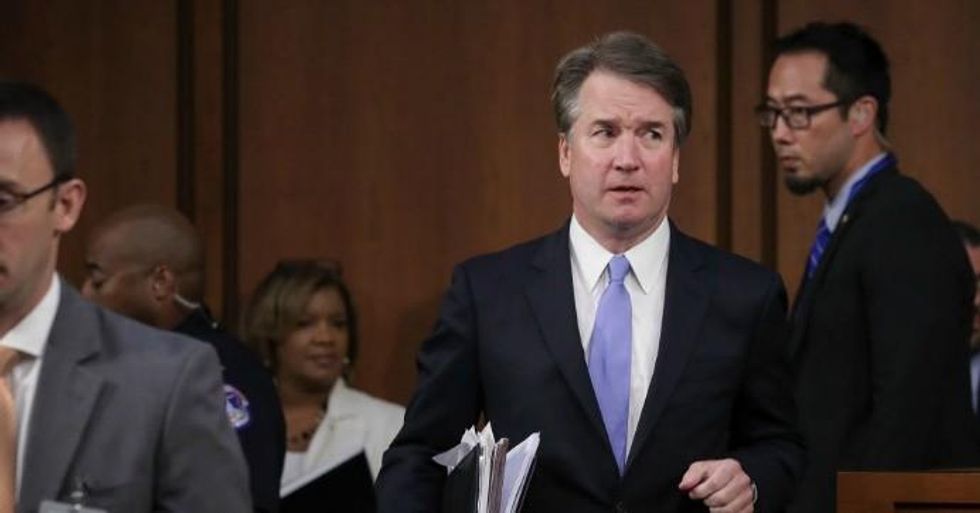
That was how one commentator responded to a flurry of new documents and emails released on Thursday by Sens. Dianne Feinstein (D-Calif.) and Patrick Leahy (D-Vt.) that appear to show President Donald Trump's Supreme Court pick Brett Kavanaugh lied under oath during hearings for his nomination to the U.S. Court of Appeals in 2004 and 2006.
"Simply put, Kavanaugh committed perjury."
--Matt McDermottIn 2004--after a Senate sergeant-at-arms report found that Republican staffer Manuel Miranda had stolen confidential communications and documents from Democratic senators--Kavanaugh told the Senate that he never received "documents that appeared...to have been drafted or prepared by Democratic staff members."
But new emails made public by Leahy on Thursday appear to show that Kavanaugh "got 8 pages of material taken verbatim from [the Vermont senator's] files, obviously written by Dem staff, labeled 'not [for] distribution." The stolen material detailed Democrats' efforts to oppose President George W. Bush's judicial nominees.
During Wednesday's confirmation hearing, Leahy confronted Kavanaugh over the apparent contradiction between these emails and the judge's 2004 testimony, but Leahy said he was not permitted to make the emails public because they were deemed "committee confidential."
The documents were released on Thursday, however, and they show that Kavanaugh received an email that detailed information gathered by a "mole for us on the left"--an indication that the information was acquired improperly.
"Kavanaugh committed perjury, [Iowa Sen. Chuck] Grassley knows that he committed perjury, and tried to keep the proof of Kavanaugh's commission of perjury confidential," noted Dante Atkins, communications director for Rep. John Garamendi (D-Calif.). "This is horrid and unconscionable."
"It is simply not 'normal' to get real-time insider intelligence from a Democratic 'mole' and marked 'spying.' Red flags abound," Leahy wrote. "And with 102,000 documents withheld by the Trump White House, mostly about judicial nominees, we can bet there's more."
"Judge Kavanaugh answered under oath more than 100 questions on this hacking in 2004 and 2006," Leahy added. "His repeated denials that he didn't receive any stolen info and didn't suspect anything 'untoward' is SIMPLY NOT CREDIBLE."
Just minutes before Leahy posted the batch of emails related to stolen Democratic materials, Sen. Feinstein pointed to Kavanaugh's claim under oath in 2004 that he "was not involved in handling" the nomination of anti-Roe v. Wade Appeals Court Judge Bill Pryor in 2003 and argued that new emails prove that assertion was false.
"Newly released emails show that's not true," Feinstein tweeted on Thursday. "Asked about how Pryor's interview went, he replied, 'call me.'"
"Simply put, Kavanaugh committed perjury," political analyst Matt McDermott wrote in response to Feinstein's tweet.
Ian Millhiser, justice editor at ThinkProgress, added that given all of the possible cases of perjury that have been uncovered by Senate Democrats, "Maybe there's a reason Senate Republicans tried to keep Kavanaugh's emails secret?"
Judd Legum, author of the Popular Information newsletter, argued that the stolen Democratic materials and the Pryor nomination are just two of four topics "where Kavanaugh appeared to commit perjury."
"How much perjury is too much perjury from a Supreme Court nominee?"
That was how one commentator responded to a flurry of new documents and emails released on Thursday by Sens. Dianne Feinstein (D-Calif.) and Patrick Leahy (D-Vt.) that appear to show President Donald Trump's Supreme Court pick Brett Kavanaugh lied under oath during hearings for his nomination to the U.S. Court of Appeals in 2004 and 2006.
"Simply put, Kavanaugh committed perjury."
--Matt McDermottIn 2004--after a Senate sergeant-at-arms report found that Republican staffer Manuel Miranda had stolen confidential communications and documents from Democratic senators--Kavanaugh told the Senate that he never received "documents that appeared...to have been drafted or prepared by Democratic staff members."
But new emails made public by Leahy on Thursday appear to show that Kavanaugh "got 8 pages of material taken verbatim from [the Vermont senator's] files, obviously written by Dem staff, labeled 'not [for] distribution." The stolen material detailed Democrats' efforts to oppose President George W. Bush's judicial nominees.
During Wednesday's confirmation hearing, Leahy confronted Kavanaugh over the apparent contradiction between these emails and the judge's 2004 testimony, but Leahy said he was not permitted to make the emails public because they were deemed "committee confidential."
The documents were released on Thursday, however, and they show that Kavanaugh received an email that detailed information gathered by a "mole for us on the left"--an indication that the information was acquired improperly.
"Kavanaugh committed perjury, [Iowa Sen. Chuck] Grassley knows that he committed perjury, and tried to keep the proof of Kavanaugh's commission of perjury confidential," noted Dante Atkins, communications director for Rep. John Garamendi (D-Calif.). "This is horrid and unconscionable."
"It is simply not 'normal' to get real-time insider intelligence from a Democratic 'mole' and marked 'spying.' Red flags abound," Leahy wrote. "And with 102,000 documents withheld by the Trump White House, mostly about judicial nominees, we can bet there's more."
"Judge Kavanaugh answered under oath more than 100 questions on this hacking in 2004 and 2006," Leahy added. "His repeated denials that he didn't receive any stolen info and didn't suspect anything 'untoward' is SIMPLY NOT CREDIBLE."
Just minutes before Leahy posted the batch of emails related to stolen Democratic materials, Sen. Feinstein pointed to Kavanaugh's claim under oath in 2004 that he "was not involved in handling" the nomination of anti-Roe v. Wade Appeals Court Judge Bill Pryor in 2003 and argued that new emails prove that assertion was false.
"Newly released emails show that's not true," Feinstein tweeted on Thursday. "Asked about how Pryor's interview went, he replied, 'call me.'"
"Simply put, Kavanaugh committed perjury," political analyst Matt McDermott wrote in response to Feinstein's tweet.
Ian Millhiser, justice editor at ThinkProgress, added that given all of the possible cases of perjury that have been uncovered by Senate Democrats, "Maybe there's a reason Senate Republicans tried to keep Kavanaugh's emails secret?"
Judd Legum, author of the Popular Information newsletter, argued that the stolen Democratic materials and the Pryor nomination are just two of four topics "where Kavanaugh appeared to commit perjury."
"How much perjury is too much perjury from a Supreme Court nominee?"
That was how one commentator responded to a flurry of new documents and emails released on Thursday by Sens. Dianne Feinstein (D-Calif.) and Patrick Leahy (D-Vt.) that appear to show President Donald Trump's Supreme Court pick Brett Kavanaugh lied under oath during hearings for his nomination to the U.S. Court of Appeals in 2004 and 2006.
"Simply put, Kavanaugh committed perjury."
--Matt McDermottIn 2004--after a Senate sergeant-at-arms report found that Republican staffer Manuel Miranda had stolen confidential communications and documents from Democratic senators--Kavanaugh told the Senate that he never received "documents that appeared...to have been drafted or prepared by Democratic staff members."
But new emails made public by Leahy on Thursday appear to show that Kavanaugh "got 8 pages of material taken verbatim from [the Vermont senator's] files, obviously written by Dem staff, labeled 'not [for] distribution." The stolen material detailed Democrats' efforts to oppose President George W. Bush's judicial nominees.
During Wednesday's confirmation hearing, Leahy confronted Kavanaugh over the apparent contradiction between these emails and the judge's 2004 testimony, but Leahy said he was not permitted to make the emails public because they were deemed "committee confidential."
The documents were released on Thursday, however, and they show that Kavanaugh received an email that detailed information gathered by a "mole for us on the left"--an indication that the information was acquired improperly.
"Kavanaugh committed perjury, [Iowa Sen. Chuck] Grassley knows that he committed perjury, and tried to keep the proof of Kavanaugh's commission of perjury confidential," noted Dante Atkins, communications director for Rep. John Garamendi (D-Calif.). "This is horrid and unconscionable."
"It is simply not 'normal' to get real-time insider intelligence from a Democratic 'mole' and marked 'spying.' Red flags abound," Leahy wrote. "And with 102,000 documents withheld by the Trump White House, mostly about judicial nominees, we can bet there's more."
"Judge Kavanaugh answered under oath more than 100 questions on this hacking in 2004 and 2006," Leahy added. "His repeated denials that he didn't receive any stolen info and didn't suspect anything 'untoward' is SIMPLY NOT CREDIBLE."
Just minutes before Leahy posted the batch of emails related to stolen Democratic materials, Sen. Feinstein pointed to Kavanaugh's claim under oath in 2004 that he "was not involved in handling" the nomination of anti-Roe v. Wade Appeals Court Judge Bill Pryor in 2003 and argued that new emails prove that assertion was false.
"Newly released emails show that's not true," Feinstein tweeted on Thursday. "Asked about how Pryor's interview went, he replied, 'call me.'"
"Simply put, Kavanaugh committed perjury," political analyst Matt McDermott wrote in response to Feinstein's tweet.
Ian Millhiser, justice editor at ThinkProgress, added that given all of the possible cases of perjury that have been uncovered by Senate Democrats, "Maybe there's a reason Senate Republicans tried to keep Kavanaugh's emails secret?"
Judd Legum, author of the Popular Information newsletter, argued that the stolen Democratic materials and the Pryor nomination are just two of four topics "where Kavanaugh appeared to commit perjury."