SUBSCRIBE TO OUR FREE NEWSLETTER
Daily news & progressive opinion—funded by the people, not the corporations—delivered straight to your inbox.
5
#000000
#FFFFFF
To donate by check, phone, or other method, see our More Ways to Give page.
Daily news & progressive opinion—funded by the people, not the corporations—delivered straight to your inbox.
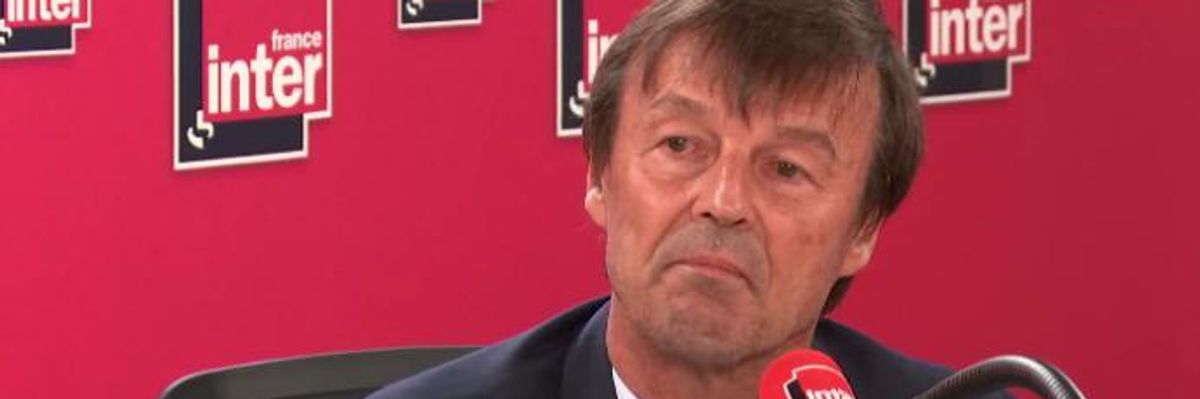
Nicolas Hulot resigned from his position as France's environment minister during a live radio show on Tuesday. (Photo: France Inter/YouTube)
Delivering a broad critique of how the French government of President Emmanuel Macron has failed to go far enough to address the global climate crisis and related issues, the nation's popular environment minister Nicolas Hulot announced his resignation on live radio Tuesday, declaring, "I don't want to lie to myself anymore."
"I don't want to give the illusion that my presence in government means that we meet the standards on these issues, so I'm taking the decision to leave the government," said Hulot, to which the France Inter radio hosts responded, "Are you serious?" He was, indeed.
"We strive to maintain an economic model that is responsible for all these climatic disorders," charged Hulot, who has been described one of the public's favorite cabinet members and "France's best-known environmentalist" as the former host of a television program.
"Have we starting to reduce the use of pesticides? The answer is no. Have we started to stop the erosion of biodiversity, the answer is no," he continued. "We're taking little steps, and France is doing a lot more than other countries, but are little steps enough? ...The answer is no."
The former minister called the move "the most difficult decision of my life," and explained that he made up his mind "throughout the summer," citing "an accumulation of disappointments" and feeling "all alone in pushing" for improvements in environmental policy. As the Guardian reported:
Hulot announced his departure after the government said it would relax hunting laws, a measure aimed at boosting Macron's appeal in rural areas, but seen by environmentalists as caving in to the powerful hunting lobby.
Under the changes, hunting licences would be cheaper and more species could be shot, sparking outrage among campaigners for the protection of birds. Hulot said lobbies had too much power over the French government.
Hulot's differences with the government had been exposed in recent months. He had been disappointed when the government backtracked on a target to reduce reliance on nuclear power to 50 percentt of the country's energy mix by 2025.
He had also sought a legal ban on the controversial weedkiller glyphosate but was overruled by the agriculture ministry, which preferred negotiating directly with farmers and industry.
EuroNews pointed out that "having the popular personality in his cabinet was a triumph for Emmanuel Macron, which scored the new leader instant green credentials," but "12 months on, environmentalists were starting to question Hulot's role and the government's commitment to the cause."
Hulot's unanticipated departure, the Guardian noted, is "a major blow to Macron and calls into question the president's credibility on the environment." The ex-minister said on the radio show that he did not warn Macron or Prime Minister Edouard Philippe prior to his announcement, which a government spokesperson quickly ridiculed as a disregard for "the most basic courtesy."
Although Macron has received praise for some small moves--such as the "Make Our Planet Great Again" grants that came in response to President Donald Trump's decision to ditch the Paris climate accord--as Juliette Legendre wrote for Foreign Policy In Focus in June, Macron's first year in office "has proven that he is...an old-fashioned, right-leaning neoliberal determined to overhaul France's hard-won social model under the guise of modernism and emancipation."
Macron had "made some fine speeches" and stood up to Trump on climate issues, Greenpeace France director Jean-Francois Julliard told Reuters, but he has "never turned these words to concrete action" at home.
"There is still no energy transition policy in France," she said.
Dear Common Dreams reader, It’s been nearly 30 years since I co-founded Common Dreams with my late wife, Lina Newhouser. We had the radical notion that journalism should serve the public good, not corporate profits. It was clear to us from the outset what it would take to build such a project. No paid advertisements. No corporate sponsors. No millionaire publisher telling us what to think or do. Many people said we wouldn't last a year, but we proved those doubters wrong. Together with a tremendous team of journalists and dedicated staff, we built an independent media outlet free from the constraints of profits and corporate control. Our mission has always been simple: To inform. To inspire. To ignite change for the common good. Building Common Dreams was not easy. Our survival was never guaranteed. When you take on the most powerful forces—Wall Street greed, fossil fuel industry destruction, Big Tech lobbyists, and uber-rich oligarchs who have spent billions upon billions rigging the economy and democracy in their favor—the only bulwark you have is supporters who believe in your work. But here’s the urgent message from me today. It's never been this bad out there. And it's never been this hard to keep us going. At the very moment Common Dreams is most needed, the threats we face are intensifying. We need your support now more than ever. We don't accept corporate advertising and never will. We don't have a paywall because we don't think people should be blocked from critical news based on their ability to pay. Everything we do is funded by the donations of readers like you. When everyone does the little they can afford, we are strong. But if that support retreats or dries up, so do we. Will you donate now to make sure Common Dreams not only survives but thrives? —Craig Brown, Co-founder |
Delivering a broad critique of how the French government of President Emmanuel Macron has failed to go far enough to address the global climate crisis and related issues, the nation's popular environment minister Nicolas Hulot announced his resignation on live radio Tuesday, declaring, "I don't want to lie to myself anymore."
"I don't want to give the illusion that my presence in government means that we meet the standards on these issues, so I'm taking the decision to leave the government," said Hulot, to which the France Inter radio hosts responded, "Are you serious?" He was, indeed.
"We strive to maintain an economic model that is responsible for all these climatic disorders," charged Hulot, who has been described one of the public's favorite cabinet members and "France's best-known environmentalist" as the former host of a television program.
"Have we starting to reduce the use of pesticides? The answer is no. Have we started to stop the erosion of biodiversity, the answer is no," he continued. "We're taking little steps, and France is doing a lot more than other countries, but are little steps enough? ...The answer is no."
The former minister called the move "the most difficult decision of my life," and explained that he made up his mind "throughout the summer," citing "an accumulation of disappointments" and feeling "all alone in pushing" for improvements in environmental policy. As the Guardian reported:
Hulot announced his departure after the government said it would relax hunting laws, a measure aimed at boosting Macron's appeal in rural areas, but seen by environmentalists as caving in to the powerful hunting lobby.
Under the changes, hunting licences would be cheaper and more species could be shot, sparking outrage among campaigners for the protection of birds. Hulot said lobbies had too much power over the French government.
Hulot's differences with the government had been exposed in recent months. He had been disappointed when the government backtracked on a target to reduce reliance on nuclear power to 50 percentt of the country's energy mix by 2025.
He had also sought a legal ban on the controversial weedkiller glyphosate but was overruled by the agriculture ministry, which preferred negotiating directly with farmers and industry.
EuroNews pointed out that "having the popular personality in his cabinet was a triumph for Emmanuel Macron, which scored the new leader instant green credentials," but "12 months on, environmentalists were starting to question Hulot's role and the government's commitment to the cause."
Hulot's unanticipated departure, the Guardian noted, is "a major blow to Macron and calls into question the president's credibility on the environment." The ex-minister said on the radio show that he did not warn Macron or Prime Minister Edouard Philippe prior to his announcement, which a government spokesperson quickly ridiculed as a disregard for "the most basic courtesy."
Although Macron has received praise for some small moves--such as the "Make Our Planet Great Again" grants that came in response to President Donald Trump's decision to ditch the Paris climate accord--as Juliette Legendre wrote for Foreign Policy In Focus in June, Macron's first year in office "has proven that he is...an old-fashioned, right-leaning neoliberal determined to overhaul France's hard-won social model under the guise of modernism and emancipation."
Macron had "made some fine speeches" and stood up to Trump on climate issues, Greenpeace France director Jean-Francois Julliard told Reuters, but he has "never turned these words to concrete action" at home.
"There is still no energy transition policy in France," she said.
Delivering a broad critique of how the French government of President Emmanuel Macron has failed to go far enough to address the global climate crisis and related issues, the nation's popular environment minister Nicolas Hulot announced his resignation on live radio Tuesday, declaring, "I don't want to lie to myself anymore."
"I don't want to give the illusion that my presence in government means that we meet the standards on these issues, so I'm taking the decision to leave the government," said Hulot, to which the France Inter radio hosts responded, "Are you serious?" He was, indeed.
"We strive to maintain an economic model that is responsible for all these climatic disorders," charged Hulot, who has been described one of the public's favorite cabinet members and "France's best-known environmentalist" as the former host of a television program.
"Have we starting to reduce the use of pesticides? The answer is no. Have we started to stop the erosion of biodiversity, the answer is no," he continued. "We're taking little steps, and France is doing a lot more than other countries, but are little steps enough? ...The answer is no."
The former minister called the move "the most difficult decision of my life," and explained that he made up his mind "throughout the summer," citing "an accumulation of disappointments" and feeling "all alone in pushing" for improvements in environmental policy. As the Guardian reported:
Hulot announced his departure after the government said it would relax hunting laws, a measure aimed at boosting Macron's appeal in rural areas, but seen by environmentalists as caving in to the powerful hunting lobby.
Under the changes, hunting licences would be cheaper and more species could be shot, sparking outrage among campaigners for the protection of birds. Hulot said lobbies had too much power over the French government.
Hulot's differences with the government had been exposed in recent months. He had been disappointed when the government backtracked on a target to reduce reliance on nuclear power to 50 percentt of the country's energy mix by 2025.
He had also sought a legal ban on the controversial weedkiller glyphosate but was overruled by the agriculture ministry, which preferred negotiating directly with farmers and industry.
EuroNews pointed out that "having the popular personality in his cabinet was a triumph for Emmanuel Macron, which scored the new leader instant green credentials," but "12 months on, environmentalists were starting to question Hulot's role and the government's commitment to the cause."
Hulot's unanticipated departure, the Guardian noted, is "a major blow to Macron and calls into question the president's credibility on the environment." The ex-minister said on the radio show that he did not warn Macron or Prime Minister Edouard Philippe prior to his announcement, which a government spokesperson quickly ridiculed as a disregard for "the most basic courtesy."
Although Macron has received praise for some small moves--such as the "Make Our Planet Great Again" grants that came in response to President Donald Trump's decision to ditch the Paris climate accord--as Juliette Legendre wrote for Foreign Policy In Focus in June, Macron's first year in office "has proven that he is...an old-fashioned, right-leaning neoliberal determined to overhaul France's hard-won social model under the guise of modernism and emancipation."
Macron had "made some fine speeches" and stood up to Trump on climate issues, Greenpeace France director Jean-Francois Julliard told Reuters, but he has "never turned these words to concrete action" at home.
"There is still no energy transition policy in France," she said.