SUBSCRIBE TO OUR FREE NEWSLETTER
Daily news & progressive opinion—funded by the people, not the corporations—delivered straight to your inbox.
5
#000000
#FFFFFF
To donate by check, phone, or other method, see our More Ways to Give page.
Daily news & progressive opinion—funded by the people, not the corporations—delivered straight to your inbox.
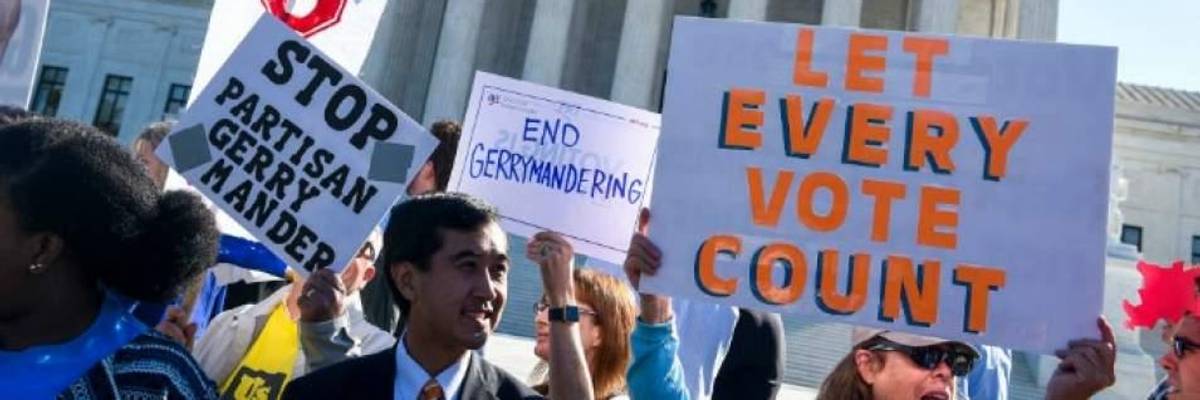
Protesters hold signs during a rally to call for 'An End to Partisan Gerrymandering' at the Supreme Court of the United States on October 3, 2017 in Washington, DC. (Photo: Leigh Vogel/Getty Images)
In a victory for voting rights, a panel of federal judges ruled Monday that North Carolina's congressional map was unconstitutionally gerrymandered by Republican lawmakers and indicated that the GOP-controlled legislature should not be trusted to redraw the map--a task that could be undertaken before the November midterms, likely weakening the Republicans' hold on the U.S. House.
The ruling was celebrated by watchdog group Common Cause, which sued the state Republicans over the map, and other voting rights advocates--but came as no surprise in a state where Republican legislators had openly admitted to drawing congressional districts in order to favor their own party.
"Common Cause and our partners in this lawsuit took the fight to politicians who manipulate our democracy and we won," said Common Cause President Karen Hobert Flynn, in a statement.
Journalist Ari Berman, an expert on Republican efforts to disenfranchise voters, called the ruling a "big victory for voting rights."
Should the state Assembly appeal the decision, the case will go directly to the U.S. Supreme Court, with voting rights groups hopeful that the nation's top judges would once and for all end politicians' practice of drawing congressional districts to maintain their own power.
"Until we prohibit partisan gerrymandering, a true representative democracy will remain out of reach, and the voices of all Americans will continue to be silent." --Kathay Feng, Common Cause"We anticipate an appeal and are ready to turn legislators' brazen partisan gerrymander into a historic ruling in the Supreme Court to end the practice nationwide," said Hobart Flynn.
Republican State Rep. David Lewis told the North Carolina General Assembly in 2016, "I think electing Republicans is better than electing Democrats. So I drew this map to help foster what I think is better for the country."
With this in mind, Judge James A. Wynn Jr., speaking for the three-judge district court panel, suggested that a court-appointed expert could be asked to quickly draw new districts before the November midterms, a move that would have major implications regarding control of the U.S. House.
After the map is redrawn, according to this explainer by the Charlotte Observer, the state could hold general elections without party primaries or hold the November elections as a primary, moving the general election to a later date.
"We continue to lament that North Carolina voters now have been deprived of a constitutional congressional districting plan--and, therefore, constitutional representation in Congress--for six years and three election cycles," Wynn wrote. "To the extent allowing the General Assembly another opportunity to draw a remedial plan would further delay electing representatives under a constitutional districting plan, that delay weighs heavily against giving the General Assembly another such opportunity."
In 2016, a federal court struck down the state's 2011 congressional map after determining it was racially gerrymandered. But the new map that resulted from that decision was barely changed, with lawmakers like Lewis simply stating that they had resorted to partisan gerrymandering.
"Although North Carolina's loud and proud admission that legislators drew districts for partisan advantage is unusual, the practice is universal when politicians are in charge," said Common Cause national redistricting director Kathay Feng. "Until we prohibit partisan gerrymandering, a true representative democracy will remain out of reach, and the voices of all Americans will continue to be silent."
Dear Common Dreams reader, It’s been nearly 30 years since I co-founded Common Dreams with my late wife, Lina Newhouser. We had the radical notion that journalism should serve the public good, not corporate profits. It was clear to us from the outset what it would take to build such a project. No paid advertisements. No corporate sponsors. No millionaire publisher telling us what to think or do. Many people said we wouldn't last a year, but we proved those doubters wrong. Together with a tremendous team of journalists and dedicated staff, we built an independent media outlet free from the constraints of profits and corporate control. Our mission has always been simple: To inform. To inspire. To ignite change for the common good. Building Common Dreams was not easy. Our survival was never guaranteed. When you take on the most powerful forces—Wall Street greed, fossil fuel industry destruction, Big Tech lobbyists, and uber-rich oligarchs who have spent billions upon billions rigging the economy and democracy in their favor—the only bulwark you have is supporters who believe in your work. But here’s the urgent message from me today. It's never been this bad out there. And it's never been this hard to keep us going. At the very moment Common Dreams is most needed, the threats we face are intensifying. We need your support now more than ever. We don't accept corporate advertising and never will. We don't have a paywall because we don't think people should be blocked from critical news based on their ability to pay. Everything we do is funded by the donations of readers like you. When everyone does the little they can afford, we are strong. But if that support retreats or dries up, so do we. Will you donate now to make sure Common Dreams not only survives but thrives? —Craig Brown, Co-founder |
In a victory for voting rights, a panel of federal judges ruled Monday that North Carolina's congressional map was unconstitutionally gerrymandered by Republican lawmakers and indicated that the GOP-controlled legislature should not be trusted to redraw the map--a task that could be undertaken before the November midterms, likely weakening the Republicans' hold on the U.S. House.
The ruling was celebrated by watchdog group Common Cause, which sued the state Republicans over the map, and other voting rights advocates--but came as no surprise in a state where Republican legislators had openly admitted to drawing congressional districts in order to favor their own party.
"Common Cause and our partners in this lawsuit took the fight to politicians who manipulate our democracy and we won," said Common Cause President Karen Hobert Flynn, in a statement.
Journalist Ari Berman, an expert on Republican efforts to disenfranchise voters, called the ruling a "big victory for voting rights."
Should the state Assembly appeal the decision, the case will go directly to the U.S. Supreme Court, with voting rights groups hopeful that the nation's top judges would once and for all end politicians' practice of drawing congressional districts to maintain their own power.
"Until we prohibit partisan gerrymandering, a true representative democracy will remain out of reach, and the voices of all Americans will continue to be silent." --Kathay Feng, Common Cause"We anticipate an appeal and are ready to turn legislators' brazen partisan gerrymander into a historic ruling in the Supreme Court to end the practice nationwide," said Hobart Flynn.
Republican State Rep. David Lewis told the North Carolina General Assembly in 2016, "I think electing Republicans is better than electing Democrats. So I drew this map to help foster what I think is better for the country."
With this in mind, Judge James A. Wynn Jr., speaking for the three-judge district court panel, suggested that a court-appointed expert could be asked to quickly draw new districts before the November midterms, a move that would have major implications regarding control of the U.S. House.
After the map is redrawn, according to this explainer by the Charlotte Observer, the state could hold general elections without party primaries or hold the November elections as a primary, moving the general election to a later date.
"We continue to lament that North Carolina voters now have been deprived of a constitutional congressional districting plan--and, therefore, constitutional representation in Congress--for six years and three election cycles," Wynn wrote. "To the extent allowing the General Assembly another opportunity to draw a remedial plan would further delay electing representatives under a constitutional districting plan, that delay weighs heavily against giving the General Assembly another such opportunity."
In 2016, a federal court struck down the state's 2011 congressional map after determining it was racially gerrymandered. But the new map that resulted from that decision was barely changed, with lawmakers like Lewis simply stating that they had resorted to partisan gerrymandering.
"Although North Carolina's loud and proud admission that legislators drew districts for partisan advantage is unusual, the practice is universal when politicians are in charge," said Common Cause national redistricting director Kathay Feng. "Until we prohibit partisan gerrymandering, a true representative democracy will remain out of reach, and the voices of all Americans will continue to be silent."
In a victory for voting rights, a panel of federal judges ruled Monday that North Carolina's congressional map was unconstitutionally gerrymandered by Republican lawmakers and indicated that the GOP-controlled legislature should not be trusted to redraw the map--a task that could be undertaken before the November midterms, likely weakening the Republicans' hold on the U.S. House.
The ruling was celebrated by watchdog group Common Cause, which sued the state Republicans over the map, and other voting rights advocates--but came as no surprise in a state where Republican legislators had openly admitted to drawing congressional districts in order to favor their own party.
"Common Cause and our partners in this lawsuit took the fight to politicians who manipulate our democracy and we won," said Common Cause President Karen Hobert Flynn, in a statement.
Journalist Ari Berman, an expert on Republican efforts to disenfranchise voters, called the ruling a "big victory for voting rights."
Should the state Assembly appeal the decision, the case will go directly to the U.S. Supreme Court, with voting rights groups hopeful that the nation's top judges would once and for all end politicians' practice of drawing congressional districts to maintain their own power.
"Until we prohibit partisan gerrymandering, a true representative democracy will remain out of reach, and the voices of all Americans will continue to be silent." --Kathay Feng, Common Cause"We anticipate an appeal and are ready to turn legislators' brazen partisan gerrymander into a historic ruling in the Supreme Court to end the practice nationwide," said Hobart Flynn.
Republican State Rep. David Lewis told the North Carolina General Assembly in 2016, "I think electing Republicans is better than electing Democrats. So I drew this map to help foster what I think is better for the country."
With this in mind, Judge James A. Wynn Jr., speaking for the three-judge district court panel, suggested that a court-appointed expert could be asked to quickly draw new districts before the November midterms, a move that would have major implications regarding control of the U.S. House.
After the map is redrawn, according to this explainer by the Charlotte Observer, the state could hold general elections without party primaries or hold the November elections as a primary, moving the general election to a later date.
"We continue to lament that North Carolina voters now have been deprived of a constitutional congressional districting plan--and, therefore, constitutional representation in Congress--for six years and three election cycles," Wynn wrote. "To the extent allowing the General Assembly another opportunity to draw a remedial plan would further delay electing representatives under a constitutional districting plan, that delay weighs heavily against giving the General Assembly another such opportunity."
In 2016, a federal court struck down the state's 2011 congressional map after determining it was racially gerrymandered. But the new map that resulted from that decision was barely changed, with lawmakers like Lewis simply stating that they had resorted to partisan gerrymandering.
"Although North Carolina's loud and proud admission that legislators drew districts for partisan advantage is unusual, the practice is universal when politicians are in charge," said Common Cause national redistricting director Kathay Feng. "Until we prohibit partisan gerrymandering, a true representative democracy will remain out of reach, and the voices of all Americans will continue to be silent."