SUBSCRIBE TO OUR FREE NEWSLETTER
Daily news & progressive opinion—funded by the people, not the corporations—delivered straight to your inbox.
5
#000000
#FFFFFF
To donate by check, phone, or other method, see our More Ways to Give page.
Daily news & progressive opinion—funded by the people, not the corporations—delivered straight to your inbox.
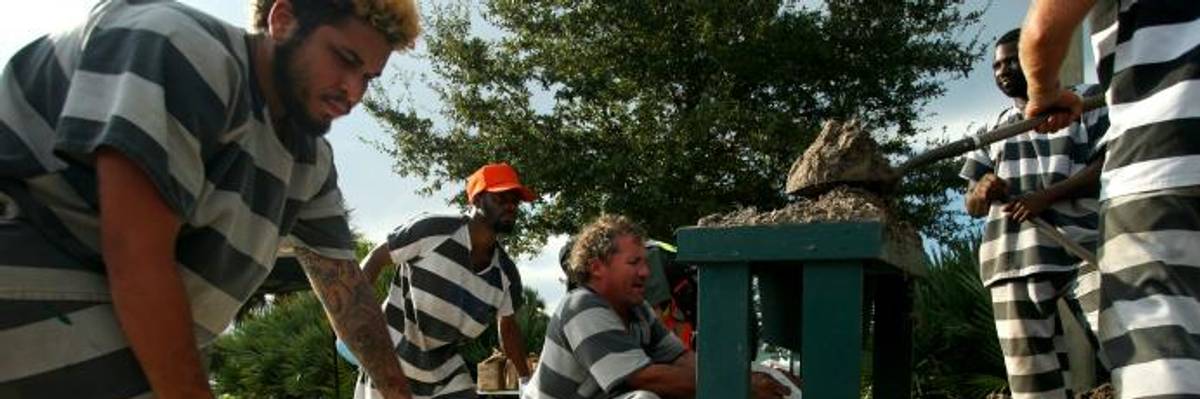
Inmate trustees from the Brevard County Jail work to fill sandbags for residents as people in the area prepare ahead of Hurricane Irma on Sept. 07, 2017 in Meritt Island, Florida.(Photo: Brian Blanco/Getty Images)
In what could become the largest prison strike in American history, prisoners in at least 17 states on Tuesday launched a series of protests that are slated to continue through Sept. 9--the anniversary of the infamous 1971 uprising at New York's Attica Correctional Facility--demanding improved living conditions, voting rights, fair wages, and an end to racist incarceration policies.
"Even with the authorities threatening, prisoners are ready for action," declared a statement from Jailhouse Lawyers Speak (JLS). "Fundamentally, it's a human rights issue. Prisoners understand they are being treated as animals. We know that our conditions are causing physical harm and deaths that could be avoided if prison policymakers actually gave a damn. Prisons in America are a warzone. Every day prisoners are harmed due to conditions of confinement. For some of us it's as if we are already dead."
The mass mobilization--which started on the anniversary of incarcerated Black Panther George Jackson's death--comes in response to an April riot at Lee Correctional Institution, a maximum-security prison in South Carolina where guards waited more than four hours to intervene in violent fighting that left seven inmates dead and more than 17 injured.
Organizers issued a list of demands (pdf) including sentence reform and access to rehabilitation services, and denounced current prison labor practices as "modern day slavery."
"More than 800,000 prisoners are daily put to work, in some states compulsorily, in roles such as cleaning, cooking, and lawn mowing," and "the remuneration can be as woeful in states such as Louisiana as four cents an hour," the Guardian reported, detailing how the such conditions are allowed to continue:
The idea that such lowly-paid work in a $2 billion industry is equivalent to slavery is leant weight by the 13th amendment of the U.S. Constitution. It banned slavery and involuntary servitude, with one vital exception: "as punishment for crime whereof the party shall have been duly convicted."
Prisoners, in other words, have no constitutional rights and can be blatantly exploited.
The prisoners' demands and planned protests--which include work strikes, sit-ins, boycotts, and hunger strikes--have garnered support from advocates for criminal justice reform across the continent. Journalist Naomi Klein urged her Twitter followers to support the national strike, noting, "states cannot afford to ignore them if there is enough pressure."
Support the historic #PrisonStrike. Real the 10 demands including voting rights + being paid the prevailing wage for all work. Thousands of inmates are risking their lives fighting fires; states cannot afford to ignore them if there is enough pressure. https://t.co/Qx1BKslKKI https://t.co/6aspGvGKzX
-- Naomi Klein (@NaomiAKlein) August 21, 2018
Several other individuals and organizations expressed solidarity, tweeting with the hashtag #prisonstrike:
On Democracy Now! Tuesday morning, host Amy Goodman spoke with Amani Sawari, who's working on behalf of JLS, and Cole Dorsey, a formerly incarcerated member of the IWW's Incarcerated Workers Organizing Committee.
"Prisoners have the ability to participate in the strike in a multitude of ways, one being work stoppages. So, if prisoners do have jobs in the prison, they can participate by refusing to go into work," Sawari said. Explaining the various actions the inmates have planned, she added:
But some prisoners don't have the privilege to have a job, so they can participate through a sit-in, which would just be prisoners coming together and sitting in a common area, refusing to move, doing so peacefully.
Some prisoners don't have access to being a part of general population, so they can participate by boycotting. And this is done through just not spending any money in the prison.
...And then, for prisoners that don't even have access to spending money, they don't have the privileges to do that. They'll be participating through hunger strikes.
"This has been completely prisoner-led," Dorsey noted. The demands, he said, "are really just a human rights declaration of basic demands that we would ask of any human across the world... And the only way their voices are going to be heard is through us on the outside amplifying their voices."
Watch:
The full list of national demands from "the men and women in federal, immigration, and state prisons" is below:
Dear Common Dreams reader, It’s been nearly 30 years since I co-founded Common Dreams with my late wife, Lina Newhouser. We had the radical notion that journalism should serve the public good, not corporate profits. It was clear to us from the outset what it would take to build such a project. No paid advertisements. No corporate sponsors. No millionaire publisher telling us what to think or do. Many people said we wouldn't last a year, but we proved those doubters wrong. Together with a tremendous team of journalists and dedicated staff, we built an independent media outlet free from the constraints of profits and corporate control. Our mission has always been simple: To inform. To inspire. To ignite change for the common good. Building Common Dreams was not easy. Our survival was never guaranteed. When you take on the most powerful forces—Wall Street greed, fossil fuel industry destruction, Big Tech lobbyists, and uber-rich oligarchs who have spent billions upon billions rigging the economy and democracy in their favor—the only bulwark you have is supporters who believe in your work. But here’s the urgent message from me today. It's never been this bad out there. And it's never been this hard to keep us going. At the very moment Common Dreams is most needed, the threats we face are intensifying. We need your support now more than ever. We don't accept corporate advertising and never will. We don't have a paywall because we don't think people should be blocked from critical news based on their ability to pay. Everything we do is funded by the donations of readers like you. When everyone does the little they can afford, we are strong. But if that support retreats or dries up, so do we. Will you donate now to make sure Common Dreams not only survives but thrives? —Craig Brown, Co-founder |
In what could become the largest prison strike in American history, prisoners in at least 17 states on Tuesday launched a series of protests that are slated to continue through Sept. 9--the anniversary of the infamous 1971 uprising at New York's Attica Correctional Facility--demanding improved living conditions, voting rights, fair wages, and an end to racist incarceration policies.
"Even with the authorities threatening, prisoners are ready for action," declared a statement from Jailhouse Lawyers Speak (JLS). "Fundamentally, it's a human rights issue. Prisoners understand they are being treated as animals. We know that our conditions are causing physical harm and deaths that could be avoided if prison policymakers actually gave a damn. Prisons in America are a warzone. Every day prisoners are harmed due to conditions of confinement. For some of us it's as if we are already dead."
The mass mobilization--which started on the anniversary of incarcerated Black Panther George Jackson's death--comes in response to an April riot at Lee Correctional Institution, a maximum-security prison in South Carolina where guards waited more than four hours to intervene in violent fighting that left seven inmates dead and more than 17 injured.
Organizers issued a list of demands (pdf) including sentence reform and access to rehabilitation services, and denounced current prison labor practices as "modern day slavery."
"More than 800,000 prisoners are daily put to work, in some states compulsorily, in roles such as cleaning, cooking, and lawn mowing," and "the remuneration can be as woeful in states such as Louisiana as four cents an hour," the Guardian reported, detailing how the such conditions are allowed to continue:
The idea that such lowly-paid work in a $2 billion industry is equivalent to slavery is leant weight by the 13th amendment of the U.S. Constitution. It banned slavery and involuntary servitude, with one vital exception: "as punishment for crime whereof the party shall have been duly convicted."
Prisoners, in other words, have no constitutional rights and can be blatantly exploited.
The prisoners' demands and planned protests--which include work strikes, sit-ins, boycotts, and hunger strikes--have garnered support from advocates for criminal justice reform across the continent. Journalist Naomi Klein urged her Twitter followers to support the national strike, noting, "states cannot afford to ignore them if there is enough pressure."
Support the historic #PrisonStrike. Real the 10 demands including voting rights + being paid the prevailing wage for all work. Thousands of inmates are risking their lives fighting fires; states cannot afford to ignore them if there is enough pressure. https://t.co/Qx1BKslKKI https://t.co/6aspGvGKzX
-- Naomi Klein (@NaomiAKlein) August 21, 2018
Several other individuals and organizations expressed solidarity, tweeting with the hashtag #prisonstrike:
On Democracy Now! Tuesday morning, host Amy Goodman spoke with Amani Sawari, who's working on behalf of JLS, and Cole Dorsey, a formerly incarcerated member of the IWW's Incarcerated Workers Organizing Committee.
"Prisoners have the ability to participate in the strike in a multitude of ways, one being work stoppages. So, if prisoners do have jobs in the prison, they can participate by refusing to go into work," Sawari said. Explaining the various actions the inmates have planned, she added:
But some prisoners don't have the privilege to have a job, so they can participate through a sit-in, which would just be prisoners coming together and sitting in a common area, refusing to move, doing so peacefully.
Some prisoners don't have access to being a part of general population, so they can participate by boycotting. And this is done through just not spending any money in the prison.
...And then, for prisoners that don't even have access to spending money, they don't have the privileges to do that. They'll be participating through hunger strikes.
"This has been completely prisoner-led," Dorsey noted. The demands, he said, "are really just a human rights declaration of basic demands that we would ask of any human across the world... And the only way their voices are going to be heard is through us on the outside amplifying their voices."
Watch:
The full list of national demands from "the men and women in federal, immigration, and state prisons" is below:
In what could become the largest prison strike in American history, prisoners in at least 17 states on Tuesday launched a series of protests that are slated to continue through Sept. 9--the anniversary of the infamous 1971 uprising at New York's Attica Correctional Facility--demanding improved living conditions, voting rights, fair wages, and an end to racist incarceration policies.
"Even with the authorities threatening, prisoners are ready for action," declared a statement from Jailhouse Lawyers Speak (JLS). "Fundamentally, it's a human rights issue. Prisoners understand they are being treated as animals. We know that our conditions are causing physical harm and deaths that could be avoided if prison policymakers actually gave a damn. Prisons in America are a warzone. Every day prisoners are harmed due to conditions of confinement. For some of us it's as if we are already dead."
The mass mobilization--which started on the anniversary of incarcerated Black Panther George Jackson's death--comes in response to an April riot at Lee Correctional Institution, a maximum-security prison in South Carolina where guards waited more than four hours to intervene in violent fighting that left seven inmates dead and more than 17 injured.
Organizers issued a list of demands (pdf) including sentence reform and access to rehabilitation services, and denounced current prison labor practices as "modern day slavery."
"More than 800,000 prisoners are daily put to work, in some states compulsorily, in roles such as cleaning, cooking, and lawn mowing," and "the remuneration can be as woeful in states such as Louisiana as four cents an hour," the Guardian reported, detailing how the such conditions are allowed to continue:
The idea that such lowly-paid work in a $2 billion industry is equivalent to slavery is leant weight by the 13th amendment of the U.S. Constitution. It banned slavery and involuntary servitude, with one vital exception: "as punishment for crime whereof the party shall have been duly convicted."
Prisoners, in other words, have no constitutional rights and can be blatantly exploited.
The prisoners' demands and planned protests--which include work strikes, sit-ins, boycotts, and hunger strikes--have garnered support from advocates for criminal justice reform across the continent. Journalist Naomi Klein urged her Twitter followers to support the national strike, noting, "states cannot afford to ignore them if there is enough pressure."
Support the historic #PrisonStrike. Real the 10 demands including voting rights + being paid the prevailing wage for all work. Thousands of inmates are risking their lives fighting fires; states cannot afford to ignore them if there is enough pressure. https://t.co/Qx1BKslKKI https://t.co/6aspGvGKzX
-- Naomi Klein (@NaomiAKlein) August 21, 2018
Several other individuals and organizations expressed solidarity, tweeting with the hashtag #prisonstrike:
On Democracy Now! Tuesday morning, host Amy Goodman spoke with Amani Sawari, who's working on behalf of JLS, and Cole Dorsey, a formerly incarcerated member of the IWW's Incarcerated Workers Organizing Committee.
"Prisoners have the ability to participate in the strike in a multitude of ways, one being work stoppages. So, if prisoners do have jobs in the prison, they can participate by refusing to go into work," Sawari said. Explaining the various actions the inmates have planned, she added:
But some prisoners don't have the privilege to have a job, so they can participate through a sit-in, which would just be prisoners coming together and sitting in a common area, refusing to move, doing so peacefully.
Some prisoners don't have access to being a part of general population, so they can participate by boycotting. And this is done through just not spending any money in the prison.
...And then, for prisoners that don't even have access to spending money, they don't have the privileges to do that. They'll be participating through hunger strikes.
"This has been completely prisoner-led," Dorsey noted. The demands, he said, "are really just a human rights declaration of basic demands that we would ask of any human across the world... And the only way their voices are going to be heard is through us on the outside amplifying their voices."
Watch:
The full list of national demands from "the men and women in federal, immigration, and state prisons" is below: