SUBSCRIBE TO OUR FREE NEWSLETTER
Daily news & progressive opinion—funded by the people, not the corporations—delivered straight to your inbox.
5
#000000
#FFFFFF
To donate by check, phone, or other method, see our More Ways to Give page.
Daily news & progressive opinion—funded by the people, not the corporations—delivered straight to your inbox.
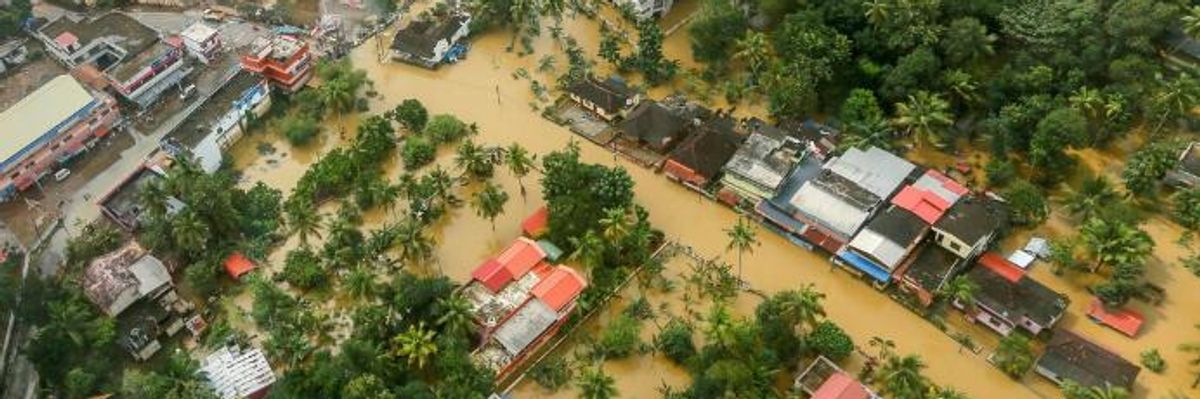
Flooding from monsoon rains has killed hundreds of people in India's Southern coastal state of Kerala in recent days. (Photo: NDTV/Twitter)
A new climate study out Monday in Nature warns that "accelerated warming in the Arctic" is stalling summer weather over North America, Europe, and Asia, and could lead to a future of even more "very-extreme extremes," including dangerous heat waves and flooding.
"While it might not sound so bad to have more prolonged sunny episodes in summer, this is in fact a major climate risk."
--Dim Coumou, Potsdam Institute for Climate Impact Research
"Giant airstreams encircle our globe in the upper troposphere--we call them planetary waves. Now evidence is mounting that humanity is messing with these enormous winds," explained co-author Hans Joachim Schellnhuber, director of Potsdam Institute for Climate Impact Research (PIK). "Fueled by human-made greenhouse-gas emissions, global warming is probably distorting the natural patterns."
As the study outlines, greenhouse gas emissions are causing rapidly rising near-surface temperatures in the Arctic, which are increasing two-to-four times faster than the rest of the globe. While past studies have focused on how this phenomenon, called Arctic amplification (AA), impacts mid-latitude winters, this research team focused on summers.
"This summer was where we saw a very strong intensity of heat waves. It'll continue and that's very worrying, especially in the mid-latitudes: the E.U., U.S., Russia, and China," study co-author Dim Coumou of PIK told the Guardian, warning about the impacts on agricultural production and human health.
The study's publication follows a series of devastating wildfires in Sweden, Greece, and California--where fires continue to force evacuations--and fatal flooding on India's Southern coast, where monsoon rains have just begun to ease. The recent extreme weather across the globe has caused climate experts to issue calls to actions and warnings about what's to come.
Greenpeace, responding to the report, concluded on Twitter, "This is #climatechange, and the time to act on it is now."
Since the temperature gradient between the Arctic and the equator drives the planetary waves eastward, as the Arctic temperature falls, the winds "slow down so the weather in a given region gets stuck," Schellnhuber explained. "Rains can grow into floods, sunny days into heat waves, and tinder-dry conditions into wildfires."
"While it might not sound so bad to have more prolonged sunny episodes in summer," Coumou added in a statement, "this is in fact a major climate risk."
"Besides Arctic warming, there's also the possibility of climate-change-induced shifting of the storm tracks, as well as changes in the tropical monsoons," noted co-author Simon Wang from Utah State University. "Under global warming, the Indian summer monsoon rainfall will likely intensify and this will also influence the global airstreams and might ultimately contribute to more stalling weather patterns."
Dear Common Dreams reader, It’s been nearly 30 years since I co-founded Common Dreams with my late wife, Lina Newhouser. We had the radical notion that journalism should serve the public good, not corporate profits. It was clear to us from the outset what it would take to build such a project. No paid advertisements. No corporate sponsors. No millionaire publisher telling us what to think or do. Many people said we wouldn't last a year, but we proved those doubters wrong. Together with a tremendous team of journalists and dedicated staff, we built an independent media outlet free from the constraints of profits and corporate control. Our mission has always been simple: To inform. To inspire. To ignite change for the common good. Building Common Dreams was not easy. Our survival was never guaranteed. When you take on the most powerful forces—Wall Street greed, fossil fuel industry destruction, Big Tech lobbyists, and uber-rich oligarchs who have spent billions upon billions rigging the economy and democracy in their favor—the only bulwark you have is supporters who believe in your work. But here’s the urgent message from me today. It's never been this bad out there. And it's never been this hard to keep us going. At the very moment Common Dreams is most needed, the threats we face are intensifying. We need your support now more than ever. We don't accept corporate advertising and never will. We don't have a paywall because we don't think people should be blocked from critical news based on their ability to pay. Everything we do is funded by the donations of readers like you. When everyone does the little they can afford, we are strong. But if that support retreats or dries up, so do we. Will you donate now to make sure Common Dreams not only survives but thrives? —Craig Brown, Co-founder |
A new climate study out Monday in Nature warns that "accelerated warming in the Arctic" is stalling summer weather over North America, Europe, and Asia, and could lead to a future of even more "very-extreme extremes," including dangerous heat waves and flooding.
"While it might not sound so bad to have more prolonged sunny episodes in summer, this is in fact a major climate risk."
--Dim Coumou, Potsdam Institute for Climate Impact Research
"Giant airstreams encircle our globe in the upper troposphere--we call them planetary waves. Now evidence is mounting that humanity is messing with these enormous winds," explained co-author Hans Joachim Schellnhuber, director of Potsdam Institute for Climate Impact Research (PIK). "Fueled by human-made greenhouse-gas emissions, global warming is probably distorting the natural patterns."
As the study outlines, greenhouse gas emissions are causing rapidly rising near-surface temperatures in the Arctic, which are increasing two-to-four times faster than the rest of the globe. While past studies have focused on how this phenomenon, called Arctic amplification (AA), impacts mid-latitude winters, this research team focused on summers.
"This summer was where we saw a very strong intensity of heat waves. It'll continue and that's very worrying, especially in the mid-latitudes: the E.U., U.S., Russia, and China," study co-author Dim Coumou of PIK told the Guardian, warning about the impacts on agricultural production and human health.
The study's publication follows a series of devastating wildfires in Sweden, Greece, and California--where fires continue to force evacuations--and fatal flooding on India's Southern coast, where monsoon rains have just begun to ease. The recent extreme weather across the globe has caused climate experts to issue calls to actions and warnings about what's to come.
Greenpeace, responding to the report, concluded on Twitter, "This is #climatechange, and the time to act on it is now."
Since the temperature gradient between the Arctic and the equator drives the planetary waves eastward, as the Arctic temperature falls, the winds "slow down so the weather in a given region gets stuck," Schellnhuber explained. "Rains can grow into floods, sunny days into heat waves, and tinder-dry conditions into wildfires."
"While it might not sound so bad to have more prolonged sunny episodes in summer," Coumou added in a statement, "this is in fact a major climate risk."
"Besides Arctic warming, there's also the possibility of climate-change-induced shifting of the storm tracks, as well as changes in the tropical monsoons," noted co-author Simon Wang from Utah State University. "Under global warming, the Indian summer monsoon rainfall will likely intensify and this will also influence the global airstreams and might ultimately contribute to more stalling weather patterns."
A new climate study out Monday in Nature warns that "accelerated warming in the Arctic" is stalling summer weather over North America, Europe, and Asia, and could lead to a future of even more "very-extreme extremes," including dangerous heat waves and flooding.
"While it might not sound so bad to have more prolonged sunny episodes in summer, this is in fact a major climate risk."
--Dim Coumou, Potsdam Institute for Climate Impact Research
"Giant airstreams encircle our globe in the upper troposphere--we call them planetary waves. Now evidence is mounting that humanity is messing with these enormous winds," explained co-author Hans Joachim Schellnhuber, director of Potsdam Institute for Climate Impact Research (PIK). "Fueled by human-made greenhouse-gas emissions, global warming is probably distorting the natural patterns."
As the study outlines, greenhouse gas emissions are causing rapidly rising near-surface temperatures in the Arctic, which are increasing two-to-four times faster than the rest of the globe. While past studies have focused on how this phenomenon, called Arctic amplification (AA), impacts mid-latitude winters, this research team focused on summers.
"This summer was where we saw a very strong intensity of heat waves. It'll continue and that's very worrying, especially in the mid-latitudes: the E.U., U.S., Russia, and China," study co-author Dim Coumou of PIK told the Guardian, warning about the impacts on agricultural production and human health.
The study's publication follows a series of devastating wildfires in Sweden, Greece, and California--where fires continue to force evacuations--and fatal flooding on India's Southern coast, where monsoon rains have just begun to ease. The recent extreme weather across the globe has caused climate experts to issue calls to actions and warnings about what's to come.
Greenpeace, responding to the report, concluded on Twitter, "This is #climatechange, and the time to act on it is now."
Since the temperature gradient between the Arctic and the equator drives the planetary waves eastward, as the Arctic temperature falls, the winds "slow down so the weather in a given region gets stuck," Schellnhuber explained. "Rains can grow into floods, sunny days into heat waves, and tinder-dry conditions into wildfires."
"While it might not sound so bad to have more prolonged sunny episodes in summer," Coumou added in a statement, "this is in fact a major climate risk."
"Besides Arctic warming, there's also the possibility of climate-change-induced shifting of the storm tracks, as well as changes in the tropical monsoons," noted co-author Simon Wang from Utah State University. "Under global warming, the Indian summer monsoon rainfall will likely intensify and this will also influence the global airstreams and might ultimately contribute to more stalling weather patterns."