SUBSCRIBE TO OUR FREE NEWSLETTER
Daily news & progressive opinion—funded by the people, not the corporations—delivered straight to your inbox.
5
#000000
#FFFFFF
To donate by check, phone, or other method, see our More Ways to Give page.
Daily news & progressive opinion—funded by the people, not the corporations—delivered straight to your inbox.
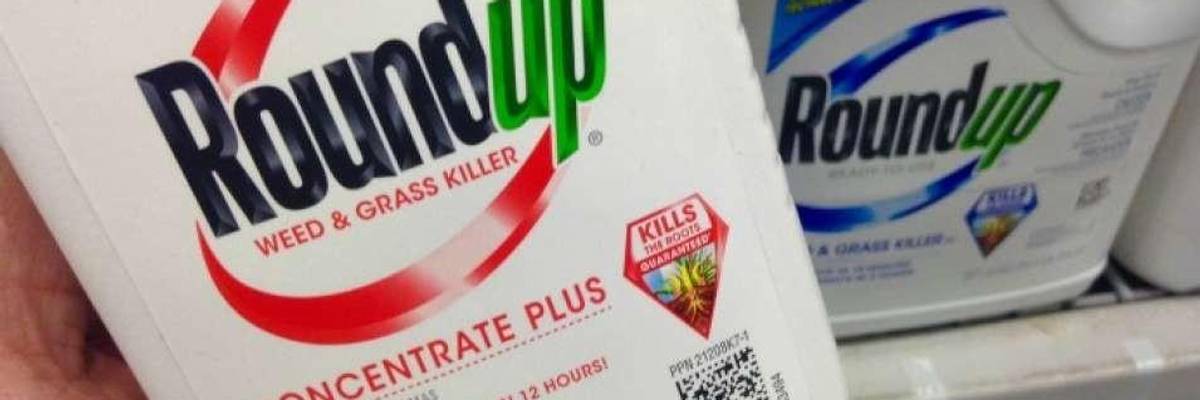
Shares in Bayer fell dramatically in the wake of a court ordering its unit Monsanto to pay out $289 million in damages in a cancer trial. (Photo: Mike Mozart/Flickr/cc)
Shares in Bayer took a nosedive on Monday--just days after newly-acquired Monsanto was ordered to pay $289 million in damages to a man who alleged that the company's glyphosate-based herbicides, including the widely used weedkiller Roundup, caused his cancer.
At one point the German pharmaceutical giant's shares fell by as much as 14 percent, Reuters reported, marking a loss in value of roughly $14 billion.
It capped off the U.S. trading day as one of the "biggest losers," ending at a 10-percent loss.
Friday was also a losing day for Monsanto, which Bayer AG controversially acquired for $62.5 billion in June. In a landmark trial, a San Francisco jury unanimously found that the company failed to warn school groundskeeper Dewayne Johnson, who's suffering from non-Hodgkin's lymphoma, and other consumers of the cancer risks from its weed killers, and said the company acted "with malice or oppression."
The International Agency for Research on Cancer (IARC)--a branch of the World Health Organization (WHO)--classified glyphosate as a probable human carcinogen, but Monsanto says its Roundup is safe, and that it plans on appealing.
Monday also marked the last day of the public comment period for the finalization of the merger process, prompting a broad range of advocacy groups to voice their opposition once again.
"No matter how you cut it," said said Daniel Raichel, an attorney with the Nature Program at NRDC, "a Bayer/Monsanto merger spells higher costs for farmers and locks in the chemical-heavy agricultural practices that threaten our health and the bees and other pollinators critical to food security."
"The Department needs to reverse course and block the merger before we all suffer the consequences," he said.
Dear Common Dreams reader, It’s been nearly 30 years since I co-founded Common Dreams with my late wife, Lina Newhouser. We had the radical notion that journalism should serve the public good, not corporate profits. It was clear to us from the outset what it would take to build such a project. No paid advertisements. No corporate sponsors. No millionaire publisher telling us what to think or do. Many people said we wouldn't last a year, but we proved those doubters wrong. Together with a tremendous team of journalists and dedicated staff, we built an independent media outlet free from the constraints of profits and corporate control. Our mission has always been simple: To inform. To inspire. To ignite change for the common good. Building Common Dreams was not easy. Our survival was never guaranteed. When you take on the most powerful forces—Wall Street greed, fossil fuel industry destruction, Big Tech lobbyists, and uber-rich oligarchs who have spent billions upon billions rigging the economy and democracy in their favor—the only bulwark you have is supporters who believe in your work. But here’s the urgent message from me today. It's never been this bad out there. And it's never been this hard to keep us going. At the very moment Common Dreams is most needed, the threats we face are intensifying. We need your support now more than ever. We don't accept corporate advertising and never will. We don't have a paywall because we don't think people should be blocked from critical news based on their ability to pay. Everything we do is funded by the donations of readers like you. When everyone does the little they can afford, we are strong. But if that support retreats or dries up, so do we. Will you donate now to make sure Common Dreams not only survives but thrives? —Craig Brown, Co-founder |
Shares in Bayer took a nosedive on Monday--just days after newly-acquired Monsanto was ordered to pay $289 million in damages to a man who alleged that the company's glyphosate-based herbicides, including the widely used weedkiller Roundup, caused his cancer.
At one point the German pharmaceutical giant's shares fell by as much as 14 percent, Reuters reported, marking a loss in value of roughly $14 billion.
It capped off the U.S. trading day as one of the "biggest losers," ending at a 10-percent loss.
Friday was also a losing day for Monsanto, which Bayer AG controversially acquired for $62.5 billion in June. In a landmark trial, a San Francisco jury unanimously found that the company failed to warn school groundskeeper Dewayne Johnson, who's suffering from non-Hodgkin's lymphoma, and other consumers of the cancer risks from its weed killers, and said the company acted "with malice or oppression."
The International Agency for Research on Cancer (IARC)--a branch of the World Health Organization (WHO)--classified glyphosate as a probable human carcinogen, but Monsanto says its Roundup is safe, and that it plans on appealing.
Monday also marked the last day of the public comment period for the finalization of the merger process, prompting a broad range of advocacy groups to voice their opposition once again.
"No matter how you cut it," said said Daniel Raichel, an attorney with the Nature Program at NRDC, "a Bayer/Monsanto merger spells higher costs for farmers and locks in the chemical-heavy agricultural practices that threaten our health and the bees and other pollinators critical to food security."
"The Department needs to reverse course and block the merger before we all suffer the consequences," he said.
Shares in Bayer took a nosedive on Monday--just days after newly-acquired Monsanto was ordered to pay $289 million in damages to a man who alleged that the company's glyphosate-based herbicides, including the widely used weedkiller Roundup, caused his cancer.
At one point the German pharmaceutical giant's shares fell by as much as 14 percent, Reuters reported, marking a loss in value of roughly $14 billion.
It capped off the U.S. trading day as one of the "biggest losers," ending at a 10-percent loss.
Friday was also a losing day for Monsanto, which Bayer AG controversially acquired for $62.5 billion in June. In a landmark trial, a San Francisco jury unanimously found that the company failed to warn school groundskeeper Dewayne Johnson, who's suffering from non-Hodgkin's lymphoma, and other consumers of the cancer risks from its weed killers, and said the company acted "with malice or oppression."
The International Agency for Research on Cancer (IARC)--a branch of the World Health Organization (WHO)--classified glyphosate as a probable human carcinogen, but Monsanto says its Roundup is safe, and that it plans on appealing.
Monday also marked the last day of the public comment period for the finalization of the merger process, prompting a broad range of advocacy groups to voice their opposition once again.
"No matter how you cut it," said said Daniel Raichel, an attorney with the Nature Program at NRDC, "a Bayer/Monsanto merger spells higher costs for farmers and locks in the chemical-heavy agricultural practices that threaten our health and the bees and other pollinators critical to food security."
"The Department needs to reverse course and block the merger before we all suffer the consequences," he said.