SUBSCRIBE TO OUR FREE NEWSLETTER
Daily news & progressive opinion—funded by the people, not the corporations—delivered straight to your inbox.
5
#000000
#FFFFFF
To donate by check, phone, or other method, see our More Ways to Give page.
Daily news & progressive opinion—funded by the people, not the corporations—delivered straight to your inbox.
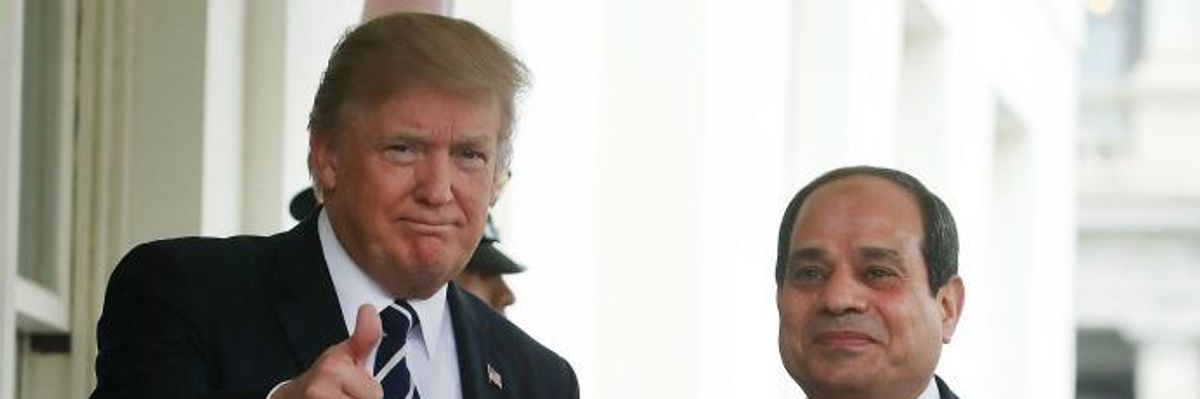
U.S. President Donald Trump welcomes Egyptian President Abdel Fattah Al Sisi during his arrival at the West Wing of the White House on April 3, 2017 in Washington, DC. (Photo: Mark Wilson/Getty Images)
Egyptian authorities on Saturday sentenced 75 people to death for taking part in a 2013 sit-in protest against the military ouster of democratically elected president Mohammed Morsi--a court decision that came days after the United States sent "the wrong message to one of the most abusive governments in Egypt's recent history" by restoring $195 million in military aid to the nation.
The dozens sentenced in Saturday's ruling are among 739 defendants, including members of the now-banned Muslim Brotherhood and members of the press, the government is targeting over their participating in the protest. The day became known as the al-Rabaa Massacre, as security forces under the command of now-President Abdul Fattah al-Sisi killed hundreds of people in a matter of hours.
The lifting of the blocked military aid was announced last week, with the Trump administration commending purported "steps Egypt has taken over the last year in response to specific U.S. concerns." The administration had withheld aid last year, citing "serious concerns regarding human rights and governance in Egypt."
Rather than making any gains, however, Amr Magdi, Middle East and North Africa researcher with Human Rights Watch, argues that the county is actually in the midst of "intensifying crackdown on human rights by the Egyptian authorities." As such, "The decision to release the funds despite a significant deterioration in the rights situation in Egypt is both baffling and troubling."
One Egyptian American who was held as a political prisoner there for three years called the release of aid a "step back for human rights."
Speaking to Middle East Eye, Aya Hijazi said, "This gives the military a green light to continue the reign of suppression it is embarking on."
Still, the development was not seen as suprising--Egypt is the second biggest recipient of U.S. foreign aid after Israel. Moreover, President Donald Trump has offered praise for Sisi on multiple occasions, including calling him "a fantastic guy" who's done "a fantastic job."
Yet Trump is merely continuing "U.S. tradition by coddling Egypt's strongman," Washington Post reporter Ishaan Tharoor argues Monday.
Tharoor points to a recent article in the New York Times by David D. Kirkpatrick, which argues that the Obama administration in fact paved the way for Trump's embrace of dictators like Sisi, and notes that "some of the coup's most vocal American advocates went on to top roles in the Trump administration, including Secretary of Defense James Mattis and Michael Flynn, Mr. Trump's first national security adviser."
He continued:
Mr. Obama and his closest advisers ... hoped to shift established American policy and forge a new relationship with the Arab world in order to undermine the appeals of anti-Western extremism. Even in the final days before the takeover, Mr. Obama was urging respect for Egypt's free elections. In an 11th--hour phone call he implored Mr. Morsi to make "bold gestures" to hold onto his office.
Most of his government, though, took the other side, reflecting longstanding worries about the intrinsic danger of political Islam and about the obstacles to Egyptian democracy.
In a White House meeting the day after Mr. Morsi's ouster--two days after that last phone call--Mr. Obama yielded to those views when he accepted the military takeover. In doing so, he had taken a first step toward the policies that have become the overriding principles of the Trump administration.
Other observers say the way was paved far before Obama took office.
"The U.S. has looked forward to working with every single Egyptian regime to date," Sherif Gaber, member of the Mosireen Independent Media Collective in Cairo, previously told Common Dreams. "It's no secret that America's greatest interest for Egypt is a stable partner to maintain status quo relations favoring U.S. policy in the region, regardless of whether that was Mubarak, Morsi, or now Sisi."
Dear Common Dreams reader, It’s been nearly 30 years since I co-founded Common Dreams with my late wife, Lina Newhouser. We had the radical notion that journalism should serve the public good, not corporate profits. It was clear to us from the outset what it would take to build such a project. No paid advertisements. No corporate sponsors. No millionaire publisher telling us what to think or do. Many people said we wouldn't last a year, but we proved those doubters wrong. Together with a tremendous team of journalists and dedicated staff, we built an independent media outlet free from the constraints of profits and corporate control. Our mission has always been simple: To inform. To inspire. To ignite change for the common good. Building Common Dreams was not easy. Our survival was never guaranteed. When you take on the most powerful forces—Wall Street greed, fossil fuel industry destruction, Big Tech lobbyists, and uber-rich oligarchs who have spent billions upon billions rigging the economy and democracy in their favor—the only bulwark you have is supporters who believe in your work. But here’s the urgent message from me today. It's never been this bad out there. And it's never been this hard to keep us going. At the very moment Common Dreams is most needed, the threats we face are intensifying. We need your support now more than ever. We don't accept corporate advertising and never will. We don't have a paywall because we don't think people should be blocked from critical news based on their ability to pay. Everything we do is funded by the donations of readers like you. When everyone does the little they can afford, we are strong. But if that support retreats or dries up, so do we. Will you donate now to make sure Common Dreams not only survives but thrives? —Craig Brown, Co-founder |
Egyptian authorities on Saturday sentenced 75 people to death for taking part in a 2013 sit-in protest against the military ouster of democratically elected president Mohammed Morsi--a court decision that came days after the United States sent "the wrong message to one of the most abusive governments in Egypt's recent history" by restoring $195 million in military aid to the nation.
The dozens sentenced in Saturday's ruling are among 739 defendants, including members of the now-banned Muslim Brotherhood and members of the press, the government is targeting over their participating in the protest. The day became known as the al-Rabaa Massacre, as security forces under the command of now-President Abdul Fattah al-Sisi killed hundreds of people in a matter of hours.
The lifting of the blocked military aid was announced last week, with the Trump administration commending purported "steps Egypt has taken over the last year in response to specific U.S. concerns." The administration had withheld aid last year, citing "serious concerns regarding human rights and governance in Egypt."
Rather than making any gains, however, Amr Magdi, Middle East and North Africa researcher with Human Rights Watch, argues that the county is actually in the midst of "intensifying crackdown on human rights by the Egyptian authorities." As such, "The decision to release the funds despite a significant deterioration in the rights situation in Egypt is both baffling and troubling."
One Egyptian American who was held as a political prisoner there for three years called the release of aid a "step back for human rights."
Speaking to Middle East Eye, Aya Hijazi said, "This gives the military a green light to continue the reign of suppression it is embarking on."
Still, the development was not seen as suprising--Egypt is the second biggest recipient of U.S. foreign aid after Israel. Moreover, President Donald Trump has offered praise for Sisi on multiple occasions, including calling him "a fantastic guy" who's done "a fantastic job."
Yet Trump is merely continuing "U.S. tradition by coddling Egypt's strongman," Washington Post reporter Ishaan Tharoor argues Monday.
Tharoor points to a recent article in the New York Times by David D. Kirkpatrick, which argues that the Obama administration in fact paved the way for Trump's embrace of dictators like Sisi, and notes that "some of the coup's most vocal American advocates went on to top roles in the Trump administration, including Secretary of Defense James Mattis and Michael Flynn, Mr. Trump's first national security adviser."
He continued:
Mr. Obama and his closest advisers ... hoped to shift established American policy and forge a new relationship with the Arab world in order to undermine the appeals of anti-Western extremism. Even in the final days before the takeover, Mr. Obama was urging respect for Egypt's free elections. In an 11th--hour phone call he implored Mr. Morsi to make "bold gestures" to hold onto his office.
Most of his government, though, took the other side, reflecting longstanding worries about the intrinsic danger of political Islam and about the obstacles to Egyptian democracy.
In a White House meeting the day after Mr. Morsi's ouster--two days after that last phone call--Mr. Obama yielded to those views when he accepted the military takeover. In doing so, he had taken a first step toward the policies that have become the overriding principles of the Trump administration.
Other observers say the way was paved far before Obama took office.
"The U.S. has looked forward to working with every single Egyptian regime to date," Sherif Gaber, member of the Mosireen Independent Media Collective in Cairo, previously told Common Dreams. "It's no secret that America's greatest interest for Egypt is a stable partner to maintain status quo relations favoring U.S. policy in the region, regardless of whether that was Mubarak, Morsi, or now Sisi."
Egyptian authorities on Saturday sentenced 75 people to death for taking part in a 2013 sit-in protest against the military ouster of democratically elected president Mohammed Morsi--a court decision that came days after the United States sent "the wrong message to one of the most abusive governments in Egypt's recent history" by restoring $195 million in military aid to the nation.
The dozens sentenced in Saturday's ruling are among 739 defendants, including members of the now-banned Muslim Brotherhood and members of the press, the government is targeting over their participating in the protest. The day became known as the al-Rabaa Massacre, as security forces under the command of now-President Abdul Fattah al-Sisi killed hundreds of people in a matter of hours.
The lifting of the blocked military aid was announced last week, with the Trump administration commending purported "steps Egypt has taken over the last year in response to specific U.S. concerns." The administration had withheld aid last year, citing "serious concerns regarding human rights and governance in Egypt."
Rather than making any gains, however, Amr Magdi, Middle East and North Africa researcher with Human Rights Watch, argues that the county is actually in the midst of "intensifying crackdown on human rights by the Egyptian authorities." As such, "The decision to release the funds despite a significant deterioration in the rights situation in Egypt is both baffling and troubling."
One Egyptian American who was held as a political prisoner there for three years called the release of aid a "step back for human rights."
Speaking to Middle East Eye, Aya Hijazi said, "This gives the military a green light to continue the reign of suppression it is embarking on."
Still, the development was not seen as suprising--Egypt is the second biggest recipient of U.S. foreign aid after Israel. Moreover, President Donald Trump has offered praise for Sisi on multiple occasions, including calling him "a fantastic guy" who's done "a fantastic job."
Yet Trump is merely continuing "U.S. tradition by coddling Egypt's strongman," Washington Post reporter Ishaan Tharoor argues Monday.
Tharoor points to a recent article in the New York Times by David D. Kirkpatrick, which argues that the Obama administration in fact paved the way for Trump's embrace of dictators like Sisi, and notes that "some of the coup's most vocal American advocates went on to top roles in the Trump administration, including Secretary of Defense James Mattis and Michael Flynn, Mr. Trump's first national security adviser."
He continued:
Mr. Obama and his closest advisers ... hoped to shift established American policy and forge a new relationship with the Arab world in order to undermine the appeals of anti-Western extremism. Even in the final days before the takeover, Mr. Obama was urging respect for Egypt's free elections. In an 11th--hour phone call he implored Mr. Morsi to make "bold gestures" to hold onto his office.
Most of his government, though, took the other side, reflecting longstanding worries about the intrinsic danger of political Islam and about the obstacles to Egyptian democracy.
In a White House meeting the day after Mr. Morsi's ouster--two days after that last phone call--Mr. Obama yielded to those views when he accepted the military takeover. In doing so, he had taken a first step toward the policies that have become the overriding principles of the Trump administration.
Other observers say the way was paved far before Obama took office.
"The U.S. has looked forward to working with every single Egyptian regime to date," Sherif Gaber, member of the Mosireen Independent Media Collective in Cairo, previously told Common Dreams. "It's no secret that America's greatest interest for Egypt is a stable partner to maintain status quo relations favoring U.S. policy in the region, regardless of whether that was Mubarak, Morsi, or now Sisi."