SUBSCRIBE TO OUR FREE NEWSLETTER
Daily news & progressive opinion—funded by the people, not the corporations—delivered straight to your inbox.
5
#000000
#FFFFFF
To donate by check, phone, or other method, see our More Ways to Give page.
Daily news & progressive opinion—funded by the people, not the corporations—delivered straight to your inbox.
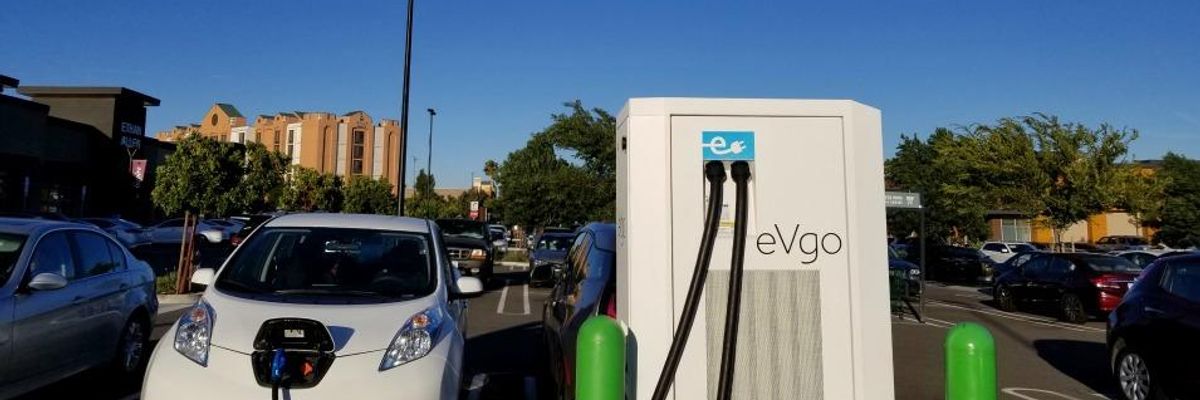
An electric car plugged in and charging at an eVgo electric vehicle charging station in a parking lot in Dublin, California, June 20, 2018. (Photo: Smith Collection/Gado/Getty Images)
The Trump administration is set this week to propose a rollback of California's highly successful auto emissions standards, in a move that could result in yet another sweeping environmental anti-regulatory measure.
The Environmental Protection Agency (EPA) and the National Highway Traffic Safety Administration (NHTSA) are expected to propose an end to the 2009 waiver that gave California the right to regulate greenhouse gas emissions from cars and mandate that car companies reach a quota of electric vehicles sold, according to Bloomberg News.
The expected proposal comes four months after former EPA Administrator Scott Pruitt officially declared the emissions standards embraced by the Obama administration, which granted California the waiver, "not appropriate."
California's stringent emissions rules have caught on across the country, with states including New York, New Jersey, Maryland, and Washington adopting the requirements. A number of states and the District of Columbia joined with California in suing the Trump administration this spring as it announced it would reconsider the state's waiver.
"We have the law on our side, as well as the people of the country and the people of the world," Dan Sperling, a member of California's Air Resources Board, told Bloomberg.
Despite Trump's claims that environmental regulations harm the economy and jobs, Jim Dalyrmple noted at Buzzfeed News earlier this month, California's economy has actually grown amid its strict enforcement of rules aimed at reducing emissions that contribute to the climate crisis:
This week, the California Air Resources Control Board (CARB) announced the state had reduced its carbon emissions by 13% percent since 2004, dropping below 1990 levels for the first time, and reaching its target four years early.
[...]
But perhaps even more significantly, California managed to reduce its pollution emissions while simultaneously growing its economy at a faster rate than the U.S. as a whole. According to CARB, California's economy grew 26 percent since 2004, when emissions peaked.
"The reduction in carbon has not significantly impaired the economy in any way," Jim Bushnell, an economist at the University of California-Davis, told Buzzfeed.
The Trump administration will also put forth a plan to weaken fuel efficiency rules put in place by President Barack Obama, who aimed to require automakers to sell cars with an average of fuel efficiency of 50 miles per gallon by 2025, according to Bloomberg. Trump would allow car companies to stop improving efficiency after 2020, when federal law mandates only 35-mile-per-gallon requirements.
On social media, some noted that Trump's attack on California's ability to regulate emissions on its own roads flies in the face of conservative arguments in favor of "states' rights"--often invoked in debates over states' ability to regulate abortion access and LGBTQ rights, as well as racial integration and slavery in the past.
Dear Common Dreams reader, It’s been nearly 30 years since I co-founded Common Dreams with my late wife, Lina Newhouser. We had the radical notion that journalism should serve the public good, not corporate profits. It was clear to us from the outset what it would take to build such a project. No paid advertisements. No corporate sponsors. No millionaire publisher telling us what to think or do. Many people said we wouldn't last a year, but we proved those doubters wrong. Together with a tremendous team of journalists and dedicated staff, we built an independent media outlet free from the constraints of profits and corporate control. Our mission has always been simple: To inform. To inspire. To ignite change for the common good. Building Common Dreams was not easy. Our survival was never guaranteed. When you take on the most powerful forces—Wall Street greed, fossil fuel industry destruction, Big Tech lobbyists, and uber-rich oligarchs who have spent billions upon billions rigging the economy and democracy in their favor—the only bulwark you have is supporters who believe in your work. But here’s the urgent message from me today. It's never been this bad out there. And it's never been this hard to keep us going. At the very moment Common Dreams is most needed, the threats we face are intensifying. We need your support now more than ever. We don't accept corporate advertising and never will. We don't have a paywall because we don't think people should be blocked from critical news based on their ability to pay. Everything we do is funded by the donations of readers like you. When everyone does the little they can afford, we are strong. But if that support retreats or dries up, so do we. Will you donate now to make sure Common Dreams not only survives but thrives? —Craig Brown, Co-founder |
The Trump administration is set this week to propose a rollback of California's highly successful auto emissions standards, in a move that could result in yet another sweeping environmental anti-regulatory measure.
The Environmental Protection Agency (EPA) and the National Highway Traffic Safety Administration (NHTSA) are expected to propose an end to the 2009 waiver that gave California the right to regulate greenhouse gas emissions from cars and mandate that car companies reach a quota of electric vehicles sold, according to Bloomberg News.
The expected proposal comes four months after former EPA Administrator Scott Pruitt officially declared the emissions standards embraced by the Obama administration, which granted California the waiver, "not appropriate."
California's stringent emissions rules have caught on across the country, with states including New York, New Jersey, Maryland, and Washington adopting the requirements. A number of states and the District of Columbia joined with California in suing the Trump administration this spring as it announced it would reconsider the state's waiver.
"We have the law on our side, as well as the people of the country and the people of the world," Dan Sperling, a member of California's Air Resources Board, told Bloomberg.
Despite Trump's claims that environmental regulations harm the economy and jobs, Jim Dalyrmple noted at Buzzfeed News earlier this month, California's economy has actually grown amid its strict enforcement of rules aimed at reducing emissions that contribute to the climate crisis:
This week, the California Air Resources Control Board (CARB) announced the state had reduced its carbon emissions by 13% percent since 2004, dropping below 1990 levels for the first time, and reaching its target four years early.
[...]
But perhaps even more significantly, California managed to reduce its pollution emissions while simultaneously growing its economy at a faster rate than the U.S. as a whole. According to CARB, California's economy grew 26 percent since 2004, when emissions peaked.
"The reduction in carbon has not significantly impaired the economy in any way," Jim Bushnell, an economist at the University of California-Davis, told Buzzfeed.
The Trump administration will also put forth a plan to weaken fuel efficiency rules put in place by President Barack Obama, who aimed to require automakers to sell cars with an average of fuel efficiency of 50 miles per gallon by 2025, according to Bloomberg. Trump would allow car companies to stop improving efficiency after 2020, when federal law mandates only 35-mile-per-gallon requirements.
On social media, some noted that Trump's attack on California's ability to regulate emissions on its own roads flies in the face of conservative arguments in favor of "states' rights"--often invoked in debates over states' ability to regulate abortion access and LGBTQ rights, as well as racial integration and slavery in the past.
The Trump administration is set this week to propose a rollback of California's highly successful auto emissions standards, in a move that could result in yet another sweeping environmental anti-regulatory measure.
The Environmental Protection Agency (EPA) and the National Highway Traffic Safety Administration (NHTSA) are expected to propose an end to the 2009 waiver that gave California the right to regulate greenhouse gas emissions from cars and mandate that car companies reach a quota of electric vehicles sold, according to Bloomberg News.
The expected proposal comes four months after former EPA Administrator Scott Pruitt officially declared the emissions standards embraced by the Obama administration, which granted California the waiver, "not appropriate."
California's stringent emissions rules have caught on across the country, with states including New York, New Jersey, Maryland, and Washington adopting the requirements. A number of states and the District of Columbia joined with California in suing the Trump administration this spring as it announced it would reconsider the state's waiver.
"We have the law on our side, as well as the people of the country and the people of the world," Dan Sperling, a member of California's Air Resources Board, told Bloomberg.
Despite Trump's claims that environmental regulations harm the economy and jobs, Jim Dalyrmple noted at Buzzfeed News earlier this month, California's economy has actually grown amid its strict enforcement of rules aimed at reducing emissions that contribute to the climate crisis:
This week, the California Air Resources Control Board (CARB) announced the state had reduced its carbon emissions by 13% percent since 2004, dropping below 1990 levels for the first time, and reaching its target four years early.
[...]
But perhaps even more significantly, California managed to reduce its pollution emissions while simultaneously growing its economy at a faster rate than the U.S. as a whole. According to CARB, California's economy grew 26 percent since 2004, when emissions peaked.
"The reduction in carbon has not significantly impaired the economy in any way," Jim Bushnell, an economist at the University of California-Davis, told Buzzfeed.
The Trump administration will also put forth a plan to weaken fuel efficiency rules put in place by President Barack Obama, who aimed to require automakers to sell cars with an average of fuel efficiency of 50 miles per gallon by 2025, according to Bloomberg. Trump would allow car companies to stop improving efficiency after 2020, when federal law mandates only 35-mile-per-gallon requirements.
On social media, some noted that Trump's attack on California's ability to regulate emissions on its own roads flies in the face of conservative arguments in favor of "states' rights"--often invoked in debates over states' ability to regulate abortion access and LGBTQ rights, as well as racial integration and slavery in the past.