SUBSCRIBE TO OUR FREE NEWSLETTER
Daily news & progressive opinion—funded by the people, not the corporations—delivered straight to your inbox.
5
#000000
#FFFFFF
To donate by check, phone, or other method, see our More Ways to Give page.
Daily news & progressive opinion—funded by the people, not the corporations—delivered straight to your inbox.
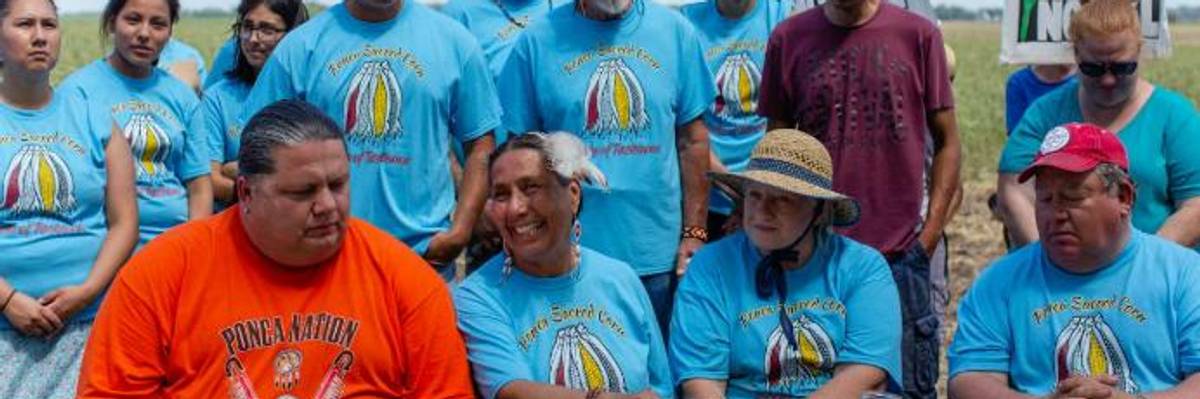
In a move that could block the path of the Keystone XL pipeline, a couple in Nebraska signed over a portion of farmland to the Ponca Tribe. (Photo: @BoldNebraska/Twitter)
In a move that could challenge the proposed path of TransCanada's Keystone XL pipeline--and acknowledges the U.S. government's long history of abusing Native Americans and forcing them off their lands--a Nebraska farm couple has returned a portion of ancestral land to the Ponca Tribe.
"Repatriating this land to the Ponca Tribe raises new challenges for the Keystone XL pipeline and respects the leadership of Native nations in the fight against the fossil fuel industry."
--May Boeve, 350.org
At a deed-signing ceremony earlier this week, farmers Art and Helen Tanderup transferred to the tribe a 1.6-acre plot of land that falls on Ponca "Trail of Tears."
Now, as the Omaha World-Herald explained, rather than battling the farmers, "TransCanada will have to negotiate with a new landowner, one that has special legal status as a tribe."
The transfer was celebrated by members of the Ponca Tribe as well as environmental advocates who oppose the construction of the pipeline and continue to demand a total transition to renewable energy.
"We want to protect this land," Larry Wright Jr., the chairman of the Ponca Tribe of Nebraska, told the World-Herald. "We don't want to see a pipeline go through."
"While TransCanada is trampling on Indigenous rights to fatten their bottom line, Native leaders are resisting by building renewable energy solutions like solar panels in the path of the pipeline," said 350.org executive director May Boeve.
"Repatriating this land to the Ponca Tribe raises new challenges for the Keystone XL pipeline and respects the leadership of Native nations in the fight against the fossil fuel industry," she added. "Tribal sovereignty is central to the movement to keep fossil fuels in the ground and build a more just society for all."
Author and 350.org cofounder Bill McKibben called the land transfer an "important strategic move," while also noting that "it's sacred ground."
In recent years, the Tanderups have worked with Ponca leaders to grow the tribe's sacred corn on the land that's now been returned. The signing ceremony featured the fifth planting of the corn and a performance by Ponca singers and grass dancers.
"It's an honor to be here today to celebrate this gracious and generous donation nation to the Ponca Nation," Wright said at the ceremony. "This event is another step to healing old wounds and bringing our people together again to a land once ours."
"The Sovereign rights of Tribal Nations, and property rights of farmers and ranchers connect all of us," said Jane Kleeb, founder of Bold Nebraska, which played a key role in facilitating the land transfer and planting the Ponca's corn on the land. "In this historic moment, we come together to remind our fellow Americans of our shared history."
The Tanderups--who have joined with Indigenous and environmental advocates to protest Keystone XL--said the possibility of blocking the pipeline was only one of the factors that contributed to their decision.
"The Ponca and people of this community continue to build strong relationships as they work in collaborative efforts," Art Tanderup told the Norfolk Daily News. "It is only fitting that out of the tragedy of the Ponca Trail of Tears that a small piece of this historic trail be transferred to them."
Watch the signing ceremony:
This post has been updated to include comment from Bold Nebraska.
Dear Common Dreams reader, It’s been nearly 30 years since I co-founded Common Dreams with my late wife, Lina Newhouser. We had the radical notion that journalism should serve the public good, not corporate profits. It was clear to us from the outset what it would take to build such a project. No paid advertisements. No corporate sponsors. No millionaire publisher telling us what to think or do. Many people said we wouldn't last a year, but we proved those doubters wrong. Together with a tremendous team of journalists and dedicated staff, we built an independent media outlet free from the constraints of profits and corporate control. Our mission has always been simple: To inform. To inspire. To ignite change for the common good. Building Common Dreams was not easy. Our survival was never guaranteed. When you take on the most powerful forces—Wall Street greed, fossil fuel industry destruction, Big Tech lobbyists, and uber-rich oligarchs who have spent billions upon billions rigging the economy and democracy in their favor—the only bulwark you have is supporters who believe in your work. But here’s the urgent message from me today. It's never been this bad out there. And it's never been this hard to keep us going. At the very moment Common Dreams is most needed, the threats we face are intensifying. We need your support now more than ever. We don't accept corporate advertising and never will. We don't have a paywall because we don't think people should be blocked from critical news based on their ability to pay. Everything we do is funded by the donations of readers like you. When everyone does the little they can afford, we are strong. But if that support retreats or dries up, so do we. Will you donate now to make sure Common Dreams not only survives but thrives? —Craig Brown, Co-founder |
In a move that could challenge the proposed path of TransCanada's Keystone XL pipeline--and acknowledges the U.S. government's long history of abusing Native Americans and forcing them off their lands--a Nebraska farm couple has returned a portion of ancestral land to the Ponca Tribe.
"Repatriating this land to the Ponca Tribe raises new challenges for the Keystone XL pipeline and respects the leadership of Native nations in the fight against the fossil fuel industry."
--May Boeve, 350.org
At a deed-signing ceremony earlier this week, farmers Art and Helen Tanderup transferred to the tribe a 1.6-acre plot of land that falls on Ponca "Trail of Tears."
Now, as the Omaha World-Herald explained, rather than battling the farmers, "TransCanada will have to negotiate with a new landowner, one that has special legal status as a tribe."
The transfer was celebrated by members of the Ponca Tribe as well as environmental advocates who oppose the construction of the pipeline and continue to demand a total transition to renewable energy.
"We want to protect this land," Larry Wright Jr., the chairman of the Ponca Tribe of Nebraska, told the World-Herald. "We don't want to see a pipeline go through."
"While TransCanada is trampling on Indigenous rights to fatten their bottom line, Native leaders are resisting by building renewable energy solutions like solar panels in the path of the pipeline," said 350.org executive director May Boeve.
"Repatriating this land to the Ponca Tribe raises new challenges for the Keystone XL pipeline and respects the leadership of Native nations in the fight against the fossil fuel industry," she added. "Tribal sovereignty is central to the movement to keep fossil fuels in the ground and build a more just society for all."
Author and 350.org cofounder Bill McKibben called the land transfer an "important strategic move," while also noting that "it's sacred ground."
In recent years, the Tanderups have worked with Ponca leaders to grow the tribe's sacred corn on the land that's now been returned. The signing ceremony featured the fifth planting of the corn and a performance by Ponca singers and grass dancers.
"It's an honor to be here today to celebrate this gracious and generous donation nation to the Ponca Nation," Wright said at the ceremony. "This event is another step to healing old wounds and bringing our people together again to a land once ours."
"The Sovereign rights of Tribal Nations, and property rights of farmers and ranchers connect all of us," said Jane Kleeb, founder of Bold Nebraska, which played a key role in facilitating the land transfer and planting the Ponca's corn on the land. "In this historic moment, we come together to remind our fellow Americans of our shared history."
The Tanderups--who have joined with Indigenous and environmental advocates to protest Keystone XL--said the possibility of blocking the pipeline was only one of the factors that contributed to their decision.
"The Ponca and people of this community continue to build strong relationships as they work in collaborative efforts," Art Tanderup told the Norfolk Daily News. "It is only fitting that out of the tragedy of the Ponca Trail of Tears that a small piece of this historic trail be transferred to them."
Watch the signing ceremony:
This post has been updated to include comment from Bold Nebraska.
In a move that could challenge the proposed path of TransCanada's Keystone XL pipeline--and acknowledges the U.S. government's long history of abusing Native Americans and forcing them off their lands--a Nebraska farm couple has returned a portion of ancestral land to the Ponca Tribe.
"Repatriating this land to the Ponca Tribe raises new challenges for the Keystone XL pipeline and respects the leadership of Native nations in the fight against the fossil fuel industry."
--May Boeve, 350.org
At a deed-signing ceremony earlier this week, farmers Art and Helen Tanderup transferred to the tribe a 1.6-acre plot of land that falls on Ponca "Trail of Tears."
Now, as the Omaha World-Herald explained, rather than battling the farmers, "TransCanada will have to negotiate with a new landowner, one that has special legal status as a tribe."
The transfer was celebrated by members of the Ponca Tribe as well as environmental advocates who oppose the construction of the pipeline and continue to demand a total transition to renewable energy.
"We want to protect this land," Larry Wright Jr., the chairman of the Ponca Tribe of Nebraska, told the World-Herald. "We don't want to see a pipeline go through."
"While TransCanada is trampling on Indigenous rights to fatten their bottom line, Native leaders are resisting by building renewable energy solutions like solar panels in the path of the pipeline," said 350.org executive director May Boeve.
"Repatriating this land to the Ponca Tribe raises new challenges for the Keystone XL pipeline and respects the leadership of Native nations in the fight against the fossil fuel industry," she added. "Tribal sovereignty is central to the movement to keep fossil fuels in the ground and build a more just society for all."
Author and 350.org cofounder Bill McKibben called the land transfer an "important strategic move," while also noting that "it's sacred ground."
In recent years, the Tanderups have worked with Ponca leaders to grow the tribe's sacred corn on the land that's now been returned. The signing ceremony featured the fifth planting of the corn and a performance by Ponca singers and grass dancers.
"It's an honor to be here today to celebrate this gracious and generous donation nation to the Ponca Nation," Wright said at the ceremony. "This event is another step to healing old wounds and bringing our people together again to a land once ours."
"The Sovereign rights of Tribal Nations, and property rights of farmers and ranchers connect all of us," said Jane Kleeb, founder of Bold Nebraska, which played a key role in facilitating the land transfer and planting the Ponca's corn on the land. "In this historic moment, we come together to remind our fellow Americans of our shared history."
The Tanderups--who have joined with Indigenous and environmental advocates to protest Keystone XL--said the possibility of blocking the pipeline was only one of the factors that contributed to their decision.
"The Ponca and people of this community continue to build strong relationships as they work in collaborative efforts," Art Tanderup told the Norfolk Daily News. "It is only fitting that out of the tragedy of the Ponca Trail of Tears that a small piece of this historic trail be transferred to them."
Watch the signing ceremony:
This post has been updated to include comment from Bold Nebraska.