SUBSCRIBE TO OUR FREE NEWSLETTER
Daily news & progressive opinion—funded by the people, not the corporations—delivered straight to your inbox.
5
#000000
#FFFFFF
To donate by check, phone, or other method, see our More Ways to Give page.
Daily news & progressive opinion—funded by the people, not the corporations—delivered straight to your inbox.
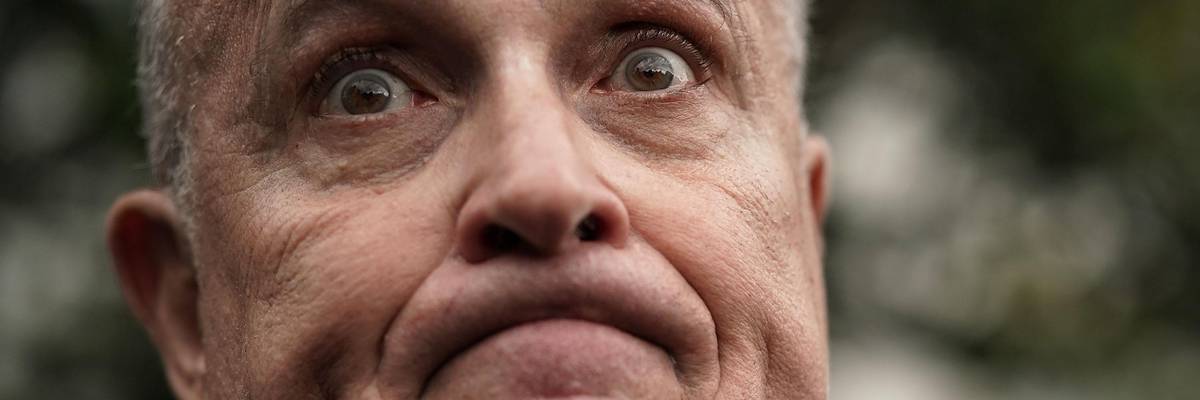
Rudy Giuliani, former New York City mayor and current lawyer for U.S. President Donald Trump, speaks to members of the media during a White House Sports and Fitness Day at the South Lawn of the White House May 30, 2018 in Washington, DC. (Photo: Alex Wong/Getty Images)
Government watchdogs and legal experts called collective 'bullshit' against the legal team of President Donald Trump on Saturday after it emerged his lawyers had sent a memo to Special Counsel Robert Mueller claiming that the president cannot be charged with obstruction of justice because, as the government's top executive, he has nearly unlimited authority over ongoing Department of Justice investigations and could also, if he desired, issue pardons for those found guilty of misdeeds or illegal behavior.
In what the Times characterized as a "brash assertion of presidential power," the 20-page letter--dated Jan. 29, 2018--states:
It remains our position that the President's actions here, by virtue of his position as the chief law enforcement officer, could neither constitutionally nor legally constitute obstruction because that would amount to him obstructing himself, and that he could if he wished, terminate the inquiry, or even exercise his power to pardon if he so desired.
According to the Times:
Mr. Trump's lawyers fear that if he answers questions, either voluntarily or in front of a grand jury, he risks exposing himself to accusations of lying to investigators, a potential crime or impeachable offense.
Mr. Trump's broad interpretation of executive authority is novel and is likely to be tested if a court battle ensues over whether he could be ordered to answer questions. It is unclear how that fight, should the case reach that point, would play out. A spokesman for Mr. Mueller declined to comment.
Posted online, the confidential memo sent to Mr. Mueller by Trump's legal team can be read here.
Citing a recent 108-page legal paper produced for the Brookings Institute (see below), Noah Bookbinder, chairperson for Citizens for Responsibility and Ethics in Washington (CREW), pushed back hard against the the claim that the president cannot--based solely on his position of power--obstruct justice. "The most fundamental American principle of all is at stake," said Bookbinder: "No one is above the law."
Subsequent to the revelations about the memo, Rudy Giuliani, now operating as one of Trump's top personal attorneys, told ABC News the president would fight any attempt by Mueller to force testimony and indicated a legal battle would result if a subpoena by the special counsel's office was issued.
"If Mueller tries to subpoena us, we're going to court," Giuliani said.
Reaction among opposition lawmakers, legal experts, and government watchdogs, however, came swiftly in reaction to the memo's release:
Dear Common Dreams reader, It’s been nearly 30 years since I co-founded Common Dreams with my late wife, Lina Newhouser. We had the radical notion that journalism should serve the public good, not corporate profits. It was clear to us from the outset what it would take to build such a project. No paid advertisements. No corporate sponsors. No millionaire publisher telling us what to think or do. Many people said we wouldn't last a year, but we proved those doubters wrong. Together with a tremendous team of journalists and dedicated staff, we built an independent media outlet free from the constraints of profits and corporate control. Our mission has always been simple: To inform. To inspire. To ignite change for the common good. Building Common Dreams was not easy. Our survival was never guaranteed. When you take on the most powerful forces—Wall Street greed, fossil fuel industry destruction, Big Tech lobbyists, and uber-rich oligarchs who have spent billions upon billions rigging the economy and democracy in their favor—the only bulwark you have is supporters who believe in your work. But here’s the urgent message from me today. It's never been this bad out there. And it's never been this hard to keep us going. At the very moment Common Dreams is most needed, the threats we face are intensifying. We need your support now more than ever. We don't accept corporate advertising and never will. We don't have a paywall because we don't think people should be blocked from critical news based on their ability to pay. Everything we do is funded by the donations of readers like you. When everyone does the little they can afford, we are strong. But if that support retreats or dries up, so do we. Will you donate now to make sure Common Dreams not only survives but thrives? —Craig Brown, Co-founder |
Government watchdogs and legal experts called collective 'bullshit' against the legal team of President Donald Trump on Saturday after it emerged his lawyers had sent a memo to Special Counsel Robert Mueller claiming that the president cannot be charged with obstruction of justice because, as the government's top executive, he has nearly unlimited authority over ongoing Department of Justice investigations and could also, if he desired, issue pardons for those found guilty of misdeeds or illegal behavior.
In what the Times characterized as a "brash assertion of presidential power," the 20-page letter--dated Jan. 29, 2018--states:
It remains our position that the President's actions here, by virtue of his position as the chief law enforcement officer, could neither constitutionally nor legally constitute obstruction because that would amount to him obstructing himself, and that he could if he wished, terminate the inquiry, or even exercise his power to pardon if he so desired.
According to the Times:
Mr. Trump's lawyers fear that if he answers questions, either voluntarily or in front of a grand jury, he risks exposing himself to accusations of lying to investigators, a potential crime or impeachable offense.
Mr. Trump's broad interpretation of executive authority is novel and is likely to be tested if a court battle ensues over whether he could be ordered to answer questions. It is unclear how that fight, should the case reach that point, would play out. A spokesman for Mr. Mueller declined to comment.
Posted online, the confidential memo sent to Mr. Mueller by Trump's legal team can be read here.
Citing a recent 108-page legal paper produced for the Brookings Institute (see below), Noah Bookbinder, chairperson for Citizens for Responsibility and Ethics in Washington (CREW), pushed back hard against the the claim that the president cannot--based solely on his position of power--obstruct justice. "The most fundamental American principle of all is at stake," said Bookbinder: "No one is above the law."
Subsequent to the revelations about the memo, Rudy Giuliani, now operating as one of Trump's top personal attorneys, told ABC News the president would fight any attempt by Mueller to force testimony and indicated a legal battle would result if a subpoena by the special counsel's office was issued.
"If Mueller tries to subpoena us, we're going to court," Giuliani said.
Reaction among opposition lawmakers, legal experts, and government watchdogs, however, came swiftly in reaction to the memo's release:
Government watchdogs and legal experts called collective 'bullshit' against the legal team of President Donald Trump on Saturday after it emerged his lawyers had sent a memo to Special Counsel Robert Mueller claiming that the president cannot be charged with obstruction of justice because, as the government's top executive, he has nearly unlimited authority over ongoing Department of Justice investigations and could also, if he desired, issue pardons for those found guilty of misdeeds or illegal behavior.
In what the Times characterized as a "brash assertion of presidential power," the 20-page letter--dated Jan. 29, 2018--states:
It remains our position that the President's actions here, by virtue of his position as the chief law enforcement officer, could neither constitutionally nor legally constitute obstruction because that would amount to him obstructing himself, and that he could if he wished, terminate the inquiry, or even exercise his power to pardon if he so desired.
According to the Times:
Mr. Trump's lawyers fear that if he answers questions, either voluntarily or in front of a grand jury, he risks exposing himself to accusations of lying to investigators, a potential crime or impeachable offense.
Mr. Trump's broad interpretation of executive authority is novel and is likely to be tested if a court battle ensues over whether he could be ordered to answer questions. It is unclear how that fight, should the case reach that point, would play out. A spokesman for Mr. Mueller declined to comment.
Posted online, the confidential memo sent to Mr. Mueller by Trump's legal team can be read here.
Citing a recent 108-page legal paper produced for the Brookings Institute (see below), Noah Bookbinder, chairperson for Citizens for Responsibility and Ethics in Washington (CREW), pushed back hard against the the claim that the president cannot--based solely on his position of power--obstruct justice. "The most fundamental American principle of all is at stake," said Bookbinder: "No one is above the law."
Subsequent to the revelations about the memo, Rudy Giuliani, now operating as one of Trump's top personal attorneys, told ABC News the president would fight any attempt by Mueller to force testimony and indicated a legal battle would result if a subpoena by the special counsel's office was issued.
"If Mueller tries to subpoena us, we're going to court," Giuliani said.
Reaction among opposition lawmakers, legal experts, and government watchdogs, however, came swiftly in reaction to the memo's release: