SUBSCRIBE TO OUR FREE NEWSLETTER
Daily news & progressive opinion—funded by the people, not the corporations—delivered straight to your inbox.
5
#000000
#FFFFFF
To donate by check, phone, or other method, see our More Ways to Give page.
Daily news & progressive opinion—funded by the people, not the corporations—delivered straight to your inbox.
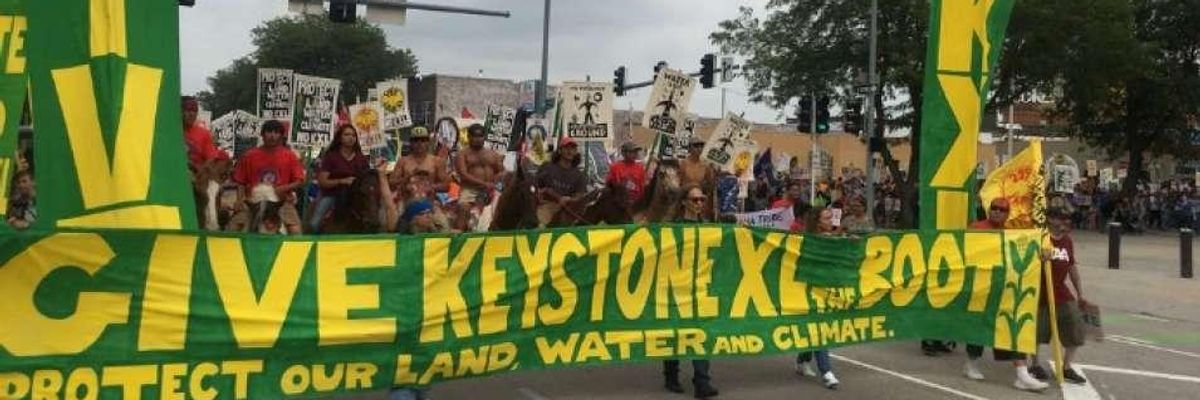
Landowners and environmentalists gathered in Lincoln, Nebraska, in August to protest TransCanada's proposed Keystone XL pipeline. (Photo: @BoldNebraska/Twitter)
TransCanada, the company behind the Keystone XL pipeline, "is showering Nebraska public officials with campaign cash as it fights for regulatory approval in a state that is one of the last lines of resistance" against the project, an Associated Press review of public records revealed Tuesday.
The AP found that a TransCanada political action committee has given more than $65,000 to campaigning officials within the past year, including $25,000 to GOP Gov. Pete Ricketts' re-election effort, $15,000 to the Nebraska Republican Party, and $25,500 to state legislators.
"There is no question big political donations have bought some politicians," responded Jane Kleeb, chair of the Nebraska Democratic Party and president of the Nebraska-based Bold Alliance, which is helping lead the local fight to block the pipeline.
"I guess from their perspective, they're doing what they think they need to do to get the pipeline built," said Jack Gould, issues chairman of Common Cause Nebraska. Gould added TransCanada's political investments are higher than many other companies that target state officials.
"In addition to the campaign contributions," the AP noted, "TransCanada has previously reported spending more than $1.2 million on lobbying in Nebraska between 2006 and mid-2017."
Responding to the report, Common Cause Minnesota tweeted that this type of political spending is a "blatant and common way" that special interest money "infiltrates our democracy."
The 36-diameter crude oil pipeline--which was blocked by the Obama administration but then approved by President Donald Trump's State Department--would carry up to 830,000 barrels daily from Alberta, Canada across Montana and South Dakota to Nebraska. Since it was first introduced a decade ago, the project has been met with fierce criticism from environmental groups, landowners, and Native American tribes.
Last week, critics of the pipeline gathered in Great Falls, Montana to protest Keystone XL ahead of a court hearing about the Trump administration's approval of the project in U.S. District Court. Environmental and indigenous groups have filed two federal lawsuits to block the presidential permit, citing concerns about property rights and groundwater contamination.
Following four hours of debate on Thursday, Judge Brian Morris, who previously rejected the Trump administration's attempt to have the case thrown out, did not issue a final ruling. However, Morris has previously ruled against the administration's deregulatory agenda. Earlier this year he declared that the Bureau of Land Management must work with environmental groups to rewrite its proposed "coal-friendly" rules for coal mining on public lands to take climate change into account.
Dear Common Dreams reader, It’s been nearly 30 years since I co-founded Common Dreams with my late wife, Lina Newhouser. We had the radical notion that journalism should serve the public good, not corporate profits. It was clear to us from the outset what it would take to build such a project. No paid advertisements. No corporate sponsors. No millionaire publisher telling us what to think or do. Many people said we wouldn't last a year, but we proved those doubters wrong. Together with a tremendous team of journalists and dedicated staff, we built an independent media outlet free from the constraints of profits and corporate control. Our mission has always been simple: To inform. To inspire. To ignite change for the common good. Building Common Dreams was not easy. Our survival was never guaranteed. When you take on the most powerful forces—Wall Street greed, fossil fuel industry destruction, Big Tech lobbyists, and uber-rich oligarchs who have spent billions upon billions rigging the economy and democracy in their favor—the only bulwark you have is supporters who believe in your work. But here’s the urgent message from me today. It's never been this bad out there. And it's never been this hard to keep us going. At the very moment Common Dreams is most needed, the threats we face are intensifying. We need your support now more than ever. We don't accept corporate advertising and never will. We don't have a paywall because we don't think people should be blocked from critical news based on their ability to pay. Everything we do is funded by the donations of readers like you. When everyone does the little they can afford, we are strong. But if that support retreats or dries up, so do we. Will you donate now to make sure Common Dreams not only survives but thrives? —Craig Brown, Co-founder |
TransCanada, the company behind the Keystone XL pipeline, "is showering Nebraska public officials with campaign cash as it fights for regulatory approval in a state that is one of the last lines of resistance" against the project, an Associated Press review of public records revealed Tuesday.
The AP found that a TransCanada political action committee has given more than $65,000 to campaigning officials within the past year, including $25,000 to GOP Gov. Pete Ricketts' re-election effort, $15,000 to the Nebraska Republican Party, and $25,500 to state legislators.
"There is no question big political donations have bought some politicians," responded Jane Kleeb, chair of the Nebraska Democratic Party and president of the Nebraska-based Bold Alliance, which is helping lead the local fight to block the pipeline.
"I guess from their perspective, they're doing what they think they need to do to get the pipeline built," said Jack Gould, issues chairman of Common Cause Nebraska. Gould added TransCanada's political investments are higher than many other companies that target state officials.
"In addition to the campaign contributions," the AP noted, "TransCanada has previously reported spending more than $1.2 million on lobbying in Nebraska between 2006 and mid-2017."
Responding to the report, Common Cause Minnesota tweeted that this type of political spending is a "blatant and common way" that special interest money "infiltrates our democracy."
The 36-diameter crude oil pipeline--which was blocked by the Obama administration but then approved by President Donald Trump's State Department--would carry up to 830,000 barrels daily from Alberta, Canada across Montana and South Dakota to Nebraska. Since it was first introduced a decade ago, the project has been met with fierce criticism from environmental groups, landowners, and Native American tribes.
Last week, critics of the pipeline gathered in Great Falls, Montana to protest Keystone XL ahead of a court hearing about the Trump administration's approval of the project in U.S. District Court. Environmental and indigenous groups have filed two federal lawsuits to block the presidential permit, citing concerns about property rights and groundwater contamination.
Following four hours of debate on Thursday, Judge Brian Morris, who previously rejected the Trump administration's attempt to have the case thrown out, did not issue a final ruling. However, Morris has previously ruled against the administration's deregulatory agenda. Earlier this year he declared that the Bureau of Land Management must work with environmental groups to rewrite its proposed "coal-friendly" rules for coal mining on public lands to take climate change into account.
TransCanada, the company behind the Keystone XL pipeline, "is showering Nebraska public officials with campaign cash as it fights for regulatory approval in a state that is one of the last lines of resistance" against the project, an Associated Press review of public records revealed Tuesday.
The AP found that a TransCanada political action committee has given more than $65,000 to campaigning officials within the past year, including $25,000 to GOP Gov. Pete Ricketts' re-election effort, $15,000 to the Nebraska Republican Party, and $25,500 to state legislators.
"There is no question big political donations have bought some politicians," responded Jane Kleeb, chair of the Nebraska Democratic Party and president of the Nebraska-based Bold Alliance, which is helping lead the local fight to block the pipeline.
"I guess from their perspective, they're doing what they think they need to do to get the pipeline built," said Jack Gould, issues chairman of Common Cause Nebraska. Gould added TransCanada's political investments are higher than many other companies that target state officials.
"In addition to the campaign contributions," the AP noted, "TransCanada has previously reported spending more than $1.2 million on lobbying in Nebraska between 2006 and mid-2017."
Responding to the report, Common Cause Minnesota tweeted that this type of political spending is a "blatant and common way" that special interest money "infiltrates our democracy."
The 36-diameter crude oil pipeline--which was blocked by the Obama administration but then approved by President Donald Trump's State Department--would carry up to 830,000 barrels daily from Alberta, Canada across Montana and South Dakota to Nebraska. Since it was first introduced a decade ago, the project has been met with fierce criticism from environmental groups, landowners, and Native American tribes.
Last week, critics of the pipeline gathered in Great Falls, Montana to protest Keystone XL ahead of a court hearing about the Trump administration's approval of the project in U.S. District Court. Environmental and indigenous groups have filed two federal lawsuits to block the presidential permit, citing concerns about property rights and groundwater contamination.
Following four hours of debate on Thursday, Judge Brian Morris, who previously rejected the Trump administration's attempt to have the case thrown out, did not issue a final ruling. However, Morris has previously ruled against the administration's deregulatory agenda. Earlier this year he declared that the Bureau of Land Management must work with environmental groups to rewrite its proposed "coal-friendly" rules for coal mining on public lands to take climate change into account.