SUBSCRIBE TO OUR FREE NEWSLETTER
Daily news & progressive opinion—funded by the people, not the corporations—delivered straight to your inbox.
5
#000000
#FFFFFF
To donate by check, phone, or other method, see our More Ways to Give page.
Daily news & progressive opinion—funded by the people, not the corporations—delivered straight to your inbox.
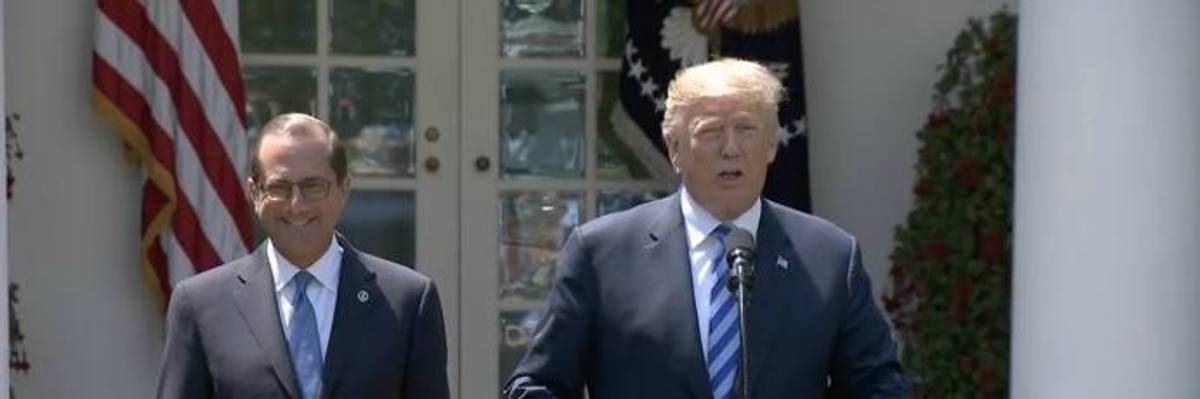
"Shock of all shocks: It turns out that President Trump was not being honest when he said he was going to stop the prescription drug companies from 'getting away with murder.' Another day. Another lie," wrote Sen. Bernie Sanders in response to Trump's plan. (Photo: Youtube/Screengrab)
Officially ditching his campaign promise to challenge the pharmaceutical industry head-on and allow Medicare to negotiate lower drug prices--a betrayal that may have something to do with the fact that the White House is currently occupied by former Big Pharma executives in key posts--President Donald Trump on Friday formally unveiled a plan ostensibly aimed at cutting medicine costs that analysts and progressive critics are already slamming as wholly inadequate and "pharma-friendly."
"Trump is proposing to increase drug prices abroad, probably through trade deals. This is the biggest item on Big Pharma's wish list! How the heck is this going to lower drug prices in this country?"
--Topher Spiro, Center for American Progress
Taking heat off the greedy pharmaceutical companies he once accused of "getting away with murder," Trump's plan shifts much of the blame for soaring drug prices in America on foreign governments that "use socialized healthcare to command unfairly low prices from U.S. drugmakers," according to a summary of Trump's proposals obtained by the New York Times.
Sen. Bernie Sanders (I-Vt.), who last October introduced legislation that would allow Medicare to negotiate drug prices, denounced Trump's plan as "lukewarm" and said approaches that don't directly take on the price-gouging of American drugmakers "just aren't going to work."
Rather than allowing the government to negotiate lower drug prices--a proposal backed by 92 percent of Americans--Trump's plan vaguely promises to "encourage innovation" in the private sector while pursuing "reforms" to Medicare to promote "greater flexibility."
"There is nothing, absolutely nothing in here to lower drug prices for the 150 million Americans with employer coverage or the millions more with other private insurance," Topher Spiro, a senior fellow at the Center for American Progress, wrote after reviewing the summary of Trump's plan.
Spiro also noted that the plan would do nothing to reduce the "sky-high" costs of specialty drugs.
While Trump's plan won't provide relief for hundreds of millions harmed by astronomical drug prices, Spiro added that it does fulfill "the biggest item on Big Pharma's wish list":
A Public Citizen report (pdf) released on Friday ahead of Trump's long-delayed drug policy unveil may provide some clues into why the president has decided to reward the U.S. pharmaceutical industry instead of taking the tough stance he promised on the campaign trail.
"We expect President Trump's upcoming speech on lowering drug prices to be rhetorically critical of pharmaceutical manufacturers and the supply chain, but he will not propose actions that actually threaten drugmakers' ability to set high prices for their product."
--Andrea Harris, Height Capital Markets
Titled "Big Pharma Swamps Trump," the report shows "the pharmaceutical industry spent $279 million on lobbying the Trump administration and Congress" in 2017--"a record amount."
"Solutions to Big Pharma's monopoly abuses are at hand, but they require a political will that we are unlikely to see from an administration in the grip of the drug corporations," Public Citizen president Robert Weissman said in a statement.
Thanks to the enormous clout of drug companies have within the Trump administration and the GOP-controlled Congress, pharmaceutical industry analysts said openly ahead of Trump's speech on Friday that they aren't worried the president will do anything to harm the profits of drugmakers.
"We expect President Trump's upcoming speech on lowering drug prices to be rhetorically critical of pharmaceutical manufacturers and the supply chain, but he will not propose actions that actually threaten drugmakers' ability to set high prices for their product," Height Capital Markets analyst Andrea Harris said in an interview with MarketWatch on Friday.
Dear Common Dreams reader, It’s been nearly 30 years since I co-founded Common Dreams with my late wife, Lina Newhouser. We had the radical notion that journalism should serve the public good, not corporate profits. It was clear to us from the outset what it would take to build such a project. No paid advertisements. No corporate sponsors. No millionaire publisher telling us what to think or do. Many people said we wouldn't last a year, but we proved those doubters wrong. Together with a tremendous team of journalists and dedicated staff, we built an independent media outlet free from the constraints of profits and corporate control. Our mission has always been simple: To inform. To inspire. To ignite change for the common good. Building Common Dreams was not easy. Our survival was never guaranteed. When you take on the most powerful forces—Wall Street greed, fossil fuel industry destruction, Big Tech lobbyists, and uber-rich oligarchs who have spent billions upon billions rigging the economy and democracy in their favor—the only bulwark you have is supporters who believe in your work. But here’s the urgent message from me today. It's never been this bad out there. And it's never been this hard to keep us going. At the very moment Common Dreams is most needed, the threats we face are intensifying. We need your support now more than ever. We don't accept corporate advertising and never will. We don't have a paywall because we don't think people should be blocked from critical news based on their ability to pay. Everything we do is funded by the donations of readers like you. When everyone does the little they can afford, we are strong. But if that support retreats or dries up, so do we. Will you donate now to make sure Common Dreams not only survives but thrives? —Craig Brown, Co-founder |
Officially ditching his campaign promise to challenge the pharmaceutical industry head-on and allow Medicare to negotiate lower drug prices--a betrayal that may have something to do with the fact that the White House is currently occupied by former Big Pharma executives in key posts--President Donald Trump on Friday formally unveiled a plan ostensibly aimed at cutting medicine costs that analysts and progressive critics are already slamming as wholly inadequate and "pharma-friendly."
"Trump is proposing to increase drug prices abroad, probably through trade deals. This is the biggest item on Big Pharma's wish list! How the heck is this going to lower drug prices in this country?"
--Topher Spiro, Center for American Progress
Taking heat off the greedy pharmaceutical companies he once accused of "getting away with murder," Trump's plan shifts much of the blame for soaring drug prices in America on foreign governments that "use socialized healthcare to command unfairly low prices from U.S. drugmakers," according to a summary of Trump's proposals obtained by the New York Times.
Sen. Bernie Sanders (I-Vt.), who last October introduced legislation that would allow Medicare to negotiate drug prices, denounced Trump's plan as "lukewarm" and said approaches that don't directly take on the price-gouging of American drugmakers "just aren't going to work."
Rather than allowing the government to negotiate lower drug prices--a proposal backed by 92 percent of Americans--Trump's plan vaguely promises to "encourage innovation" in the private sector while pursuing "reforms" to Medicare to promote "greater flexibility."
"There is nothing, absolutely nothing in here to lower drug prices for the 150 million Americans with employer coverage or the millions more with other private insurance," Topher Spiro, a senior fellow at the Center for American Progress, wrote after reviewing the summary of Trump's plan.
Spiro also noted that the plan would do nothing to reduce the "sky-high" costs of specialty drugs.
While Trump's plan won't provide relief for hundreds of millions harmed by astronomical drug prices, Spiro added that it does fulfill "the biggest item on Big Pharma's wish list":
A Public Citizen report (pdf) released on Friday ahead of Trump's long-delayed drug policy unveil may provide some clues into why the president has decided to reward the U.S. pharmaceutical industry instead of taking the tough stance he promised on the campaign trail.
"We expect President Trump's upcoming speech on lowering drug prices to be rhetorically critical of pharmaceutical manufacturers and the supply chain, but he will not propose actions that actually threaten drugmakers' ability to set high prices for their product."
--Andrea Harris, Height Capital Markets
Titled "Big Pharma Swamps Trump," the report shows "the pharmaceutical industry spent $279 million on lobbying the Trump administration and Congress" in 2017--"a record amount."
"Solutions to Big Pharma's monopoly abuses are at hand, but they require a political will that we are unlikely to see from an administration in the grip of the drug corporations," Public Citizen president Robert Weissman said in a statement.
Thanks to the enormous clout of drug companies have within the Trump administration and the GOP-controlled Congress, pharmaceutical industry analysts said openly ahead of Trump's speech on Friday that they aren't worried the president will do anything to harm the profits of drugmakers.
"We expect President Trump's upcoming speech on lowering drug prices to be rhetorically critical of pharmaceutical manufacturers and the supply chain, but he will not propose actions that actually threaten drugmakers' ability to set high prices for their product," Height Capital Markets analyst Andrea Harris said in an interview with MarketWatch on Friday.
Officially ditching his campaign promise to challenge the pharmaceutical industry head-on and allow Medicare to negotiate lower drug prices--a betrayal that may have something to do with the fact that the White House is currently occupied by former Big Pharma executives in key posts--President Donald Trump on Friday formally unveiled a plan ostensibly aimed at cutting medicine costs that analysts and progressive critics are already slamming as wholly inadequate and "pharma-friendly."
"Trump is proposing to increase drug prices abroad, probably through trade deals. This is the biggest item on Big Pharma's wish list! How the heck is this going to lower drug prices in this country?"
--Topher Spiro, Center for American Progress
Taking heat off the greedy pharmaceutical companies he once accused of "getting away with murder," Trump's plan shifts much of the blame for soaring drug prices in America on foreign governments that "use socialized healthcare to command unfairly low prices from U.S. drugmakers," according to a summary of Trump's proposals obtained by the New York Times.
Sen. Bernie Sanders (I-Vt.), who last October introduced legislation that would allow Medicare to negotiate drug prices, denounced Trump's plan as "lukewarm" and said approaches that don't directly take on the price-gouging of American drugmakers "just aren't going to work."
Rather than allowing the government to negotiate lower drug prices--a proposal backed by 92 percent of Americans--Trump's plan vaguely promises to "encourage innovation" in the private sector while pursuing "reforms" to Medicare to promote "greater flexibility."
"There is nothing, absolutely nothing in here to lower drug prices for the 150 million Americans with employer coverage or the millions more with other private insurance," Topher Spiro, a senior fellow at the Center for American Progress, wrote after reviewing the summary of Trump's plan.
Spiro also noted that the plan would do nothing to reduce the "sky-high" costs of specialty drugs.
While Trump's plan won't provide relief for hundreds of millions harmed by astronomical drug prices, Spiro added that it does fulfill "the biggest item on Big Pharma's wish list":
A Public Citizen report (pdf) released on Friday ahead of Trump's long-delayed drug policy unveil may provide some clues into why the president has decided to reward the U.S. pharmaceutical industry instead of taking the tough stance he promised on the campaign trail.
"We expect President Trump's upcoming speech on lowering drug prices to be rhetorically critical of pharmaceutical manufacturers and the supply chain, but he will not propose actions that actually threaten drugmakers' ability to set high prices for their product."
--Andrea Harris, Height Capital Markets
Titled "Big Pharma Swamps Trump," the report shows "the pharmaceutical industry spent $279 million on lobbying the Trump administration and Congress" in 2017--"a record amount."
"Solutions to Big Pharma's monopoly abuses are at hand, but they require a political will that we are unlikely to see from an administration in the grip of the drug corporations," Public Citizen president Robert Weissman said in a statement.
Thanks to the enormous clout of drug companies have within the Trump administration and the GOP-controlled Congress, pharmaceutical industry analysts said openly ahead of Trump's speech on Friday that they aren't worried the president will do anything to harm the profits of drugmakers.
"We expect President Trump's upcoming speech on lowering drug prices to be rhetorically critical of pharmaceutical manufacturers and the supply chain, but he will not propose actions that actually threaten drugmakers' ability to set high prices for their product," Height Capital Markets analyst Andrea Harris said in an interview with MarketWatch on Friday.