SUBSCRIBE TO OUR FREE NEWSLETTER
Daily news & progressive opinion—funded by the people, not the corporations—delivered straight to your inbox.
5
#000000
#FFFFFF
To donate by check, phone, or other method, see our More Ways to Give page.
Daily news & progressive opinion—funded by the people, not the corporations—delivered straight to your inbox.
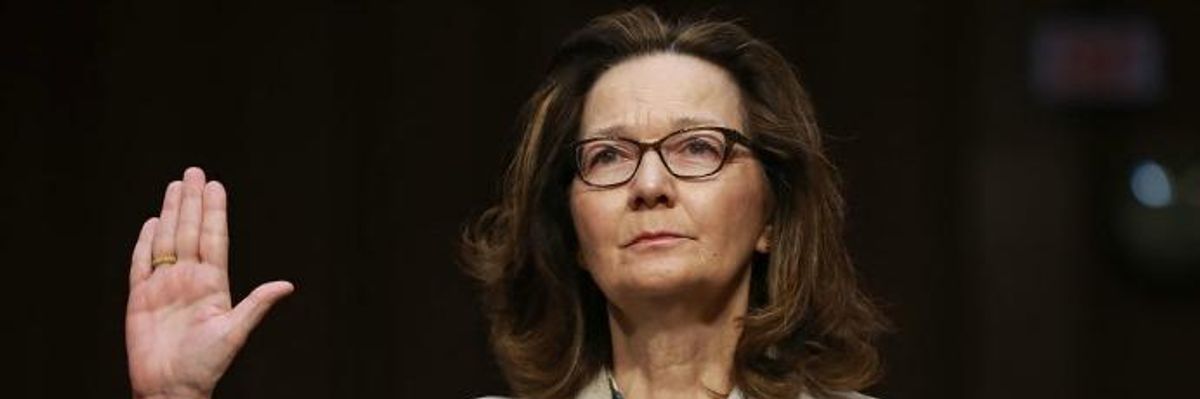
Central Intelligence Agency Deputy Director Gina Haspel is sworn in before the Senate Intelligence Committee during her confirmation hearing to become the next CIA director in the Hart Senate Office Building May 9, 2018 in Washington, D.C. (Photo: Chip Somodevilla/Getty Images)
After presenting herself as "a typical middle-class American" who was brought up with a strong "moral compass" in her opening remarks before the Senate Intelligence Committee on Wednesday, Gina Haspel--President Donald Trump's pick to head the CIA--would not admit that the agency has ever tortured nor would she say that she believes torture is immoral.
Asked repeatedly by Sen. Kamala Harris (D-Calif.) to provide a "yes or no" answer to whether the CIA's torture techniques used in the aftermath of 9/11 were immoral, Haspel repeatedly dodged and at one point strongly endorsed the tactics she reportedly oversaw as an a CIA official, saying the agency "did extraordinary work to prevent another attack on this country."
Haspel went on to say that while she doesn't believe "torture works" as Trump has suggested, she does think the CIA's "program" elicited "valuable information" from detainees.
Watch:
While the CIA and its many apologists have long attempted to deny or sow confusion over whether certain forms of the agency's abuse constituted torture, legal and human rights experts have been crystal clear that "torture is torture, and waterboarding is not an exception."
Though President Obama once acknowledged how the U.S. "tortured some folks," throughout her prepared statement and during questioning, Haspel repeatedly referred to the CIA as having a "detention and interrogation program" in which she played a pivotal role. However, she avoided at every opportunity use of the word "torture" and never once admitted that the agency "tortured" anybody.
Responding to Senate hearing on Twitter, The Intercept's Jeremy Scahill denounced Haspel's answers to even the most mild and poorly framed questions raised by lawmakers.
"Even through the most mainstream bullshit prism of Senate politics, Haspel's answers were a disgrace," Scahill wrote. "Any Democrat that votes to confirm Haspel should never be allowed to live it down."
After the two-and-a-half hour hearing was finally brought to a close, Scahill concluded, "My god, that was horrid."
This country and this world are at a monumental crossroads. US voters have an opportunity to beat back the forces of fascism and confront the billionaires who are rigging the economy, our media system, and our democracy, making it increasingly impossible for ordinary people to get by. We’re not just talking about the election. We’re talking about what must be done once these fascist elements are vanquished from power. We need a bolder set of solutions than what either major party has so far been willing to offer and a working-class movement ready to fight like hell for it. Trump didn't emerge from nowhere. The conditions that fueled MAGA authoritarianism were created by decades of radical neoliberal economic policies and a corrupt political system dominated by corporate interests. They slashed taxes on the super-rich, promising that the benefits would trickle down. They said giveaways to the corporate titans would make life more affordable for the rest of us. It was all bullshit. And when a bitter, betrayed populace searches for someone to blame, right-wing demagogues have little trouble finding scapegoats. People know when they're being lied to, but you won't hear any of this from the corporate media. Only independent journalism—powered and funded by people who believe in building a better world—can deliver truly trustworthy daily news. If you share our vision, please contribute whatever you can to sustain our work. |
After presenting herself as "a typical middle-class American" who was brought up with a strong "moral compass" in her opening remarks before the Senate Intelligence Committee on Wednesday, Gina Haspel--President Donald Trump's pick to head the CIA--would not admit that the agency has ever tortured nor would she say that she believes torture is immoral.
Asked repeatedly by Sen. Kamala Harris (D-Calif.) to provide a "yes or no" answer to whether the CIA's torture techniques used in the aftermath of 9/11 were immoral, Haspel repeatedly dodged and at one point strongly endorsed the tactics she reportedly oversaw as an a CIA official, saying the agency "did extraordinary work to prevent another attack on this country."
Haspel went on to say that while she doesn't believe "torture works" as Trump has suggested, she does think the CIA's "program" elicited "valuable information" from detainees.
Watch:
While the CIA and its many apologists have long attempted to deny or sow confusion over whether certain forms of the agency's abuse constituted torture, legal and human rights experts have been crystal clear that "torture is torture, and waterboarding is not an exception."
Though President Obama once acknowledged how the U.S. "tortured some folks," throughout her prepared statement and during questioning, Haspel repeatedly referred to the CIA as having a "detention and interrogation program" in which she played a pivotal role. However, she avoided at every opportunity use of the word "torture" and never once admitted that the agency "tortured" anybody.
Responding to Senate hearing on Twitter, The Intercept's Jeremy Scahill denounced Haspel's answers to even the most mild and poorly framed questions raised by lawmakers.
"Even through the most mainstream bullshit prism of Senate politics, Haspel's answers were a disgrace," Scahill wrote. "Any Democrat that votes to confirm Haspel should never be allowed to live it down."
After the two-and-a-half hour hearing was finally brought to a close, Scahill concluded, "My god, that was horrid."