

SUBSCRIBE TO OUR FREE NEWSLETTER
Daily news & progressive opinion—funded by the people, not the corporations—delivered straight to your inbox.
5
#000000
#FFFFFF
To donate by check, phone, or other method, see our More Ways to Give page.
Daily news & progressive opinion—funded by the people, not the corporations—delivered straight to your inbox.
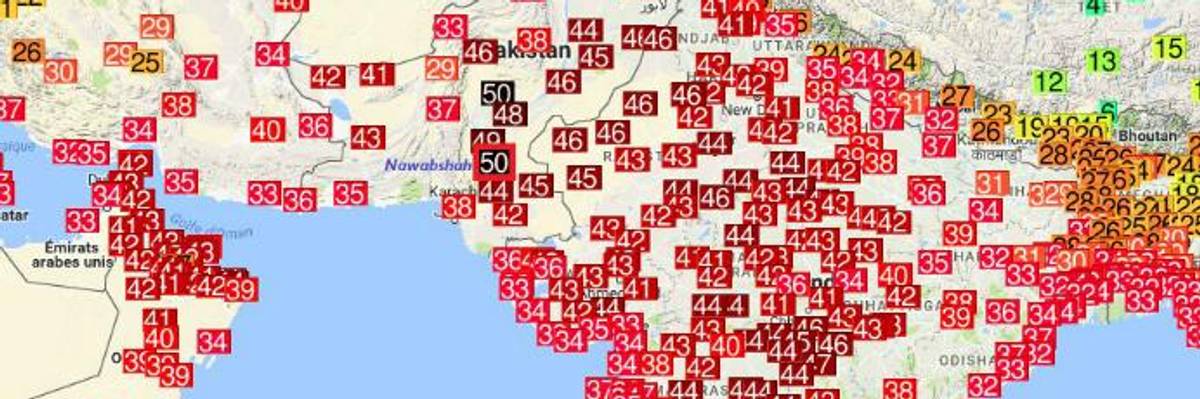
The temperature in a Pakistani city may have broken world records for the month of April. (Photo: @EKMeteo/Twitter)
While climate scientists worldwide continue to issue urgent warnings that human-caused global warming will make heat waves "hotter, longer, and more frequent," a city in Pakistan on Monday may have set a record for the highest April temperature ever recorded on Earth.
As highlighted by French meteorologist Etienne Kapikian on Twitter, the city of Nawabshah hit 50.2degC (122.36degF) on Monday, which "caused dozens of people to faint" from heatstroke, according to the Pakistani newspaper The Dawn.
Kapikian claimed it is the hottest April temperature ever recorded not only in Pakistan but across Asia. Extreme weather expert and historian Christopher Burt not only backed up that assertion--he told told the Earther that it is likely "the hottest April temperature yet reliably observed on Earth in modern records."
"There was a 51.0degC reading reported from Santa Rosa, Mexico in April 2011," Burt acknowledged, "but this figure is considered of dubious reliability."
This is the second straight month that Nawabshah has broken an extreme heat record. The city hit 45.5degC (113.9degF) in March, Pakistan's highest ever for that month.
And, as Kapikian and 350.org co-founder Bill McKibben pointed out, it's also the second year in a row that Pakistan set a record for the month. On April 19, 2017, the temperature in Lakarna soared to 50degC (122degF).
The potential new record temperature even surpasses the highest that was recorded during an "unbelievable" heat wave that struck the region in June of 2015, killing hundreds of people and forcing Pakistani officials to declare a state of emergency for hospitals.
As the Washington Post noted, the "reading in Nawabshah adds to a long list of international hot weather extremes since 2017, which includes Spain's and Iran's highest temperatures ever recorded last summer" and Pakistan breaking the monthly world record when the temperature reached 53.5degC (128.3degF) in Turbat last May.
"The recent eye-popping temperatures in Pakistan fall in line with a growing body of research showing how climate change is making heat waves more common and intense nearly everywhere," which is "particularly dire news for what's already one of the hottest parts of the world," Earther concluded.
A study published last summer by the journal Nature Climate Change found that half the world could experience deadly heat waves by the end of the century. The research, combined with the record-breaking temperatures, boslters calls to ramp up efforts to reduce greenhouse gas emissions that are fueling global warming.
Speaking at press conference on Monday, UN Climate Change executive secretary Patricia Espinosa said, "We are witnessing the severe impacts of climate change throughout the world."
"Every credible scientific source is telling us that these impacts will only get worse if we do not address climate change, and it also tells us that our window of time for addressing it is closing very soon," Espinosa added. "We need to dramatically increase our ambitions."
Dear Common Dreams reader, It’s been nearly 30 years since I co-founded Common Dreams with my late wife, Lina Newhouser. We had the radical notion that journalism should serve the public good, not corporate profits. It was clear to us from the outset what it would take to build such a project. No paid advertisements. No corporate sponsors. No millionaire publisher telling us what to think or do. Many people said we wouldn't last a year, but we proved those doubters wrong. Together with a tremendous team of journalists and dedicated staff, we built an independent media outlet free from the constraints of profits and corporate control. Our mission has always been simple: To inform. To inspire. To ignite change for the common good. Building Common Dreams was not easy. Our survival was never guaranteed. When you take on the most powerful forces—Wall Street greed, fossil fuel industry destruction, Big Tech lobbyists, and uber-rich oligarchs who have spent billions upon billions rigging the economy and democracy in their favor—the only bulwark you have is supporters who believe in your work. But here’s the urgent message from me today. It's never been this bad out there. And it's never been this hard to keep us going. At the very moment Common Dreams is most needed, the threats we face are intensifying. We need your support now more than ever. We don't accept corporate advertising and never will. We don't have a paywall because we don't think people should be blocked from critical news based on their ability to pay. Everything we do is funded by the donations of readers like you. When everyone does the little they can afford, we are strong. But if that support retreats or dries up, so do we. Will you donate now to make sure Common Dreams not only survives but thrives? —Craig Brown, Co-founder |
While climate scientists worldwide continue to issue urgent warnings that human-caused global warming will make heat waves "hotter, longer, and more frequent," a city in Pakistan on Monday may have set a record for the highest April temperature ever recorded on Earth.
As highlighted by French meteorologist Etienne Kapikian on Twitter, the city of Nawabshah hit 50.2degC (122.36degF) on Monday, which "caused dozens of people to faint" from heatstroke, according to the Pakistani newspaper The Dawn.
Kapikian claimed it is the hottest April temperature ever recorded not only in Pakistan but across Asia. Extreme weather expert and historian Christopher Burt not only backed up that assertion--he told told the Earther that it is likely "the hottest April temperature yet reliably observed on Earth in modern records."
"There was a 51.0degC reading reported from Santa Rosa, Mexico in April 2011," Burt acknowledged, "but this figure is considered of dubious reliability."
This is the second straight month that Nawabshah has broken an extreme heat record. The city hit 45.5degC (113.9degF) in March, Pakistan's highest ever for that month.
And, as Kapikian and 350.org co-founder Bill McKibben pointed out, it's also the second year in a row that Pakistan set a record for the month. On April 19, 2017, the temperature in Lakarna soared to 50degC (122degF).
The potential new record temperature even surpasses the highest that was recorded during an "unbelievable" heat wave that struck the region in June of 2015, killing hundreds of people and forcing Pakistani officials to declare a state of emergency for hospitals.
As the Washington Post noted, the "reading in Nawabshah adds to a long list of international hot weather extremes since 2017, which includes Spain's and Iran's highest temperatures ever recorded last summer" and Pakistan breaking the monthly world record when the temperature reached 53.5degC (128.3degF) in Turbat last May.
"The recent eye-popping temperatures in Pakistan fall in line with a growing body of research showing how climate change is making heat waves more common and intense nearly everywhere," which is "particularly dire news for what's already one of the hottest parts of the world," Earther concluded.
A study published last summer by the journal Nature Climate Change found that half the world could experience deadly heat waves by the end of the century. The research, combined with the record-breaking temperatures, boslters calls to ramp up efforts to reduce greenhouse gas emissions that are fueling global warming.
Speaking at press conference on Monday, UN Climate Change executive secretary Patricia Espinosa said, "We are witnessing the severe impacts of climate change throughout the world."
"Every credible scientific source is telling us that these impacts will only get worse if we do not address climate change, and it also tells us that our window of time for addressing it is closing very soon," Espinosa added. "We need to dramatically increase our ambitions."
While climate scientists worldwide continue to issue urgent warnings that human-caused global warming will make heat waves "hotter, longer, and more frequent," a city in Pakistan on Monday may have set a record for the highest April temperature ever recorded on Earth.
As highlighted by French meteorologist Etienne Kapikian on Twitter, the city of Nawabshah hit 50.2degC (122.36degF) on Monday, which "caused dozens of people to faint" from heatstroke, according to the Pakistani newspaper The Dawn.
Kapikian claimed it is the hottest April temperature ever recorded not only in Pakistan but across Asia. Extreme weather expert and historian Christopher Burt not only backed up that assertion--he told told the Earther that it is likely "the hottest April temperature yet reliably observed on Earth in modern records."
"There was a 51.0degC reading reported from Santa Rosa, Mexico in April 2011," Burt acknowledged, "but this figure is considered of dubious reliability."
This is the second straight month that Nawabshah has broken an extreme heat record. The city hit 45.5degC (113.9degF) in March, Pakistan's highest ever for that month.
And, as Kapikian and 350.org co-founder Bill McKibben pointed out, it's also the second year in a row that Pakistan set a record for the month. On April 19, 2017, the temperature in Lakarna soared to 50degC (122degF).
The potential new record temperature even surpasses the highest that was recorded during an "unbelievable" heat wave that struck the region in June of 2015, killing hundreds of people and forcing Pakistani officials to declare a state of emergency for hospitals.
As the Washington Post noted, the "reading in Nawabshah adds to a long list of international hot weather extremes since 2017, which includes Spain's and Iran's highest temperatures ever recorded last summer" and Pakistan breaking the monthly world record when the temperature reached 53.5degC (128.3degF) in Turbat last May.
"The recent eye-popping temperatures in Pakistan fall in line with a growing body of research showing how climate change is making heat waves more common and intense nearly everywhere," which is "particularly dire news for what's already one of the hottest parts of the world," Earther concluded.
A study published last summer by the journal Nature Climate Change found that half the world could experience deadly heat waves by the end of the century. The research, combined with the record-breaking temperatures, boslters calls to ramp up efforts to reduce greenhouse gas emissions that are fueling global warming.
Speaking at press conference on Monday, UN Climate Change executive secretary Patricia Espinosa said, "We are witnessing the severe impacts of climate change throughout the world."
"Every credible scientific source is telling us that these impacts will only get worse if we do not address climate change, and it also tells us that our window of time for addressing it is closing very soon," Espinosa added. "We need to dramatically increase our ambitions."

