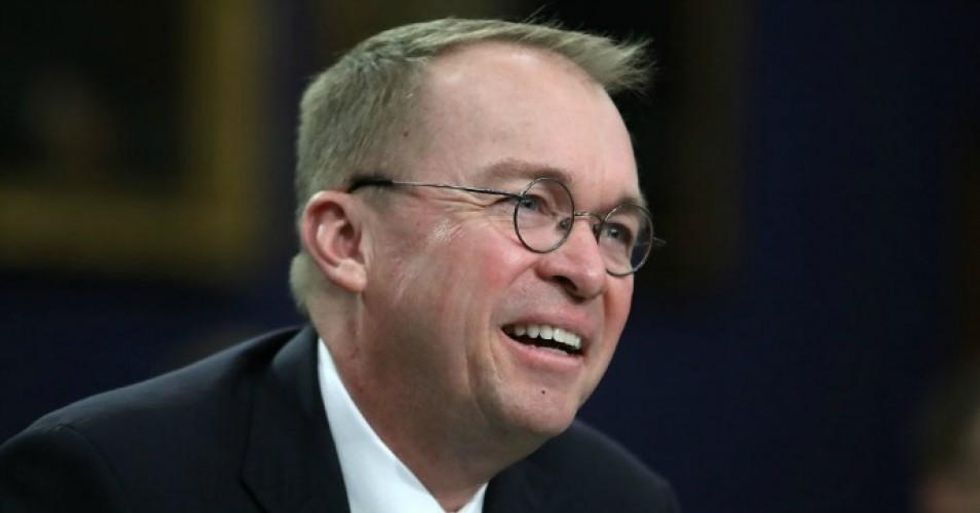
Providing a remarkably blatant account of how Congress is basically "an extortion racket" and perhaps offering some insight into how he makes decisions at the CFPB, White House budget chief Mick Mulvaney told a gathering of bank executives on Tuesday that as a lawmaker he would only meet with lobbyists who gave him cash.
"A consummate grifter with a penchant for petty, penny-ante bullshit, Mick Mulvaney really is the embodiment of this whole administration."
--Kevin Kruse
"We had a hierarchy in my office in Congress," Mulvaney, who previously represented South Carolina in the House, told executives at an American Bankers Association conference in Washington. "If you're a lobbyist who never gave us money, I didn't talk to you. If you're a lobbyist who gave us money, I might talk to you."
Mulvaney's comment came as he was advising bankers on how to most effectively pursue their deregulatory agenda with Congress.
Influencing legislators, Mulvaney explained to the audience of ultra-wealthy financiers, is one of the "fundamental underpinnings of our representative democracy. And you have to continue to do it."
Robert Reich, former Secretary of Labor and professor at University of California, Berkeley, offered a simple translation of Mulvaney's advice on how to sway lawmakers: "Bribe them with even more money."
Others also weighed in on social media, arguing that Mulvaney's speech lays bare the corruption at the heart of Washington, which is being drastically and openly expanded by the Trump administration.
Mulvaney, who was controversially placed in charge of the CFPB by President Donald Trump last year, is no stranger to campaign contributions from the financial sector--and many have argued that these contributions are currently driving his effort to dismantle the consumer bureau he now runs.
As the New York Times noted on Tuesday, Mulvaney raked in around $63,000 from payday lenders as a member of Congress. As acting head of the CFPB, Mulvaney has moved to kill probes into payday lenders accused of exploiting poor Americans.
"Mulvaney's comments Tuesday laid bare the conflicts of interest present in his running of the Obama-era financial regulator into the ground, while also raising obvious questions about his time as a legislator," Slate's Elliot Hannon observes. "The Trump administration generally, and Mulvaney specifically, have not done much to hide their disdain for the consumer protection mandate given the CFPB in the wake of the 2008 financial crisis and have intermittently worked to roll back its authority where possible and sabotage it elsewhere."
Providing a remarkably blatant account of how Congress is basically "an extortion racket" and perhaps offering some insight into how he makes decisions at the CFPB, White House budget chief Mick Mulvaney told a gathering of bank executives on Tuesday that as a lawmaker he would only meet with lobbyists who gave him cash.
"A consummate grifter with a penchant for petty, penny-ante bullshit, Mick Mulvaney really is the embodiment of this whole administration."
--Kevin Kruse
"We had a hierarchy in my office in Congress," Mulvaney, who previously represented South Carolina in the House, told executives at an American Bankers Association conference in Washington. "If you're a lobbyist who never gave us money, I didn't talk to you. If you're a lobbyist who gave us money, I might talk to you."
Mulvaney's comment came as he was advising bankers on how to most effectively pursue their deregulatory agenda with Congress.
Influencing legislators, Mulvaney explained to the audience of ultra-wealthy financiers, is one of the "fundamental underpinnings of our representative democracy. And you have to continue to do it."
Robert Reich, former Secretary of Labor and professor at University of California, Berkeley, offered a simple translation of Mulvaney's advice on how to sway lawmakers: "Bribe them with even more money."
Others also weighed in on social media, arguing that Mulvaney's speech lays bare the corruption at the heart of Washington, which is being drastically and openly expanded by the Trump administration.
Mulvaney, who was controversially placed in charge of the CFPB by President Donald Trump last year, is no stranger to campaign contributions from the financial sector--and many have argued that these contributions are currently driving his effort to dismantle the consumer bureau he now runs.
As the New York Times noted on Tuesday, Mulvaney raked in around $63,000 from payday lenders as a member of Congress. As acting head of the CFPB, Mulvaney has moved to kill probes into payday lenders accused of exploiting poor Americans.
"Mulvaney's comments Tuesday laid bare the conflicts of interest present in his running of the Obama-era financial regulator into the ground, while also raising obvious questions about his time as a legislator," Slate's Elliot Hannon observes. "The Trump administration generally, and Mulvaney specifically, have not done much to hide their disdain for the consumer protection mandate given the CFPB in the wake of the 2008 financial crisis and have intermittently worked to roll back its authority where possible and sabotage it elsewhere."
Providing a remarkably blatant account of how Congress is basically "an extortion racket" and perhaps offering some insight into how he makes decisions at the CFPB, White House budget chief Mick Mulvaney told a gathering of bank executives on Tuesday that as a lawmaker he would only meet with lobbyists who gave him cash.
"A consummate grifter with a penchant for petty, penny-ante bullshit, Mick Mulvaney really is the embodiment of this whole administration."
--Kevin Kruse
"We had a hierarchy in my office in Congress," Mulvaney, who previously represented South Carolina in the House, told executives at an American Bankers Association conference in Washington. "If you're a lobbyist who never gave us money, I didn't talk to you. If you're a lobbyist who gave us money, I might talk to you."
Mulvaney's comment came as he was advising bankers on how to most effectively pursue their deregulatory agenda with Congress.
Influencing legislators, Mulvaney explained to the audience of ultra-wealthy financiers, is one of the "fundamental underpinnings of our representative democracy. And you have to continue to do it."
Robert Reich, former Secretary of Labor and professor at University of California, Berkeley, offered a simple translation of Mulvaney's advice on how to sway lawmakers: "Bribe them with even more money."
Others also weighed in on social media, arguing that Mulvaney's speech lays bare the corruption at the heart of Washington, which is being drastically and openly expanded by the Trump administration.
Mulvaney, who was controversially placed in charge of the CFPB by President Donald Trump last year, is no stranger to campaign contributions from the financial sector--and many have argued that these contributions are currently driving his effort to dismantle the consumer bureau he now runs.
As the New York Times noted on Tuesday, Mulvaney raked in around $63,000 from payday lenders as a member of Congress. As acting head of the CFPB, Mulvaney has moved to kill probes into payday lenders accused of exploiting poor Americans.
"Mulvaney's comments Tuesday laid bare the conflicts of interest present in his running of the Obama-era financial regulator into the ground, while also raising obvious questions about his time as a legislator," Slate's Elliot Hannon observes. "The Trump administration generally, and Mulvaney specifically, have not done much to hide their disdain for the consumer protection mandate given the CFPB in the wake of the 2008 financial crisis and have intermittently worked to roll back its authority where possible and sabotage it elsewhere."