SUBSCRIBE TO OUR FREE NEWSLETTER
Daily news & progressive opinion—funded by the people, not the corporations—delivered straight to your inbox.
5
#000000
#FFFFFF
To donate by check, phone, or other method, see our More Ways to Give page.
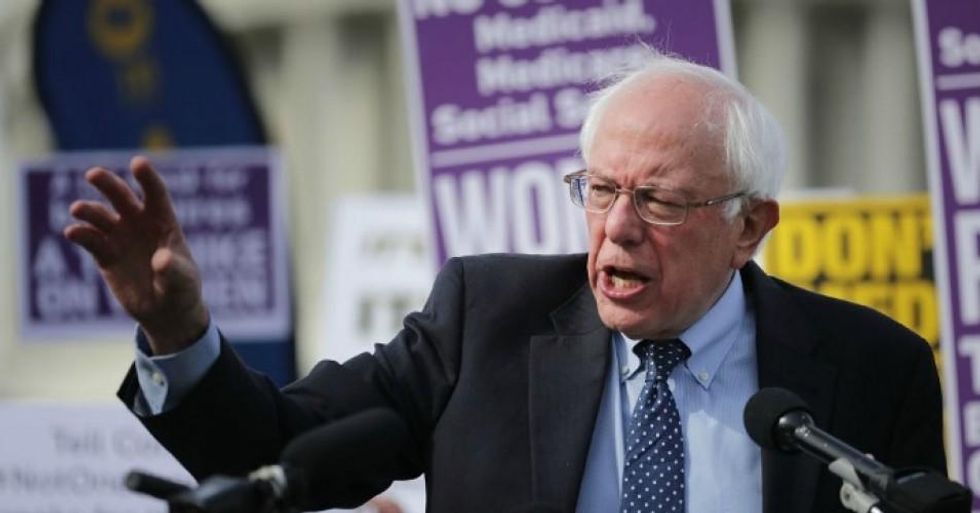
With the goal of eliminating "working poverty and involuntary unemployment," driving up wages, and curtailing income inequality, Sen. Bernie Sanders (I-Vt.) is reportedly planning to introduce a federal jobs guarantee that would provide decent-paying employment to every American "who wants or needs" it.
"This is an opportunity for something transformative, beyond the tinkering we've been doing for the last 40 years, where all the productivity gains have gone to the elite of society."
--Darrick Hamilton, The New School
First detailed by the Washington Post's Jeff Stein on Monday, Sanders' plan would "fund hundreds of projects throughout the United States aimed at addressing priorities such as infrastructure, caregiving, the environment, education, and other goals."
"Under the job guarantee, every American would be entitled to a job under one of these projects or receive job training to be able to do so, according to an early draft of the proposal," Stein notes. "Proponents trace the idea back to the New Deal Era, when President Franklin Delano Roosevelt pitched a 'Second Bill of Rights' to Congress in 1944. First on the list: the 'right to a useful and remunerative job.'"
In addition to providing workers with health benefits, Sanders' proposal would also require that Americans employed by the federal program be paid at least $15 an hour, which supporters say would lift the wages of all workers by boosting competition with the private sector.
"The plan's authors envision millions of Americans getting hired under the proposal," Stein notes.
Darrick Hamilton, an economist at the New School in New York, lauded Sanders' plan in an interview with the Washington Post, saying, "This is an opportunity for something transformative, beyond the tinkering we've been doing for the last 40 years, where all the productivity gains have gone to the elite of society."
Others embraced Sanders' proposal on social media:
News of Sanders' plan--which is still in the draft stage--comes as recent polling data has suggested that a federal jobs guarantee is immensely popular nationwide.
"We find that the job guarantee polls stunningly well in all 50 states," Sean McElwee, Colin McAuliffe, and Jon Green of Data for Progress noted in a recent article for The Nation. "Even in the state with the lowest modeled support, Utah, support is still 57 percent. Deep-red states like West Virginia (62 percent support), Indiana (61 percent), and Kansas (67 percent) all boast strong support for a job guarantee."
In addition to Sanders--who has also introduced legislation to guarantee healthcare to all Americans as a right--Sens. Cory Booker (D-N.J.) and Kirsten Gillibrand (D-N.Y.) have also expressed support for a federal jobs guarantee.
"This is not a radical idea," Hamilton concluded in an interview with the Post. "It was well-couched in the Democratic platform that existed during its heyday."
With the goal of eliminating "working poverty and involuntary unemployment," driving up wages, and curtailing income inequality, Sen. Bernie Sanders (I-Vt.) is reportedly planning to introduce a federal jobs guarantee that would provide decent-paying employment to every American "who wants or needs" it.
"This is an opportunity for something transformative, beyond the tinkering we've been doing for the last 40 years, where all the productivity gains have gone to the elite of society."
--Darrick Hamilton, The New School
First detailed by the Washington Post's Jeff Stein on Monday, Sanders' plan would "fund hundreds of projects throughout the United States aimed at addressing priorities such as infrastructure, caregiving, the environment, education, and other goals."
"Under the job guarantee, every American would be entitled to a job under one of these projects or receive job training to be able to do so, according to an early draft of the proposal," Stein notes. "Proponents trace the idea back to the New Deal Era, when President Franklin Delano Roosevelt pitched a 'Second Bill of Rights' to Congress in 1944. First on the list: the 'right to a useful and remunerative job.'"
In addition to providing workers with health benefits, Sanders' proposal would also require that Americans employed by the federal program be paid at least $15 an hour, which supporters say would lift the wages of all workers by boosting competition with the private sector.
"The plan's authors envision millions of Americans getting hired under the proposal," Stein notes.
Darrick Hamilton, an economist at the New School in New York, lauded Sanders' plan in an interview with the Washington Post, saying, "This is an opportunity for something transformative, beyond the tinkering we've been doing for the last 40 years, where all the productivity gains have gone to the elite of society."
Others embraced Sanders' proposal on social media:
News of Sanders' plan--which is still in the draft stage--comes as recent polling data has suggested that a federal jobs guarantee is immensely popular nationwide.
"We find that the job guarantee polls stunningly well in all 50 states," Sean McElwee, Colin McAuliffe, and Jon Green of Data for Progress noted in a recent article for The Nation. "Even in the state with the lowest modeled support, Utah, support is still 57 percent. Deep-red states like West Virginia (62 percent support), Indiana (61 percent), and Kansas (67 percent) all boast strong support for a job guarantee."
In addition to Sanders--who has also introduced legislation to guarantee healthcare to all Americans as a right--Sens. Cory Booker (D-N.J.) and Kirsten Gillibrand (D-N.Y.) have also expressed support for a federal jobs guarantee.
"This is not a radical idea," Hamilton concluded in an interview with the Post. "It was well-couched in the Democratic platform that existed during its heyday."
With the goal of eliminating "working poverty and involuntary unemployment," driving up wages, and curtailing income inequality, Sen. Bernie Sanders (I-Vt.) is reportedly planning to introduce a federal jobs guarantee that would provide decent-paying employment to every American "who wants or needs" it.
"This is an opportunity for something transformative, beyond the tinkering we've been doing for the last 40 years, where all the productivity gains have gone to the elite of society."
--Darrick Hamilton, The New School
First detailed by the Washington Post's Jeff Stein on Monday, Sanders' plan would "fund hundreds of projects throughout the United States aimed at addressing priorities such as infrastructure, caregiving, the environment, education, and other goals."
"Under the job guarantee, every American would be entitled to a job under one of these projects or receive job training to be able to do so, according to an early draft of the proposal," Stein notes. "Proponents trace the idea back to the New Deal Era, when President Franklin Delano Roosevelt pitched a 'Second Bill of Rights' to Congress in 1944. First on the list: the 'right to a useful and remunerative job.'"
In addition to providing workers with health benefits, Sanders' proposal would also require that Americans employed by the federal program be paid at least $15 an hour, which supporters say would lift the wages of all workers by boosting competition with the private sector.
"The plan's authors envision millions of Americans getting hired under the proposal," Stein notes.
Darrick Hamilton, an economist at the New School in New York, lauded Sanders' plan in an interview with the Washington Post, saying, "This is an opportunity for something transformative, beyond the tinkering we've been doing for the last 40 years, where all the productivity gains have gone to the elite of society."
Others embraced Sanders' proposal on social media:
News of Sanders' plan--which is still in the draft stage--comes as recent polling data has suggested that a federal jobs guarantee is immensely popular nationwide.
"We find that the job guarantee polls stunningly well in all 50 states," Sean McElwee, Colin McAuliffe, and Jon Green of Data for Progress noted in a recent article for The Nation. "Even in the state with the lowest modeled support, Utah, support is still 57 percent. Deep-red states like West Virginia (62 percent support), Indiana (61 percent), and Kansas (67 percent) all boast strong support for a job guarantee."
In addition to Sanders--who has also introduced legislation to guarantee healthcare to all Americans as a right--Sens. Cory Booker (D-N.J.) and Kirsten Gillibrand (D-N.Y.) have also expressed support for a federal jobs guarantee.
"This is not a radical idea," Hamilton concluded in an interview with the Post. "It was well-couched in the Democratic platform that existed during its heyday."