SUBSCRIBE TO OUR FREE NEWSLETTER
Daily news & progressive opinion—funded by the people, not the corporations—delivered straight to your inbox.
5
#000000
#FFFFFF
To donate by check, phone, or other method, see our More Ways to Give page.
Daily news & progressive opinion—funded by the people, not the corporations—delivered straight to your inbox.
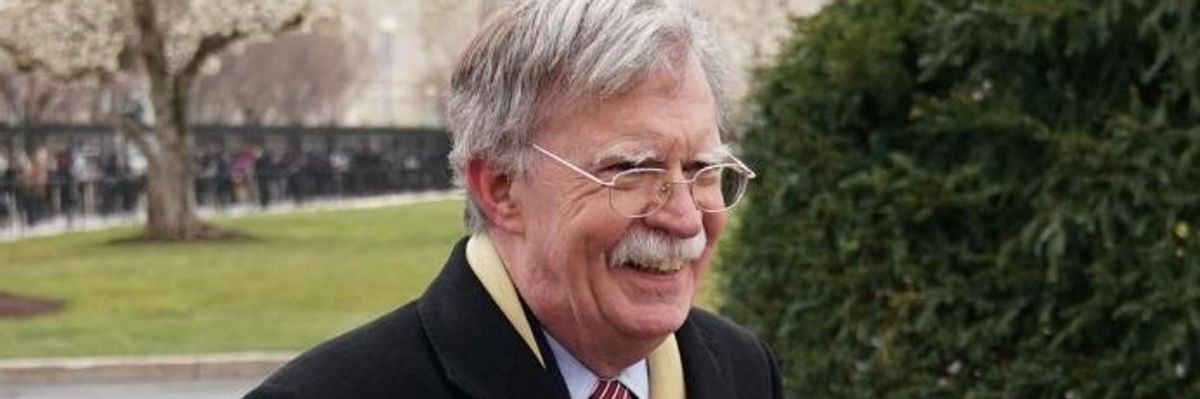
"Blaming Iran, along with Russia, for the alleged Syrian government role in the chemical weapons, as Trump has already done, gives Bolton an immediate Day One project: to endorse and embrace any reckless military move this president might choose," Phyllis Bennis of the Institute for Policy Studies said. (Photo: Mandel Ngam/AFP/Getty Images)
With the White House set to decide whether to ramp up U.S. military involvement in Syria after the Assad government was accused over the weekend of launching a chemical weapons attack, President Donald Trump will for the first time on Monday have inveterate warmonger and accused intelligence manipulator John Bolton whispering directly in his ear as national security adviser.
"The volatile situation in Syria significantly raises the danger of a major intensification of direct U.S. involvement."
-- Phyllis Bennis, Institute for Policy StudiesBolton's official arrival represents "a terrifying reality for Syrians, Iranians, Koreans, and many others around the world," Phyllis Bennis--director of the New Internationalism Project at the Institute for Policy Studies--told Common Dreams in an email on Monday, labeling Bolton a "fanatic war supporter."
"Blaming Iran, along with Russia, for the alleged Syrian government role in the chemical weapons, as Trump has already done, gives Bolton an immediate Day One project: to endorse and embrace any reckless military move this president might choose, regardless of its deadly consequences," Bennis added, highlighting Trump's tweet on Sunday vaguely promising to impose a "big price" on the Syrian regime for its alleged chemical attack. "The volatile situation in Syria significantly raises the danger of a major intensification of direct U.S. involvement."
In addition to his repeated calls for the U.S. to bomb Iran and North Korea, Bolton has recently been a loud proponent of ramping up airstrikes against the Syrian government, which has denied any role in the latest chemical attacks. During an appearance on Fox News last month, Bolton said more airstrikes in Syria "would be justified" and expressed support for Trump's attacks on a Syrian air base last April.
Asked if the U.S. military's growing involvement in Syria is moving toward a direct confrontation with Russia and Iran, Bolton said, "I think that's one possibility."
"There are few people less suited to navigate our nation through these challenging situations than John Bolton, who never met a war he didn't want to start or a diplomatic initiative he didn't want to scuttle."
--Stephen Miles, Win Without WarBolton's arrival at the White House in his official capacity as national security adviser came as Syria and Russia accused Israel early Monday of launching strikes against Syrian government targets, reportedly killing more than a dozen people, including Iranians. Israel has yet to comment on the strikes.
According to Bloomberg, Bolton convened with his new team at the White House Monday morning to discuss Syria.
Stephen Miles, director of Win Without War, told Common Dreams that "there couldn't be a worse time for John Bolton to start as Donald Trump's national security adviser," given the wide range of tense diplomatic issues the administration is set to confront in the weeks ahead--from the president's proposed meeting with North Korean leader Kim Jong-un to his "self-imposed" May 12 deadline to renew the Iran nuclear deal, which Bolton opposes.
"There are few people less suited to navigate our nation through these challenging situations than John Bolton, who never met a war he didn't want to start or a diplomatic initiative he didn't want to scuttle," Miles said.
Dear Common Dreams reader, It’s been nearly 30 years since I co-founded Common Dreams with my late wife, Lina Newhouser. We had the radical notion that journalism should serve the public good, not corporate profits. It was clear to us from the outset what it would take to build such a project. No paid advertisements. No corporate sponsors. No millionaire publisher telling us what to think or do. Many people said we wouldn't last a year, but we proved those doubters wrong. Together with a tremendous team of journalists and dedicated staff, we built an independent media outlet free from the constraints of profits and corporate control. Our mission has always been simple: To inform. To inspire. To ignite change for the common good. Building Common Dreams was not easy. Our survival was never guaranteed. When you take on the most powerful forces—Wall Street greed, fossil fuel industry destruction, Big Tech lobbyists, and uber-rich oligarchs who have spent billions upon billions rigging the economy and democracy in their favor—the only bulwark you have is supporters who believe in your work. But here’s the urgent message from me today. It's never been this bad out there. And it's never been this hard to keep us going. At the very moment Common Dreams is most needed, the threats we face are intensifying. We need your support now more than ever. We don't accept corporate advertising and never will. We don't have a paywall because we don't think people should be blocked from critical news based on their ability to pay. Everything we do is funded by the donations of readers like you. When everyone does the little they can afford, we are strong. But if that support retreats or dries up, so do we. Will you donate now to make sure Common Dreams not only survives but thrives? —Craig Brown, Co-founder |
With the White House set to decide whether to ramp up U.S. military involvement in Syria after the Assad government was accused over the weekend of launching a chemical weapons attack, President Donald Trump will for the first time on Monday have inveterate warmonger and accused intelligence manipulator John Bolton whispering directly in his ear as national security adviser.
"The volatile situation in Syria significantly raises the danger of a major intensification of direct U.S. involvement."
-- Phyllis Bennis, Institute for Policy StudiesBolton's official arrival represents "a terrifying reality for Syrians, Iranians, Koreans, and many others around the world," Phyllis Bennis--director of the New Internationalism Project at the Institute for Policy Studies--told Common Dreams in an email on Monday, labeling Bolton a "fanatic war supporter."
"Blaming Iran, along with Russia, for the alleged Syrian government role in the chemical weapons, as Trump has already done, gives Bolton an immediate Day One project: to endorse and embrace any reckless military move this president might choose, regardless of its deadly consequences," Bennis added, highlighting Trump's tweet on Sunday vaguely promising to impose a "big price" on the Syrian regime for its alleged chemical attack. "The volatile situation in Syria significantly raises the danger of a major intensification of direct U.S. involvement."
In addition to his repeated calls for the U.S. to bomb Iran and North Korea, Bolton has recently been a loud proponent of ramping up airstrikes against the Syrian government, which has denied any role in the latest chemical attacks. During an appearance on Fox News last month, Bolton said more airstrikes in Syria "would be justified" and expressed support for Trump's attacks on a Syrian air base last April.
Asked if the U.S. military's growing involvement in Syria is moving toward a direct confrontation with Russia and Iran, Bolton said, "I think that's one possibility."
"There are few people less suited to navigate our nation through these challenging situations than John Bolton, who never met a war he didn't want to start or a diplomatic initiative he didn't want to scuttle."
--Stephen Miles, Win Without WarBolton's arrival at the White House in his official capacity as national security adviser came as Syria and Russia accused Israel early Monday of launching strikes against Syrian government targets, reportedly killing more than a dozen people, including Iranians. Israel has yet to comment on the strikes.
According to Bloomberg, Bolton convened with his new team at the White House Monday morning to discuss Syria.
Stephen Miles, director of Win Without War, told Common Dreams that "there couldn't be a worse time for John Bolton to start as Donald Trump's national security adviser," given the wide range of tense diplomatic issues the administration is set to confront in the weeks ahead--from the president's proposed meeting with North Korean leader Kim Jong-un to his "self-imposed" May 12 deadline to renew the Iran nuclear deal, which Bolton opposes.
"There are few people less suited to navigate our nation through these challenging situations than John Bolton, who never met a war he didn't want to start or a diplomatic initiative he didn't want to scuttle," Miles said.
With the White House set to decide whether to ramp up U.S. military involvement in Syria after the Assad government was accused over the weekend of launching a chemical weapons attack, President Donald Trump will for the first time on Monday have inveterate warmonger and accused intelligence manipulator John Bolton whispering directly in his ear as national security adviser.
"The volatile situation in Syria significantly raises the danger of a major intensification of direct U.S. involvement."
-- Phyllis Bennis, Institute for Policy StudiesBolton's official arrival represents "a terrifying reality for Syrians, Iranians, Koreans, and many others around the world," Phyllis Bennis--director of the New Internationalism Project at the Institute for Policy Studies--told Common Dreams in an email on Monday, labeling Bolton a "fanatic war supporter."
"Blaming Iran, along with Russia, for the alleged Syrian government role in the chemical weapons, as Trump has already done, gives Bolton an immediate Day One project: to endorse and embrace any reckless military move this president might choose, regardless of its deadly consequences," Bennis added, highlighting Trump's tweet on Sunday vaguely promising to impose a "big price" on the Syrian regime for its alleged chemical attack. "The volatile situation in Syria significantly raises the danger of a major intensification of direct U.S. involvement."
In addition to his repeated calls for the U.S. to bomb Iran and North Korea, Bolton has recently been a loud proponent of ramping up airstrikes against the Syrian government, which has denied any role in the latest chemical attacks. During an appearance on Fox News last month, Bolton said more airstrikes in Syria "would be justified" and expressed support for Trump's attacks on a Syrian air base last April.
Asked if the U.S. military's growing involvement in Syria is moving toward a direct confrontation with Russia and Iran, Bolton said, "I think that's one possibility."
"There are few people less suited to navigate our nation through these challenging situations than John Bolton, who never met a war he didn't want to start or a diplomatic initiative he didn't want to scuttle."
--Stephen Miles, Win Without WarBolton's arrival at the White House in his official capacity as national security adviser came as Syria and Russia accused Israel early Monday of launching strikes against Syrian government targets, reportedly killing more than a dozen people, including Iranians. Israel has yet to comment on the strikes.
According to Bloomberg, Bolton convened with his new team at the White House Monday morning to discuss Syria.
Stephen Miles, director of Win Without War, told Common Dreams that "there couldn't be a worse time for John Bolton to start as Donald Trump's national security adviser," given the wide range of tense diplomatic issues the administration is set to confront in the weeks ahead--from the president's proposed meeting with North Korean leader Kim Jong-un to his "self-imposed" May 12 deadline to renew the Iran nuclear deal, which Bolton opposes.
"There are few people less suited to navigate our nation through these challenging situations than John Bolton, who never met a war he didn't want to start or a diplomatic initiative he didn't want to scuttle," Miles said.