SUBSCRIBE TO OUR FREE NEWSLETTER
Daily news & progressive opinion—funded by the people, not the corporations—delivered straight to your inbox.
5
#000000
#FFFFFF
To donate by check, phone, or other method, see our More Ways to Give page.
Daily news & progressive opinion—funded by the people, not the corporations—delivered straight to your inbox.
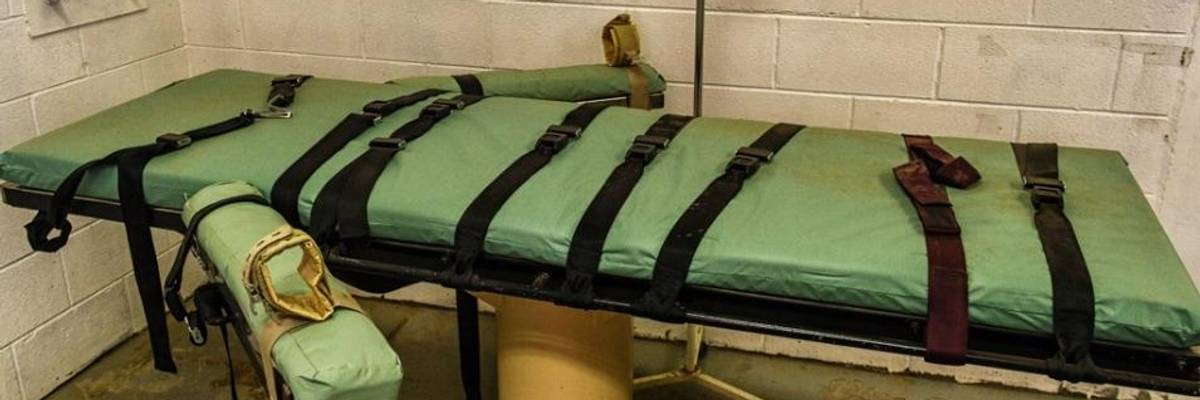
Texas wants to opt-in to a federal law that would restrict: the ability of federal judges to grant stays on executions; how long federal courts have to rule on cases; the claims convicts can raise during federal proceedings; and the amount of time defense attorneys have to file federal appeals. (Photo: Ken Piorkowski/flickr/cc)
Texas is seeking permission from Trump administration Attorney General Jeff Sessions to opt-in to a federal law that would fast-track executions, a move that critics warn could lead to the state killing more people--including those who are wrongfully convicted and those deemed too handicapped to be executed.
"Opt-in would speed up the death penalty treadmill exponentially."
--Kathryn Kase, defense attorney
While a spokesperson for the Texas attorney general's office claimed to Houston Chronicle that it is pursuing the measure--which would limit the length of the legal process and convicts' appeals options--to avoid "stressful delays" and "excessive costs," defense attorney Kathryn Kase warned that "opt-in would speed up the death penalty treadmill exponentially."
"Opt-in presumes that we've reached this promised land of excellent and well-resourced legal representation at all levels for everyone on death row and in fact we have not," added Kase, the former executive director of Texas Defender Services, a nonprofit that provides legal support to people challenging death penalty sentences.
Although the federal law has been on the books for two decades, no state has ever received opt-in approval from the Justice Department. However, the decision could be swayed by President Donald Trump's repeated endorsements of state-sanctioned killings.
Additionally, Sessions' actions so far suggest the Attorney General may be personally supportive of the move: In November, he reportedly sent letters to Texas and Arizona, the two states that have previously expressed interest in opting in, to inquire about whether they were still interested.
"And, because Texas has requested certification dating back to 1995," the Chronicle reports, "there's some question as to whether it would retroactively applied to cases now entering federal appeals." Currently, 229 inmates are on death row in Texas.
The law would restrict: the ability of federal judges to grant stays on executions; how long federal courts have to rule on cases; the claims convicts can raise during federal proceedings; and the amount of time defense attorneys have to file federal appeals.
Rather than a year, attorneys representing death row inmates would have only six months, as the Chronice explains, "to interview witnesses, hire investigators, and familiarize themselves sometimes a decade or more of case files to sift out any possible past lawyering mistakes, suspicion of withheld evidence, or proof of actual innocence stuffed away in boxes and boxes of materials."
"Doing all that in one year is already extraordinarily difficult, and any further limitations would only exacerbate the existing problem," said Emily Olson-Gault, director of the Death Penalty Representation Project at the American Bar Association. "We know that errors are made in capital cases... The more that the allotted time to prepare is limited, the greater the risk that serious constitutional errors will stand uncorrected."
"It's an appeal to [Republican] Gov. [Greg] Abbott's base to make it very proudly explained that we have an express lane to death."
--Patrick McCann, defense attorney
Houston-based defense attorney Patrick McCann pointed out that the limitations would likely reduce the number of Texas inmates' cases that make it to federal courts, which determined that Anthony Graves was wrongfully convicted and Bobby Moore (pdf) was too intellectually disabled to execute.
"Bobby Moore would be dead under this standard of time limits. Anthony Graves would be dead," McCann said. "Pretty much everybody who's been released or commuted on death row would have already been executed so not only would we have done wrong we wouldn't even know we had."
Calling the state's opt-in move "a political quest," McCann concluded, "It's an appeal to [Republican] Gov. [Greg] Abbott's base to make it very proudly explained that we have an express lane to death."
Dear Common Dreams reader, It’s been nearly 30 years since I co-founded Common Dreams with my late wife, Lina Newhouser. We had the radical notion that journalism should serve the public good, not corporate profits. It was clear to us from the outset what it would take to build such a project. No paid advertisements. No corporate sponsors. No millionaire publisher telling us what to think or do. Many people said we wouldn't last a year, but we proved those doubters wrong. Together with a tremendous team of journalists and dedicated staff, we built an independent media outlet free from the constraints of profits and corporate control. Our mission has always been simple: To inform. To inspire. To ignite change for the common good. Building Common Dreams was not easy. Our survival was never guaranteed. When you take on the most powerful forces—Wall Street greed, fossil fuel industry destruction, Big Tech lobbyists, and uber-rich oligarchs who have spent billions upon billions rigging the economy and democracy in their favor—the only bulwark you have is supporters who believe in your work. But here’s the urgent message from me today. It's never been this bad out there. And it's never been this hard to keep us going. At the very moment Common Dreams is most needed, the threats we face are intensifying. We need your support now more than ever. We don't accept corporate advertising and never will. We don't have a paywall because we don't think people should be blocked from critical news based on their ability to pay. Everything we do is funded by the donations of readers like you. When everyone does the little they can afford, we are strong. But if that support retreats or dries up, so do we. Will you donate now to make sure Common Dreams not only survives but thrives? —Craig Brown, Co-founder |
Texas is seeking permission from Trump administration Attorney General Jeff Sessions to opt-in to a federal law that would fast-track executions, a move that critics warn could lead to the state killing more people--including those who are wrongfully convicted and those deemed too handicapped to be executed.
"Opt-in would speed up the death penalty treadmill exponentially."
--Kathryn Kase, defense attorney
While a spokesperson for the Texas attorney general's office claimed to Houston Chronicle that it is pursuing the measure--which would limit the length of the legal process and convicts' appeals options--to avoid "stressful delays" and "excessive costs," defense attorney Kathryn Kase warned that "opt-in would speed up the death penalty treadmill exponentially."
"Opt-in presumes that we've reached this promised land of excellent and well-resourced legal representation at all levels for everyone on death row and in fact we have not," added Kase, the former executive director of Texas Defender Services, a nonprofit that provides legal support to people challenging death penalty sentences.
Although the federal law has been on the books for two decades, no state has ever received opt-in approval from the Justice Department. However, the decision could be swayed by President Donald Trump's repeated endorsements of state-sanctioned killings.
Additionally, Sessions' actions so far suggest the Attorney General may be personally supportive of the move: In November, he reportedly sent letters to Texas and Arizona, the two states that have previously expressed interest in opting in, to inquire about whether they were still interested.
"And, because Texas has requested certification dating back to 1995," the Chronicle reports, "there's some question as to whether it would retroactively applied to cases now entering federal appeals." Currently, 229 inmates are on death row in Texas.
The law would restrict: the ability of federal judges to grant stays on executions; how long federal courts have to rule on cases; the claims convicts can raise during federal proceedings; and the amount of time defense attorneys have to file federal appeals.
Rather than a year, attorneys representing death row inmates would have only six months, as the Chronice explains, "to interview witnesses, hire investigators, and familiarize themselves sometimes a decade or more of case files to sift out any possible past lawyering mistakes, suspicion of withheld evidence, or proof of actual innocence stuffed away in boxes and boxes of materials."
"Doing all that in one year is already extraordinarily difficult, and any further limitations would only exacerbate the existing problem," said Emily Olson-Gault, director of the Death Penalty Representation Project at the American Bar Association. "We know that errors are made in capital cases... The more that the allotted time to prepare is limited, the greater the risk that serious constitutional errors will stand uncorrected."
"It's an appeal to [Republican] Gov. [Greg] Abbott's base to make it very proudly explained that we have an express lane to death."
--Patrick McCann, defense attorney
Houston-based defense attorney Patrick McCann pointed out that the limitations would likely reduce the number of Texas inmates' cases that make it to federal courts, which determined that Anthony Graves was wrongfully convicted and Bobby Moore (pdf) was too intellectually disabled to execute.
"Bobby Moore would be dead under this standard of time limits. Anthony Graves would be dead," McCann said. "Pretty much everybody who's been released or commuted on death row would have already been executed so not only would we have done wrong we wouldn't even know we had."
Calling the state's opt-in move "a political quest," McCann concluded, "It's an appeal to [Republican] Gov. [Greg] Abbott's base to make it very proudly explained that we have an express lane to death."
Texas is seeking permission from Trump administration Attorney General Jeff Sessions to opt-in to a federal law that would fast-track executions, a move that critics warn could lead to the state killing more people--including those who are wrongfully convicted and those deemed too handicapped to be executed.
"Opt-in would speed up the death penalty treadmill exponentially."
--Kathryn Kase, defense attorney
While a spokesperson for the Texas attorney general's office claimed to Houston Chronicle that it is pursuing the measure--which would limit the length of the legal process and convicts' appeals options--to avoid "stressful delays" and "excessive costs," defense attorney Kathryn Kase warned that "opt-in would speed up the death penalty treadmill exponentially."
"Opt-in presumes that we've reached this promised land of excellent and well-resourced legal representation at all levels for everyone on death row and in fact we have not," added Kase, the former executive director of Texas Defender Services, a nonprofit that provides legal support to people challenging death penalty sentences.
Although the federal law has been on the books for two decades, no state has ever received opt-in approval from the Justice Department. However, the decision could be swayed by President Donald Trump's repeated endorsements of state-sanctioned killings.
Additionally, Sessions' actions so far suggest the Attorney General may be personally supportive of the move: In November, he reportedly sent letters to Texas and Arizona, the two states that have previously expressed interest in opting in, to inquire about whether they were still interested.
"And, because Texas has requested certification dating back to 1995," the Chronicle reports, "there's some question as to whether it would retroactively applied to cases now entering federal appeals." Currently, 229 inmates are on death row in Texas.
The law would restrict: the ability of federal judges to grant stays on executions; how long federal courts have to rule on cases; the claims convicts can raise during federal proceedings; and the amount of time defense attorneys have to file federal appeals.
Rather than a year, attorneys representing death row inmates would have only six months, as the Chronice explains, "to interview witnesses, hire investigators, and familiarize themselves sometimes a decade or more of case files to sift out any possible past lawyering mistakes, suspicion of withheld evidence, or proof of actual innocence stuffed away in boxes and boxes of materials."
"Doing all that in one year is already extraordinarily difficult, and any further limitations would only exacerbate the existing problem," said Emily Olson-Gault, director of the Death Penalty Representation Project at the American Bar Association. "We know that errors are made in capital cases... The more that the allotted time to prepare is limited, the greater the risk that serious constitutional errors will stand uncorrected."
"It's an appeal to [Republican] Gov. [Greg] Abbott's base to make it very proudly explained that we have an express lane to death."
--Patrick McCann, defense attorney
Houston-based defense attorney Patrick McCann pointed out that the limitations would likely reduce the number of Texas inmates' cases that make it to federal courts, which determined that Anthony Graves was wrongfully convicted and Bobby Moore (pdf) was too intellectually disabled to execute.
"Bobby Moore would be dead under this standard of time limits. Anthony Graves would be dead," McCann said. "Pretty much everybody who's been released or commuted on death row would have already been executed so not only would we have done wrong we wouldn't even know we had."
Calling the state's opt-in move "a political quest," McCann concluded, "It's an appeal to [Republican] Gov. [Greg] Abbott's base to make it very proudly explained that we have an express lane to death."