

SUBSCRIBE TO OUR FREE NEWSLETTER
Daily news & progressive opinion—funded by the people, not the corporations—delivered straight to your inbox.
5
#000000
#FFFFFF
To donate by check, phone, or other method, see our More Ways to Give page.
Daily news & progressive opinion—funded by the people, not the corporations—delivered straight to your inbox.
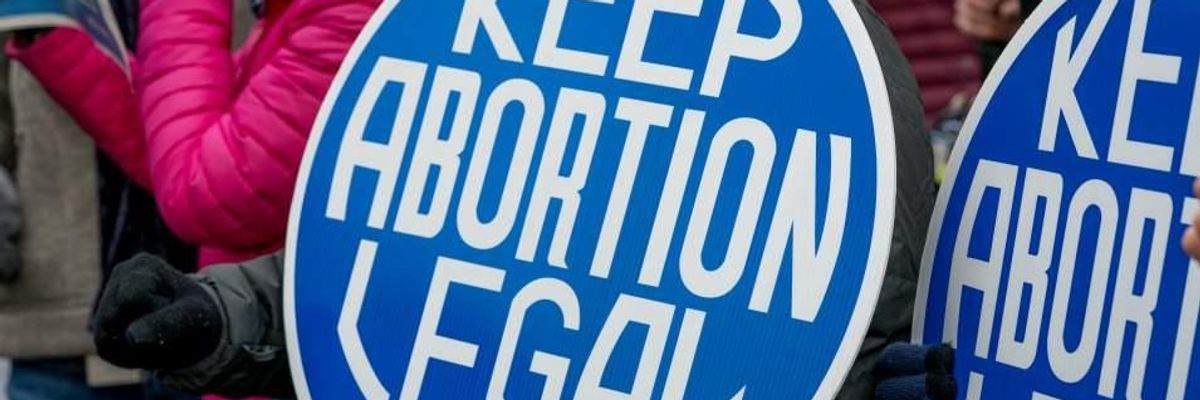
Anti-choice Republicans are passing unconstitutional state-level abortion restrictions in an effort to force the U.S. Supreme Court to consider reversing Roe v. Wade. (Photo: Victoria Pickering/Flickr/cc)
On Tuesday the Kentucky legislature passed a bill--which Republican Gov. Matt Bevin is expected to sign--barring a common abortion procedure after 11 weeks of pregnancy, just the latest move by anti-choice politicians to enact unconstitutional state-level abortion regulations in hopes of forcing the U.S. Supreme Court to reconsider its landmark Roe v. Wade ruling.
This attempt to restrict access to the dilation and evacuation procedure in Kentucky came just a week after a federal judge temporarily blocked a Mississippi law that banned abortion after 15 weeks, days after Idaho and Indiana enacted laws requiring doctors to report abortion complications to state health officials, and as lawmakers in Ohio are considering legislation that would totally outlaw abortion across the state, without exceptions for rape, incest, and medical emergencies.
"If this all sounds legally unsound, that's because it is," the New York Times editorial board wrote on Sunday. The editorial came in response to the Ohio legislation but acknowledged that "this rash of radically unconstitutional bills is appearing by design."
State-level efforts to challenge the Supreme Court ruling that legalized abortions before fetal viability are not new. As Jennifer Dalven, director of the ACLU's Reproductive Freedom Project, pointed out on the anniversary of Roe earlier this year, "in the 45 years since the Supreme Court recognized the right to have an abortion, state and federal lawmakers have passed hundreds of restrictions eroding this right. In 2017 alone, 19 states adopted 63 new restrictions on abortion rights and access."
However, with this recent onslaught of blatantly unconstitutional laws that ultimately seek the high court's reversal on Roe, "we're entering a period where states are trying to effectively one-up each other," Elizabeth Nash, the Guttmatcher Institute's senior state issues manager, explained to The Hill. "They're jockeying for position as to which would be the state that would have their name on that case."
The states' efforts are further emboldened by the administration of President Donald Trump, who called for more federal restrictions in his January speech to participants of March for Life--where the rabidly anti-choice Vice President Mike Pence described him as "the most pro-life president in American history."
"Under the current administration, we have a new Supreme Court justice [Neil Gorsuch] who is anti-abortion, and we also have a lot of Trump nominees to the federal courts," said Heather Shumaker, senior counsel at the National Women's Law Center. "So state legislatures are feeling more emboldened to push things that are obviously unconstitutional."
"If there's any lesson to learn from [these unconstitutional laws], it's that the Republican anti-abortion strategy doesn't stop with one extreme bill," the Times concluded. "If it's up to them, they won't stop until it's impossible for many or all women in America to make their own choices about whether to access a safe, popular, and common form of healthcare."
Dear Common Dreams reader, It’s been nearly 30 years since I co-founded Common Dreams with my late wife, Lina Newhouser. We had the radical notion that journalism should serve the public good, not corporate profits. It was clear to us from the outset what it would take to build such a project. No paid advertisements. No corporate sponsors. No millionaire publisher telling us what to think or do. Many people said we wouldn't last a year, but we proved those doubters wrong. Together with a tremendous team of journalists and dedicated staff, we built an independent media outlet free from the constraints of profits and corporate control. Our mission has always been simple: To inform. To inspire. To ignite change for the common good. Building Common Dreams was not easy. Our survival was never guaranteed. When you take on the most powerful forces—Wall Street greed, fossil fuel industry destruction, Big Tech lobbyists, and uber-rich oligarchs who have spent billions upon billions rigging the economy and democracy in their favor—the only bulwark you have is supporters who believe in your work. But here’s the urgent message from me today. It's never been this bad out there. And it's never been this hard to keep us going. At the very moment Common Dreams is most needed, the threats we face are intensifying. We need your support now more than ever. We don't accept corporate advertising and never will. We don't have a paywall because we don't think people should be blocked from critical news based on their ability to pay. Everything we do is funded by the donations of readers like you. When everyone does the little they can afford, we are strong. But if that support retreats or dries up, so do we. Will you donate now to make sure Common Dreams not only survives but thrives? —Craig Brown, Co-founder |
On Tuesday the Kentucky legislature passed a bill--which Republican Gov. Matt Bevin is expected to sign--barring a common abortion procedure after 11 weeks of pregnancy, just the latest move by anti-choice politicians to enact unconstitutional state-level abortion regulations in hopes of forcing the U.S. Supreme Court to reconsider its landmark Roe v. Wade ruling.
This attempt to restrict access to the dilation and evacuation procedure in Kentucky came just a week after a federal judge temporarily blocked a Mississippi law that banned abortion after 15 weeks, days after Idaho and Indiana enacted laws requiring doctors to report abortion complications to state health officials, and as lawmakers in Ohio are considering legislation that would totally outlaw abortion across the state, without exceptions for rape, incest, and medical emergencies.
"If this all sounds legally unsound, that's because it is," the New York Times editorial board wrote on Sunday. The editorial came in response to the Ohio legislation but acknowledged that "this rash of radically unconstitutional bills is appearing by design."
State-level efforts to challenge the Supreme Court ruling that legalized abortions before fetal viability are not new. As Jennifer Dalven, director of the ACLU's Reproductive Freedom Project, pointed out on the anniversary of Roe earlier this year, "in the 45 years since the Supreme Court recognized the right to have an abortion, state and federal lawmakers have passed hundreds of restrictions eroding this right. In 2017 alone, 19 states adopted 63 new restrictions on abortion rights and access."
However, with this recent onslaught of blatantly unconstitutional laws that ultimately seek the high court's reversal on Roe, "we're entering a period where states are trying to effectively one-up each other," Elizabeth Nash, the Guttmatcher Institute's senior state issues manager, explained to The Hill. "They're jockeying for position as to which would be the state that would have their name on that case."
The states' efforts are further emboldened by the administration of President Donald Trump, who called for more federal restrictions in his January speech to participants of March for Life--where the rabidly anti-choice Vice President Mike Pence described him as "the most pro-life president in American history."
"Under the current administration, we have a new Supreme Court justice [Neil Gorsuch] who is anti-abortion, and we also have a lot of Trump nominees to the federal courts," said Heather Shumaker, senior counsel at the National Women's Law Center. "So state legislatures are feeling more emboldened to push things that are obviously unconstitutional."
"If there's any lesson to learn from [these unconstitutional laws], it's that the Republican anti-abortion strategy doesn't stop with one extreme bill," the Times concluded. "If it's up to them, they won't stop until it's impossible for many or all women in America to make their own choices about whether to access a safe, popular, and common form of healthcare."
On Tuesday the Kentucky legislature passed a bill--which Republican Gov. Matt Bevin is expected to sign--barring a common abortion procedure after 11 weeks of pregnancy, just the latest move by anti-choice politicians to enact unconstitutional state-level abortion regulations in hopes of forcing the U.S. Supreme Court to reconsider its landmark Roe v. Wade ruling.
This attempt to restrict access to the dilation and evacuation procedure in Kentucky came just a week after a federal judge temporarily blocked a Mississippi law that banned abortion after 15 weeks, days after Idaho and Indiana enacted laws requiring doctors to report abortion complications to state health officials, and as lawmakers in Ohio are considering legislation that would totally outlaw abortion across the state, without exceptions for rape, incest, and medical emergencies.
"If this all sounds legally unsound, that's because it is," the New York Times editorial board wrote on Sunday. The editorial came in response to the Ohio legislation but acknowledged that "this rash of radically unconstitutional bills is appearing by design."
State-level efforts to challenge the Supreme Court ruling that legalized abortions before fetal viability are not new. As Jennifer Dalven, director of the ACLU's Reproductive Freedom Project, pointed out on the anniversary of Roe earlier this year, "in the 45 years since the Supreme Court recognized the right to have an abortion, state and federal lawmakers have passed hundreds of restrictions eroding this right. In 2017 alone, 19 states adopted 63 new restrictions on abortion rights and access."
However, with this recent onslaught of blatantly unconstitutional laws that ultimately seek the high court's reversal on Roe, "we're entering a period where states are trying to effectively one-up each other," Elizabeth Nash, the Guttmatcher Institute's senior state issues manager, explained to The Hill. "They're jockeying for position as to which would be the state that would have their name on that case."
The states' efforts are further emboldened by the administration of President Donald Trump, who called for more federal restrictions in his January speech to participants of March for Life--where the rabidly anti-choice Vice President Mike Pence described him as "the most pro-life president in American history."
"Under the current administration, we have a new Supreme Court justice [Neil Gorsuch] who is anti-abortion, and we also have a lot of Trump nominees to the federal courts," said Heather Shumaker, senior counsel at the National Women's Law Center. "So state legislatures are feeling more emboldened to push things that are obviously unconstitutional."
"If there's any lesson to learn from [these unconstitutional laws], it's that the Republican anti-abortion strategy doesn't stop with one extreme bill," the Times concluded. "If it's up to them, they won't stop until it's impossible for many or all women in America to make their own choices about whether to access a safe, popular, and common form of healthcare."

