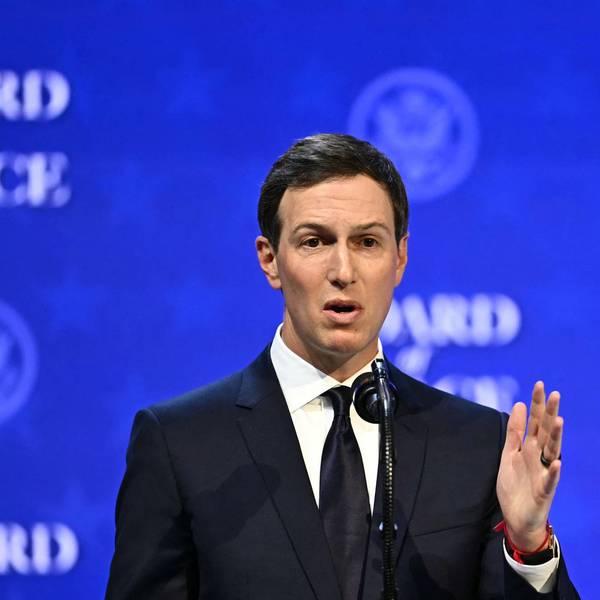
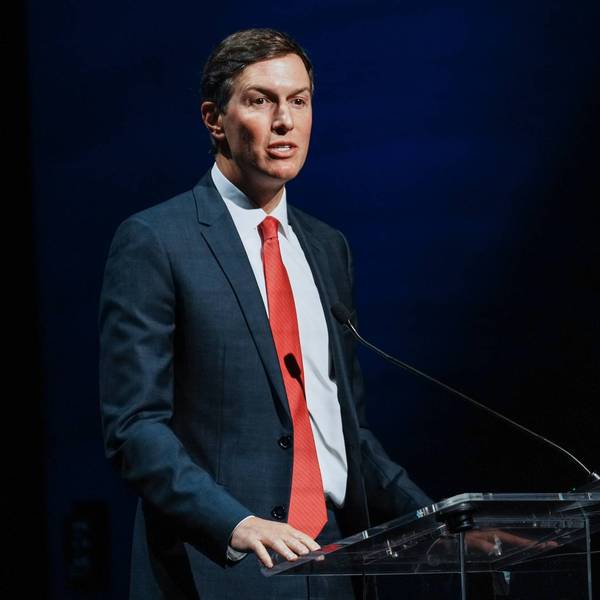
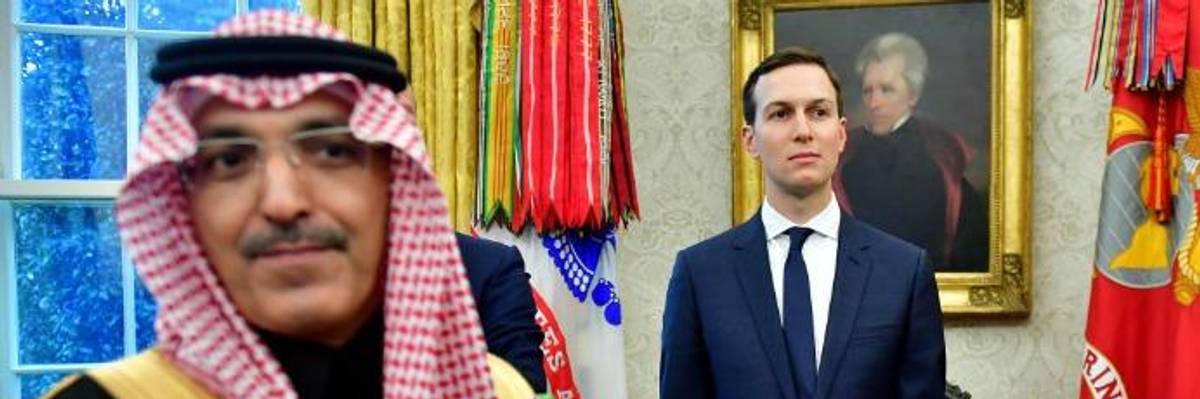
White House Advisor Jared Kushner, watches alongside a member of the Saudi Delegation during a meeting between President Donald Trump and Crown Prince Mohammed bin Salman of the Kingdom of Saudi Arabia in the Oval Office at the White House on March 20, 2018 in Washington, D.C. (Photo: Kevin Dietsch-Pool/Getty Images)
Demands for Federal Probe as Saudi Crown Prince Reportedly Claims Kushner 'In His Pocket'
The reporting, argued a former government ethics chief, "makes one wonder what effect conflicts of interest may be having on our foreign policy and national security."
Already under fire after the revelation last month that officials from at least four foreign governments--the United Arab Emirates, China, Israel and Mexico--have discussed ways to "manipulate" his financial entanglements to their advantage, White House adviser and Trump son-in-law Jared Kushner came under even more scrutiny Wednesday night after The Intercept reported that Saudi Crown Prince Mohammed bin Salman (MbS) believes that he has Kushner "in his pocket."
"There should be a federal investigation into Trump, Kushner et. al. over their collusion with the Saudis, the UAE and Israel. Kind of amazing how little attention this all gets."
-- Jeremy Scahill, The Intercept
Citing both U.S. officials and and sources "close to the Saudi royal family," The Intercept notes that "Kushner has grown so close to the Saudi and Emirati crown princes that he has communicated with them directly using WhatsApp, a reasonably secure messaging app owned by Facebook and popular in the Middle East."
In addition to further detailing Kushner's sprawling financial conflicts, the new report also raises alarming questions about his possible role in the Saudi Crown Prince's recent so-called "anti-corruption crackdown," which was launched just a week after Kushner took an unannounced trip to Saudi Arabia's capital last October. The trip came months before Kushner's security clearance was downgraded.
According to The Intercept, MbS "told confidants that Kushner had discussed the names of Saudis disloyal to the crown prince"--names he would have learned from reading the President's Daily Brief, which "contained information on Saudi Arabia's evolving political situation, including a handful of names of royal family members opposed to the crown prince's power grab."
While acknowledging that MbS likely already knew the names of his opponents within the kingdom, The Intercept notes that Kushner could have violated federal law if he discussed these names with MbS without authorization from President Donald Trump. A spokesperson for Kushner's lawyer dismissed claims that he divulged the identities of MbS's opponents as "obviously false."
"If Kushner discussed names with MBS as an approved tactic of U.S. foreign policy, the move would be a striking intervention by the U.S. into an unfolding power struggle at the top levels of an allied nation," The Intercept observes. "If Kushner discussed the names with the Saudi prince without presidential authorization, however, he may have violated federal laws around the sharing of classified intelligence."
In response to the explosive new reporting, Jeremy Scahill--a co-founder of The Intercept--argued that there should be a federal probe into "Trump, Kushner, et. al. over their collusion with the Saudis, the UAE, and Israel."
"Kind of amazing how little attention this all gets," Scahill added.
Walter Shaub, former head of the Office of Government Ethics, argued in a tweet late Wednesday that if The Intercept's reporting is accurate, "it shows the incompetence that comes with nepotism can get people killed."
"It also makes one wonder what effect conflicts of interest may be having on our foreign policy and national security," Shaub concluded.
We are at a crossroads
This country and this world are at a monumental crossroads. In a few short weeks, US voters will have an opportunity to beat back the forces of fascism and confront the billionaires who are rigging the economy, our media system, and our democracy, making it increasingly impossible for ordinary people to get by. We’re not just talking about the election. We’re talking about what must be done once these fascist elements are vanquished from power. We need a bolder set of solutions than what either major party has so far been willing to offer and a working-class movement ready to fight like hell for it. Trump didn't emerge from nowhere. The conditions that fueled MAGA authoritarianism were created by decades of radical neoliberal economic policies and a corrupt political system dominated by corporate interests. They slashed taxes on the super-rich, promising that the benefits would trickle down. They said giveaways to the corporate titans would make life more affordable for the rest of us. It was all bullshit. And when a bitter, betrayed populace searches for someone to blame, right-wing demagogues have little trouble finding scapegoats. People know when they're being lied to, but you won't hear any of this from the corporate media. Only independent journalism—powered and funded by people who believe in building a better world—can deliver truly trustworthy daily news. Our Fall Campaign is underway, and we need your help. To power our newsroom through the rest of the year, we need to raise $125,000 by midnight on October 31. So if you share our vision, please contribute whatever you can to sustain our work. |
Already under fire after the revelation last month that officials from at least four foreign governments--the United Arab Emirates, China, Israel and Mexico--have discussed ways to "manipulate" his financial entanglements to their advantage, White House adviser and Trump son-in-law Jared Kushner came under even more scrutiny Wednesday night after The Intercept reported that Saudi Crown Prince Mohammed bin Salman (MbS) believes that he has Kushner "in his pocket."
"There should be a federal investigation into Trump, Kushner et. al. over their collusion with the Saudis, the UAE and Israel. Kind of amazing how little attention this all gets."
-- Jeremy Scahill, The Intercept
Citing both U.S. officials and and sources "close to the Saudi royal family," The Intercept notes that "Kushner has grown so close to the Saudi and Emirati crown princes that he has communicated with them directly using WhatsApp, a reasonably secure messaging app owned by Facebook and popular in the Middle East."
In addition to further detailing Kushner's sprawling financial conflicts, the new report also raises alarming questions about his possible role in the Saudi Crown Prince's recent so-called "anti-corruption crackdown," which was launched just a week after Kushner took an unannounced trip to Saudi Arabia's capital last October. The trip came months before Kushner's security clearance was downgraded.
According to The Intercept, MbS "told confidants that Kushner had discussed the names of Saudis disloyal to the crown prince"--names he would have learned from reading the President's Daily Brief, which "contained information on Saudi Arabia's evolving political situation, including a handful of names of royal family members opposed to the crown prince's power grab."
While acknowledging that MbS likely already knew the names of his opponents within the kingdom, The Intercept notes that Kushner could have violated federal law if he discussed these names with MbS without authorization from President Donald Trump. A spokesperson for Kushner's lawyer dismissed claims that he divulged the identities of MbS's opponents as "obviously false."
"If Kushner discussed names with MBS as an approved tactic of U.S. foreign policy, the move would be a striking intervention by the U.S. into an unfolding power struggle at the top levels of an allied nation," The Intercept observes. "If Kushner discussed the names with the Saudi prince without presidential authorization, however, he may have violated federal laws around the sharing of classified intelligence."
In response to the explosive new reporting, Jeremy Scahill--a co-founder of The Intercept--argued that there should be a federal probe into "Trump, Kushner, et. al. over their collusion with the Saudis, the UAE, and Israel."
"Kind of amazing how little attention this all gets," Scahill added.
Walter Shaub, former head of the Office of Government Ethics, argued in a tweet late Wednesday that if The Intercept's reporting is accurate, "it shows the incompetence that comes with nepotism can get people killed."
"It also makes one wonder what effect conflicts of interest may be having on our foreign policy and national security," Shaub concluded.
Already under fire after the revelation last month that officials from at least four foreign governments--the United Arab Emirates, China, Israel and Mexico--have discussed ways to "manipulate" his financial entanglements to their advantage, White House adviser and Trump son-in-law Jared Kushner came under even more scrutiny Wednesday night after The Intercept reported that Saudi Crown Prince Mohammed bin Salman (MbS) believes that he has Kushner "in his pocket."
"There should be a federal investigation into Trump, Kushner et. al. over their collusion with the Saudis, the UAE and Israel. Kind of amazing how little attention this all gets."
-- Jeremy Scahill, The Intercept
Citing both U.S. officials and and sources "close to the Saudi royal family," The Intercept notes that "Kushner has grown so close to the Saudi and Emirati crown princes that he has communicated with them directly using WhatsApp, a reasonably secure messaging app owned by Facebook and popular in the Middle East."
In addition to further detailing Kushner's sprawling financial conflicts, the new report also raises alarming questions about his possible role in the Saudi Crown Prince's recent so-called "anti-corruption crackdown," which was launched just a week after Kushner took an unannounced trip to Saudi Arabia's capital last October. The trip came months before Kushner's security clearance was downgraded.
According to The Intercept, MbS "told confidants that Kushner had discussed the names of Saudis disloyal to the crown prince"--names he would have learned from reading the President's Daily Brief, which "contained information on Saudi Arabia's evolving political situation, including a handful of names of royal family members opposed to the crown prince's power grab."
While acknowledging that MbS likely already knew the names of his opponents within the kingdom, The Intercept notes that Kushner could have violated federal law if he discussed these names with MbS without authorization from President Donald Trump. A spokesperson for Kushner's lawyer dismissed claims that he divulged the identities of MbS's opponents as "obviously false."
"If Kushner discussed names with MBS as an approved tactic of U.S. foreign policy, the move would be a striking intervention by the U.S. into an unfolding power struggle at the top levels of an allied nation," The Intercept observes. "If Kushner discussed the names with the Saudi prince without presidential authorization, however, he may have violated federal laws around the sharing of classified intelligence."
In response to the explosive new reporting, Jeremy Scahill--a co-founder of The Intercept--argued that there should be a federal probe into "Trump, Kushner, et. al. over their collusion with the Saudis, the UAE, and Israel."
"Kind of amazing how little attention this all gets," Scahill added.
Walter Shaub, former head of the Office of Government Ethics, argued in a tweet late Wednesday that if The Intercept's reporting is accurate, "it shows the incompetence that comes with nepotism can get people killed."
"It also makes one wonder what effect conflicts of interest may be having on our foreign policy and national security," Shaub concluded.