SUBSCRIBE TO OUR FREE NEWSLETTER
Daily news & progressive opinion—funded by the people, not the corporations—delivered straight to your inbox.
5
#000000
#FFFFFF
To donate by check, phone, or other method, see our More Ways to Give page.
Daily news & progressive opinion—funded by the people, not the corporations—delivered straight to your inbox.
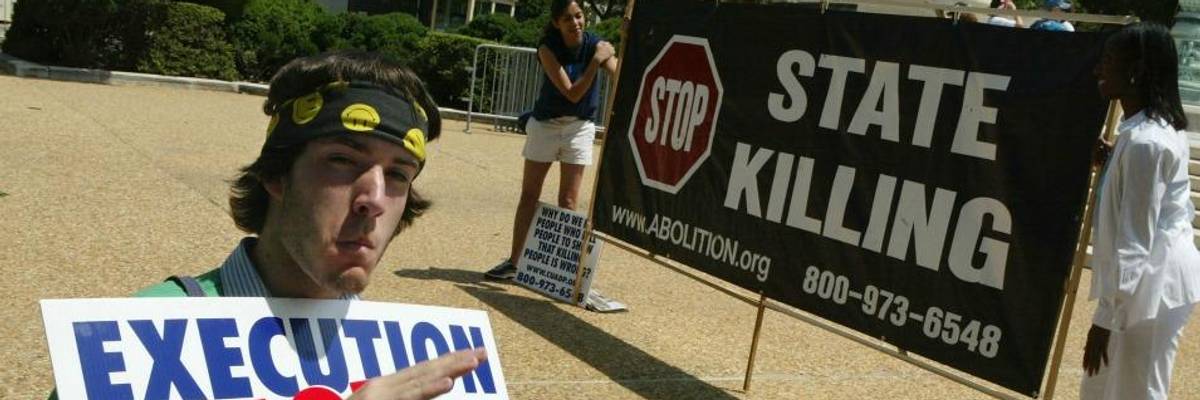
Anti-capital punishment advocates hold a banner at a protest at the U.S. Supreme Court. (Photo: Alex Wong/Getty Images)
Anti-capital punishment advocates on Thursday condemned an announcement by Oklahoma Attorney General Mike Hunter this week that the state would begin using nitrogen gas to execute death row inmates, after being unable to secure lethal injection drugs.
Following challenges by prisoners and rights advocates, some manufacturers have stopped selling certain kinds of drugs to states for lethal injections, leaving some ready to use those on death row as guinea pigs as they experiment with the ways to carry out executions.
Oklahoma temporarily suspended its use of the death penalty in 2015 after the state used the wrong drug in one execution and left another inmate writhing in pain for 43 minutes due to an improperly placed IV. Later, that inmate died from what was determined to be a massive heart attack.
Hunter equated halting executions to "sitting on the sidelines" in a statement on Wednesday and said using nitrogen gas to kill inmates would be "effective, simple to administer, [and] easy to obtain."
Critics, including Robert Dunham, executive director of the Death Penalty Information Center, raised concerns over the experimental nature of the newly proposed procedure.
"This is another execution process that is untested, untried, and experimental," he told the Independent.
According to the Independent, the American Veterinary Medical Association has deemed the use of nitrogen gas as unacceptable for euthanizing animals, and has said it would take several minutes for a 70-pound animal to die if the gas was administered.
Nitrogen gas has been used to euthanize people who have requested the procedure.
But "there is a significant difference between when someone is seeking to terminate their own life--and they are not struggling and are willfully participating--and what happens when you involuntarily seek to terminate the life of someone who wants to live, and who will be struggling and trying not to breathe," Dunham told the New York Times.
On social media, anti-death penalty activist Sister Helen Prejean denounced Oklahoma's plan to asphyxiate inmates.
Dear Common Dreams reader, It’s been nearly 30 years since I co-founded Common Dreams with my late wife, Lina Newhouser. We had the radical notion that journalism should serve the public good, not corporate profits. It was clear to us from the outset what it would take to build such a project. No paid advertisements. No corporate sponsors. No millionaire publisher telling us what to think or do. Many people said we wouldn't last a year, but we proved those doubters wrong. Together with a tremendous team of journalists and dedicated staff, we built an independent media outlet free from the constraints of profits and corporate control. Our mission has always been simple: To inform. To inspire. To ignite change for the common good. Building Common Dreams was not easy. Our survival was never guaranteed. When you take on the most powerful forces—Wall Street greed, fossil fuel industry destruction, Big Tech lobbyists, and uber-rich oligarchs who have spent billions upon billions rigging the economy and democracy in their favor—the only bulwark you have is supporters who believe in your work. But here’s the urgent message from me today. It's never been this bad out there. And it's never been this hard to keep us going. At the very moment Common Dreams is most needed, the threats we face are intensifying. We need your support now more than ever. We don't accept corporate advertising and never will. We don't have a paywall because we don't think people should be blocked from critical news based on their ability to pay. Everything we do is funded by the donations of readers like you. When everyone does the little they can afford, we are strong. But if that support retreats or dries up, so do we. Will you donate now to make sure Common Dreams not only survives but thrives? —Craig Brown, Co-founder |
Anti-capital punishment advocates on Thursday condemned an announcement by Oklahoma Attorney General Mike Hunter this week that the state would begin using nitrogen gas to execute death row inmates, after being unable to secure lethal injection drugs.
Following challenges by prisoners and rights advocates, some manufacturers have stopped selling certain kinds of drugs to states for lethal injections, leaving some ready to use those on death row as guinea pigs as they experiment with the ways to carry out executions.
Oklahoma temporarily suspended its use of the death penalty in 2015 after the state used the wrong drug in one execution and left another inmate writhing in pain for 43 minutes due to an improperly placed IV. Later, that inmate died from what was determined to be a massive heart attack.
Hunter equated halting executions to "sitting on the sidelines" in a statement on Wednesday and said using nitrogen gas to kill inmates would be "effective, simple to administer, [and] easy to obtain."
Critics, including Robert Dunham, executive director of the Death Penalty Information Center, raised concerns over the experimental nature of the newly proposed procedure.
"This is another execution process that is untested, untried, and experimental," he told the Independent.
According to the Independent, the American Veterinary Medical Association has deemed the use of nitrogen gas as unacceptable for euthanizing animals, and has said it would take several minutes for a 70-pound animal to die if the gas was administered.
Nitrogen gas has been used to euthanize people who have requested the procedure.
But "there is a significant difference between when someone is seeking to terminate their own life--and they are not struggling and are willfully participating--and what happens when you involuntarily seek to terminate the life of someone who wants to live, and who will be struggling and trying not to breathe," Dunham told the New York Times.
On social media, anti-death penalty activist Sister Helen Prejean denounced Oklahoma's plan to asphyxiate inmates.
Anti-capital punishment advocates on Thursday condemned an announcement by Oklahoma Attorney General Mike Hunter this week that the state would begin using nitrogen gas to execute death row inmates, after being unable to secure lethal injection drugs.
Following challenges by prisoners and rights advocates, some manufacturers have stopped selling certain kinds of drugs to states for lethal injections, leaving some ready to use those on death row as guinea pigs as they experiment with the ways to carry out executions.
Oklahoma temporarily suspended its use of the death penalty in 2015 after the state used the wrong drug in one execution and left another inmate writhing in pain for 43 minutes due to an improperly placed IV. Later, that inmate died from what was determined to be a massive heart attack.
Hunter equated halting executions to "sitting on the sidelines" in a statement on Wednesday and said using nitrogen gas to kill inmates would be "effective, simple to administer, [and] easy to obtain."
Critics, including Robert Dunham, executive director of the Death Penalty Information Center, raised concerns over the experimental nature of the newly proposed procedure.
"This is another execution process that is untested, untried, and experimental," he told the Independent.
According to the Independent, the American Veterinary Medical Association has deemed the use of nitrogen gas as unacceptable for euthanizing animals, and has said it would take several minutes for a 70-pound animal to die if the gas was administered.
Nitrogen gas has been used to euthanize people who have requested the procedure.
But "there is a significant difference between when someone is seeking to terminate their own life--and they are not struggling and are willfully participating--and what happens when you involuntarily seek to terminate the life of someone who wants to live, and who will be struggling and trying not to breathe," Dunham told the New York Times.
On social media, anti-death penalty activist Sister Helen Prejean denounced Oklahoma's plan to asphyxiate inmates.