SUBSCRIBE TO OUR FREE NEWSLETTER
Daily news & progressive opinion—funded by the people, not the corporations—delivered straight to your inbox.
5
#000000
#FFFFFF
To donate by check, phone, or other method, see our More Ways to Give page.
Daily news & progressive opinion—funded by the people, not the corporations—delivered straight to your inbox.
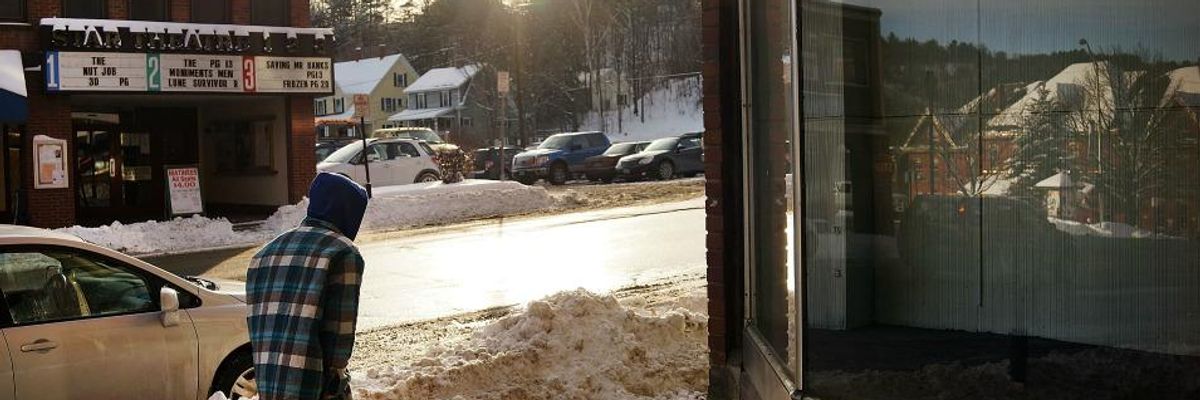
A man walks down a street in St. Johnsbury, Vermont, which has had a high rate of heroin abuse in recent years. (Photo: Spencer Platt/Getty Images)
President Donald Trump's recent threats to execute drug dealers are reportedly materializing in his final plan to combat the opioid addiction epidemic that has killed tens of thousands of people annually in recent years.
According to Politico, the proposal--expected to be unveiled next week when the president visits New Hampshire, one of the hardest-hit states--will call for capital punishment for dealers and traffickers in "certain cases where opioid, including Fentanyl-related, drug dealing and trafficking are directly responsible for death."
The notion of state-sanctioned executions of drug dealers has alarmed public health experts and criminal justice reform advocates in recent days, as Trump has expressed admiration for Filipino President Rodrigo Duterte's deadly war on drugs and similar measures by other leaders.
Human rights groups have condemned Duterte's drug war as it has led to thousands of deaths in poor communities, many at the hands of the Philippine National Police.
A senior administration official told Axios last week that the president "often jokes about killing drug dealers....He'll say, 'You know the Chinese and Filipinos don't have a drug problem. They just kill them.'" Trump also has privately expressed admiration for Singapore's policy of putting to death people who sell, administer, transport, or distribute certain quantities of drugs.
"Think of it, you kill one person, you get the death penalty in many states," Trump told a crowd in Pennsylvania last weekend. "You kill 5,000 people with drugs because you're smuggling them in and you're making a lot of money and people are dying, and they don't even put you in jail. They don't do anything...and then you wonder why we have a problem."
The expected proposal and Trump's recent rhetoric have led many to argue that pushing for the executions of drug dealers would result in targeting low-income and black communities.
"I wish that he had the same tenacity in attacking the practices of multi-national pharmaceutical companies that have pushed prescription opioids, which have led to the vast majority of abuse cases," Rep. Jared Polis (D-Colo.) told Rolling Stone on Thursday.
Dear Common Dreams reader, It’s been nearly 30 years since I co-founded Common Dreams with my late wife, Lina Newhouser. We had the radical notion that journalism should serve the public good, not corporate profits. It was clear to us from the outset what it would take to build such a project. No paid advertisements. No corporate sponsors. No millionaire publisher telling us what to think or do. Many people said we wouldn't last a year, but we proved those doubters wrong. Together with a tremendous team of journalists and dedicated staff, we built an independent media outlet free from the constraints of profits and corporate control. Our mission has always been simple: To inform. To inspire. To ignite change for the common good. Building Common Dreams was not easy. Our survival was never guaranteed. When you take on the most powerful forces—Wall Street greed, fossil fuel industry destruction, Big Tech lobbyists, and uber-rich oligarchs who have spent billions upon billions rigging the economy and democracy in their favor—the only bulwark you have is supporters who believe in your work. But here’s the urgent message from me today. It's never been this bad out there. And it's never been this hard to keep us going. At the very moment Common Dreams is most needed, the threats we face are intensifying. We need your support now more than ever. We don't accept corporate advertising and never will. We don't have a paywall because we don't think people should be blocked from critical news based on their ability to pay. Everything we do is funded by the donations of readers like you. When everyone does the little they can afford, we are strong. But if that support retreats or dries up, so do we. Will you donate now to make sure Common Dreams not only survives but thrives? —Craig Brown, Co-founder |
President Donald Trump's recent threats to execute drug dealers are reportedly materializing in his final plan to combat the opioid addiction epidemic that has killed tens of thousands of people annually in recent years.
According to Politico, the proposal--expected to be unveiled next week when the president visits New Hampshire, one of the hardest-hit states--will call for capital punishment for dealers and traffickers in "certain cases where opioid, including Fentanyl-related, drug dealing and trafficking are directly responsible for death."
The notion of state-sanctioned executions of drug dealers has alarmed public health experts and criminal justice reform advocates in recent days, as Trump has expressed admiration for Filipino President Rodrigo Duterte's deadly war on drugs and similar measures by other leaders.
Human rights groups have condemned Duterte's drug war as it has led to thousands of deaths in poor communities, many at the hands of the Philippine National Police.
A senior administration official told Axios last week that the president "often jokes about killing drug dealers....He'll say, 'You know the Chinese and Filipinos don't have a drug problem. They just kill them.'" Trump also has privately expressed admiration for Singapore's policy of putting to death people who sell, administer, transport, or distribute certain quantities of drugs.
"Think of it, you kill one person, you get the death penalty in many states," Trump told a crowd in Pennsylvania last weekend. "You kill 5,000 people with drugs because you're smuggling them in and you're making a lot of money and people are dying, and they don't even put you in jail. They don't do anything...and then you wonder why we have a problem."
The expected proposal and Trump's recent rhetoric have led many to argue that pushing for the executions of drug dealers would result in targeting low-income and black communities.
"I wish that he had the same tenacity in attacking the practices of multi-national pharmaceutical companies that have pushed prescription opioids, which have led to the vast majority of abuse cases," Rep. Jared Polis (D-Colo.) told Rolling Stone on Thursday.
President Donald Trump's recent threats to execute drug dealers are reportedly materializing in his final plan to combat the opioid addiction epidemic that has killed tens of thousands of people annually in recent years.
According to Politico, the proposal--expected to be unveiled next week when the president visits New Hampshire, one of the hardest-hit states--will call for capital punishment for dealers and traffickers in "certain cases where opioid, including Fentanyl-related, drug dealing and trafficking are directly responsible for death."
The notion of state-sanctioned executions of drug dealers has alarmed public health experts and criminal justice reform advocates in recent days, as Trump has expressed admiration for Filipino President Rodrigo Duterte's deadly war on drugs and similar measures by other leaders.
Human rights groups have condemned Duterte's drug war as it has led to thousands of deaths in poor communities, many at the hands of the Philippine National Police.
A senior administration official told Axios last week that the president "often jokes about killing drug dealers....He'll say, 'You know the Chinese and Filipinos don't have a drug problem. They just kill them.'" Trump also has privately expressed admiration for Singapore's policy of putting to death people who sell, administer, transport, or distribute certain quantities of drugs.
"Think of it, you kill one person, you get the death penalty in many states," Trump told a crowd in Pennsylvania last weekend. "You kill 5,000 people with drugs because you're smuggling them in and you're making a lot of money and people are dying, and they don't even put you in jail. They don't do anything...and then you wonder why we have a problem."
The expected proposal and Trump's recent rhetoric have led many to argue that pushing for the executions of drug dealers would result in targeting low-income and black communities.
"I wish that he had the same tenacity in attacking the practices of multi-national pharmaceutical companies that have pushed prescription opioids, which have led to the vast majority of abuse cases," Rep. Jared Polis (D-Colo.) told Rolling Stone on Thursday.