SUBSCRIBE TO OUR FREE NEWSLETTER
Daily news & progressive opinion—funded by the people, not the corporations—delivered straight to your inbox.
5
#000000
#FFFFFF
To donate by check, phone, or other method, see our More Ways to Give page.
Daily news & progressive opinion—funded by the people, not the corporations—delivered straight to your inbox.
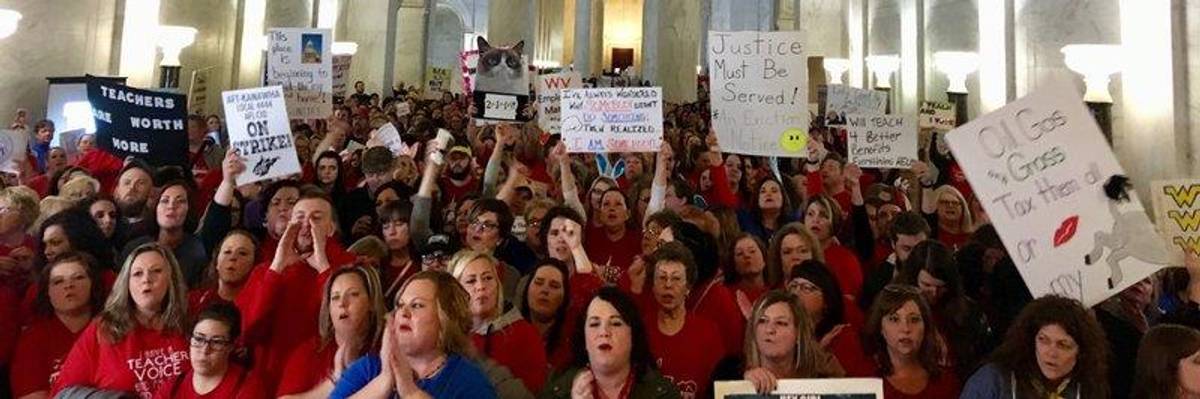
Thousands of teachers rallied at the state Capitol in Charleston, W.Va., last Thursday. (Photo: John Raby/AP)
Thousands of teachers and other school personnel rallied outside in the West Virginia Capitol on Monday, where union officials announced that the first-ever statewide walkout underway would continue for a fourth day.
"Our teachers and our public employees are getting less in pay per year every year, and people are fed up and fired up about it," said Morgantown High School art teacher Sam Brunett at a candlelight vigil Sunday outside the Capitol.
The strike, which began Thursday, is indeed historic. (A nearly statewide strike took place in 1990.)
The current action is taking place throughout the state's 55 counties, which means roughly 20,000 teachers are taking part.
West Virginia Public Broadcasting explained the reasons for the strike thusly:
Leaders of teacher unions and their members are calling for salary increases, a permanent fix to healthcare through the Public Employees Insurance Agency and a stop to legislation on what they call attacks on seniority. They are also hoping lawmakers will walk away from a bill known as "paycheck protection" that would make union members opt-in yearly to have dues withdrawn from paychecks.
West Virginia ranked 48th in the nation for average teacher pay in 2017.
While Gov. Jim Justice has signed Senate Bill 267 calling for a salary increase of 2 percent this year with an additional 1 percent increase the following two years, teachers and their union leaders say that's not enough -- especially considering teachers were offered a 2 percent increase last year in more economically troubling times.
The West Virginia Center on Budget & Policy tweeted that the legislation "is not enough to keep with inflation":
Speaking to CNN at the Sunday night vigil, Jacob Fertig, an art teacher at Riverside High School in Belle, in Kanawha County, laid out what the pay means in real terms: "You know, as a professional degreed teacher, working two jobs, I qualify for WIC and food stamps."
Randi Weingarten, national president of the American Federation of Teachers has said the teachers "are engaged in a righteous and fundamental American values fight for dignity and respect."
At the rally Monday, Dale Lee, president of the West Virginia Education Association, said, "We still have a lot of work to do."
"We will be on the picket lines and be back at the Capitol tomorrow. Make sure they hear your voices."
Dear Common Dreams reader, It’s been nearly 30 years since I co-founded Common Dreams with my late wife, Lina Newhouser. We had the radical notion that journalism should serve the public good, not corporate profits. It was clear to us from the outset what it would take to build such a project. No paid advertisements. No corporate sponsors. No millionaire publisher telling us what to think or do. Many people said we wouldn't last a year, but we proved those doubters wrong. Together with a tremendous team of journalists and dedicated staff, we built an independent media outlet free from the constraints of profits and corporate control. Our mission has always been simple: To inform. To inspire. To ignite change for the common good. Building Common Dreams was not easy. Our survival was never guaranteed. When you take on the most powerful forces—Wall Street greed, fossil fuel industry destruction, Big Tech lobbyists, and uber-rich oligarchs who have spent billions upon billions rigging the economy and democracy in their favor—the only bulwark you have is supporters who believe in your work. But here’s the urgent message from me today. It's never been this bad out there. And it's never been this hard to keep us going. At the very moment Common Dreams is most needed, the threats we face are intensifying. We need your support now more than ever. We don't accept corporate advertising and never will. We don't have a paywall because we don't think people should be blocked from critical news based on their ability to pay. Everything we do is funded by the donations of readers like you. When everyone does the little they can afford, we are strong. But if that support retreats or dries up, so do we. Will you donate now to make sure Common Dreams not only survives but thrives? —Craig Brown, Co-founder |
Thousands of teachers and other school personnel rallied outside in the West Virginia Capitol on Monday, where union officials announced that the first-ever statewide walkout underway would continue for a fourth day.
"Our teachers and our public employees are getting less in pay per year every year, and people are fed up and fired up about it," said Morgantown High School art teacher Sam Brunett at a candlelight vigil Sunday outside the Capitol.
The strike, which began Thursday, is indeed historic. (A nearly statewide strike took place in 1990.)
The current action is taking place throughout the state's 55 counties, which means roughly 20,000 teachers are taking part.
West Virginia Public Broadcasting explained the reasons for the strike thusly:
Leaders of teacher unions and their members are calling for salary increases, a permanent fix to healthcare through the Public Employees Insurance Agency and a stop to legislation on what they call attacks on seniority. They are also hoping lawmakers will walk away from a bill known as "paycheck protection" that would make union members opt-in yearly to have dues withdrawn from paychecks.
West Virginia ranked 48th in the nation for average teacher pay in 2017.
While Gov. Jim Justice has signed Senate Bill 267 calling for a salary increase of 2 percent this year with an additional 1 percent increase the following two years, teachers and their union leaders say that's not enough -- especially considering teachers were offered a 2 percent increase last year in more economically troubling times.
The West Virginia Center on Budget & Policy tweeted that the legislation "is not enough to keep with inflation":
Speaking to CNN at the Sunday night vigil, Jacob Fertig, an art teacher at Riverside High School in Belle, in Kanawha County, laid out what the pay means in real terms: "You know, as a professional degreed teacher, working two jobs, I qualify for WIC and food stamps."
Randi Weingarten, national president of the American Federation of Teachers has said the teachers "are engaged in a righteous and fundamental American values fight for dignity and respect."
At the rally Monday, Dale Lee, president of the West Virginia Education Association, said, "We still have a lot of work to do."
"We will be on the picket lines and be back at the Capitol tomorrow. Make sure they hear your voices."
Thousands of teachers and other school personnel rallied outside in the West Virginia Capitol on Monday, where union officials announced that the first-ever statewide walkout underway would continue for a fourth day.
"Our teachers and our public employees are getting less in pay per year every year, and people are fed up and fired up about it," said Morgantown High School art teacher Sam Brunett at a candlelight vigil Sunday outside the Capitol.
The strike, which began Thursday, is indeed historic. (A nearly statewide strike took place in 1990.)
The current action is taking place throughout the state's 55 counties, which means roughly 20,000 teachers are taking part.
West Virginia Public Broadcasting explained the reasons for the strike thusly:
Leaders of teacher unions and their members are calling for salary increases, a permanent fix to healthcare through the Public Employees Insurance Agency and a stop to legislation on what they call attacks on seniority. They are also hoping lawmakers will walk away from a bill known as "paycheck protection" that would make union members opt-in yearly to have dues withdrawn from paychecks.
West Virginia ranked 48th in the nation for average teacher pay in 2017.
While Gov. Jim Justice has signed Senate Bill 267 calling for a salary increase of 2 percent this year with an additional 1 percent increase the following two years, teachers and their union leaders say that's not enough -- especially considering teachers were offered a 2 percent increase last year in more economically troubling times.
The West Virginia Center on Budget & Policy tweeted that the legislation "is not enough to keep with inflation":
Speaking to CNN at the Sunday night vigil, Jacob Fertig, an art teacher at Riverside High School in Belle, in Kanawha County, laid out what the pay means in real terms: "You know, as a professional degreed teacher, working two jobs, I qualify for WIC and food stamps."
Randi Weingarten, national president of the American Federation of Teachers has said the teachers "are engaged in a righteous and fundamental American values fight for dignity and respect."
At the rally Monday, Dale Lee, president of the West Virginia Education Association, said, "We still have a lot of work to do."
"We will be on the picket lines and be back at the Capitol tomorrow. Make sure they hear your voices."