

SUBSCRIBE TO OUR FREE NEWSLETTER
Daily news & progressive opinion—funded by the people, not the corporations—delivered straight to your inbox.
5
#000000
#FFFFFF
To donate by check, phone, or other method, see our More Ways to Give page.
Daily news & progressive opinion—funded by the people, not the corporations—delivered straight to your inbox.
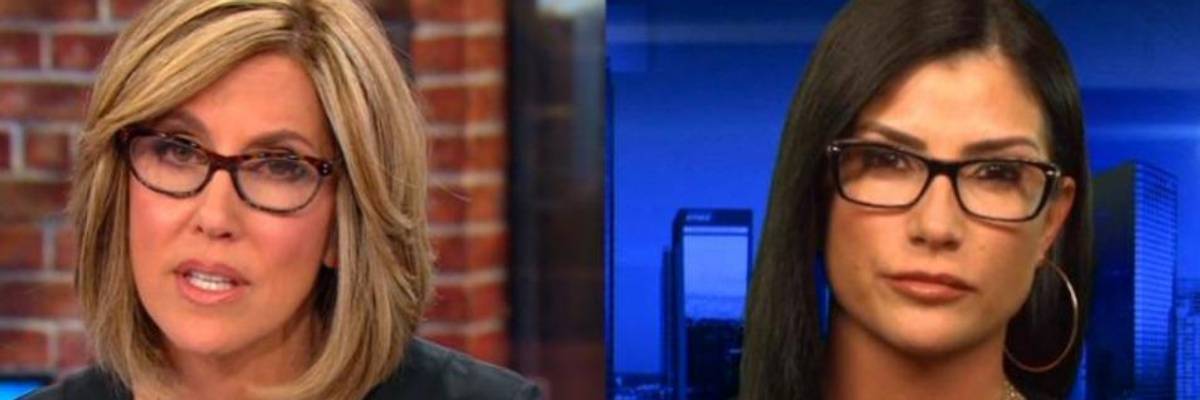
NRA spokesperson Dana Loesch, right, told CNN host Alisyn Camerota on Friday that the news media "loves" the ratings delivered by mass shootings--a remark that drew condemnation from journalists on social media. (Photo: @CNN/Twitter)
Journalists on social media pushed back on Friday against NRA spokesperson Dana Loesch's claim that the news media "loves" mass shootings because they deliver ratings boosts.
"Many in legacy media love mass shootings. You guys love it," Loesch said Thursday at the annual Conservative Political Action Conference (CPAC), addressing reporters in the back of the room. "Now I'm not saying that you love the tragedy. But I am saying that you love the ratings. Crying white mothers are ratings gold to you and many in the legacy media."
Loesch's comments echoed those made in a video released this week by the NRA, in which gun rights activist Colion Noir argued, "If there's one organization in this country that has a vested interest in the perpetuation of mass tragedy, it's the mainstream media."
The former Blaze host doubled-down on her comments in a Friday morning interview on CNN with Alisyn Camerota, who told her, "You're wrong on every single level," and argued against her claim that shootings provide a ratings boost for news programs.
"Americans have reached saturation level," said Camerota. "They're so sick of it and it's so heartbreaking that they actually often turn away."
Many in the news media have pushed to refine how news stations cover mass shootings, urging journalists to focus less on the perpetrators of attacks. Much of the ongoing coverage of the shooting in Parkland, Florida last week has focused on efforts by survivors to achieve gun control legislation in order to prevent more shootings--a push that is strongly opposed by the NRA.
On social media, many reporters reminded Loesch and her supporters that journalists are members of their communities whose families are put at as much risk as any other American household by the prevalence of military-style semi-automatic firearms like the AR-15.
Others pointed to the emotional toll covering repeated mass killings--typically with little to no action by legislators in the wake of such attacks, to curb shootings--can take on journalists.
As Catherine Woodiwiss wrote at Sojourners last July, reporters' prolonged exposure to violent and traumatic events including shootings can correspond with high levels of distress:
In 2014, a study of "frequent and prolonged exposure to deeply disturbing images" published in the Journal of the Royal Society of Medicine found that the frequency with which a journalist watches violent content correlates with the journalist's likelihood of having anxiety, depression, PTSD, or alcoholism.
The Radio Television Digital News Association also released a statement about the NRA's new talking point.
"We are your neighbors. Your friends. We attend the same houses of worship. We go the same classes at the gym. Our children are in the same classes at school...We are deeply affected by tragedy. We are journalists and we do what we do because you have a need to know and understand the world around you."
Dear Common Dreams reader, It’s been nearly 30 years since I co-founded Common Dreams with my late wife, Lina Newhouser. We had the radical notion that journalism should serve the public good, not corporate profits. It was clear to us from the outset what it would take to build such a project. No paid advertisements. No corporate sponsors. No millionaire publisher telling us what to think or do. Many people said we wouldn't last a year, but we proved those doubters wrong. Together with a tremendous team of journalists and dedicated staff, we built an independent media outlet free from the constraints of profits and corporate control. Our mission has always been simple: To inform. To inspire. To ignite change for the common good. Building Common Dreams was not easy. Our survival was never guaranteed. When you take on the most powerful forces—Wall Street greed, fossil fuel industry destruction, Big Tech lobbyists, and uber-rich oligarchs who have spent billions upon billions rigging the economy and democracy in their favor—the only bulwark you have is supporters who believe in your work. But here’s the urgent message from me today. It's never been this bad out there. And it's never been this hard to keep us going. At the very moment Common Dreams is most needed, the threats we face are intensifying. We need your support now more than ever. We don't accept corporate advertising and never will. We don't have a paywall because we don't think people should be blocked from critical news based on their ability to pay. Everything we do is funded by the donations of readers like you. When everyone does the little they can afford, we are strong. But if that support retreats or dries up, so do we. Will you donate now to make sure Common Dreams not only survives but thrives? —Craig Brown, Co-founder |
Journalists on social media pushed back on Friday against NRA spokesperson Dana Loesch's claim that the news media "loves" mass shootings because they deliver ratings boosts.
"Many in legacy media love mass shootings. You guys love it," Loesch said Thursday at the annual Conservative Political Action Conference (CPAC), addressing reporters in the back of the room. "Now I'm not saying that you love the tragedy. But I am saying that you love the ratings. Crying white mothers are ratings gold to you and many in the legacy media."
Loesch's comments echoed those made in a video released this week by the NRA, in which gun rights activist Colion Noir argued, "If there's one organization in this country that has a vested interest in the perpetuation of mass tragedy, it's the mainstream media."
The former Blaze host doubled-down on her comments in a Friday morning interview on CNN with Alisyn Camerota, who told her, "You're wrong on every single level," and argued against her claim that shootings provide a ratings boost for news programs.
"Americans have reached saturation level," said Camerota. "They're so sick of it and it's so heartbreaking that they actually often turn away."
Many in the news media have pushed to refine how news stations cover mass shootings, urging journalists to focus less on the perpetrators of attacks. Much of the ongoing coverage of the shooting in Parkland, Florida last week has focused on efforts by survivors to achieve gun control legislation in order to prevent more shootings--a push that is strongly opposed by the NRA.
On social media, many reporters reminded Loesch and her supporters that journalists are members of their communities whose families are put at as much risk as any other American household by the prevalence of military-style semi-automatic firearms like the AR-15.
Others pointed to the emotional toll covering repeated mass killings--typically with little to no action by legislators in the wake of such attacks, to curb shootings--can take on journalists.
As Catherine Woodiwiss wrote at Sojourners last July, reporters' prolonged exposure to violent and traumatic events including shootings can correspond with high levels of distress:
In 2014, a study of "frequent and prolonged exposure to deeply disturbing images" published in the Journal of the Royal Society of Medicine found that the frequency with which a journalist watches violent content correlates with the journalist's likelihood of having anxiety, depression, PTSD, or alcoholism.
The Radio Television Digital News Association also released a statement about the NRA's new talking point.
"We are your neighbors. Your friends. We attend the same houses of worship. We go the same classes at the gym. Our children are in the same classes at school...We are deeply affected by tragedy. We are journalists and we do what we do because you have a need to know and understand the world around you."
Journalists on social media pushed back on Friday against NRA spokesperson Dana Loesch's claim that the news media "loves" mass shootings because they deliver ratings boosts.
"Many in legacy media love mass shootings. You guys love it," Loesch said Thursday at the annual Conservative Political Action Conference (CPAC), addressing reporters in the back of the room. "Now I'm not saying that you love the tragedy. But I am saying that you love the ratings. Crying white mothers are ratings gold to you and many in the legacy media."
Loesch's comments echoed those made in a video released this week by the NRA, in which gun rights activist Colion Noir argued, "If there's one organization in this country that has a vested interest in the perpetuation of mass tragedy, it's the mainstream media."
The former Blaze host doubled-down on her comments in a Friday morning interview on CNN with Alisyn Camerota, who told her, "You're wrong on every single level," and argued against her claim that shootings provide a ratings boost for news programs.
"Americans have reached saturation level," said Camerota. "They're so sick of it and it's so heartbreaking that they actually often turn away."
Many in the news media have pushed to refine how news stations cover mass shootings, urging journalists to focus less on the perpetrators of attacks. Much of the ongoing coverage of the shooting in Parkland, Florida last week has focused on efforts by survivors to achieve gun control legislation in order to prevent more shootings--a push that is strongly opposed by the NRA.
On social media, many reporters reminded Loesch and her supporters that journalists are members of their communities whose families are put at as much risk as any other American household by the prevalence of military-style semi-automatic firearms like the AR-15.
Others pointed to the emotional toll covering repeated mass killings--typically with little to no action by legislators in the wake of such attacks, to curb shootings--can take on journalists.
As Catherine Woodiwiss wrote at Sojourners last July, reporters' prolonged exposure to violent and traumatic events including shootings can correspond with high levels of distress:
In 2014, a study of "frequent and prolonged exposure to deeply disturbing images" published in the Journal of the Royal Society of Medicine found that the frequency with which a journalist watches violent content correlates with the journalist's likelihood of having anxiety, depression, PTSD, or alcoholism.
The Radio Television Digital News Association also released a statement about the NRA's new talking point.
"We are your neighbors. Your friends. We attend the same houses of worship. We go the same classes at the gym. Our children are in the same classes at school...We are deeply affected by tragedy. We are journalists and we do what we do because you have a need to know and understand the world around you."

