SUBSCRIBE TO OUR FREE NEWSLETTER
Daily news & progressive opinion—funded by the people, not the corporations—delivered straight to your inbox.
5
#000000
#FFFFFF
To donate by check, phone, or other method, see our More Ways to Give page.
Daily news & progressive opinion—funded by the people, not the corporations—delivered straight to your inbox.
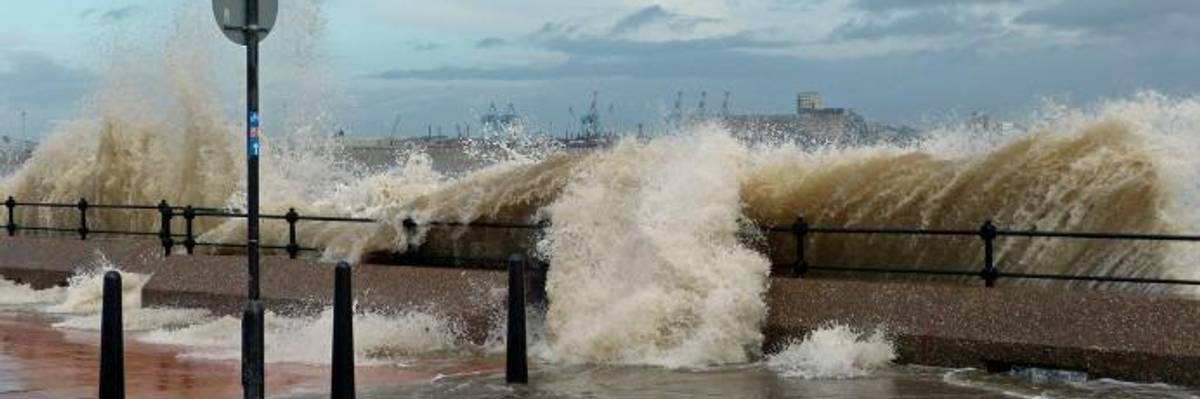
In a new study published Feb. 12, scientists found that global sea level rise is accelerating each year. (Photo: Andrew/Flickr/cc)
As the Trump White House continues to advocate for the increased use of fossil fuels for energy--while every single other nation on Earth has committed to decreasing greenhouse gas emissions that are driving global warming--scientists have found that global sea level rise is accelerating each year.
"We are already seeing signs of ice sheet instability in Greenland and Antarctica, so if they experience rapid changes, then we would likely see more than 65 centimeters of sea level rise by 2100."
--Steve Nerem, lead author
Rather than using the typical tide-gauge data, a team of scientists from across the U.S. turned to satellite data from the past 25 years to study the annual rate of global sea level rise.
They found that oceans are encroaching on coastlines worldwide at a greater pace with every passing year, as detailed in a report (pdf) published Monday in the Proceedings of the National Academy of Sciences.
Due to greenhouse gas emissions, largely generated by modern agricultural and dirty energy practices, the planet's warming atmosphere and oceans are causing ice sheets in Greenland and Antarctica to melt quickly, which the researchers say is producing "climate-change driven accelerated sea level rise."
"It's a big deal," said the study's lead author, Steve Nerem of the University of Colorado Boulder, because these findings indicate that the data-based projections from past studies that relied on a constant rate of sea level rise are too conservative.
"This acceleration, driven mainly by accelerated melting in Greenland and Antarctica, has the potential to double the total sea level rise by 2100," Nerem explained, "as compared to projections that assume a constant rate, to more than 60 centimeters instead of about 30," or about two feet instead of about one.
In fact, "65 centimeters is probably on the low end for 2100, since it assumes the rate and acceleration we have seen over the last 25 years continues for the next 82 years," Nerem added. "We are already seeing signs of ice sheet instability in Greenland and Antarctica, so if they experience rapid changes, then we would likely see more than 65 centimeters of sea level rise by 2100."
The study provides a "data-driven assessment of sea level change" that backs up climate models that were used in the most recent International Panel on Climate Change report (pdf), which showed oceans rising 52 to 98 centimenters by the end of this century.
"The acceleration predicted by the models has now been detected directly from the observations," noted study co-author Gary Mitchum of Florida's College of Marine Science. "I think this is a game-changer as far as the climate change discussion goes."
The findings elicited calls for the United States to get onboard with the rest of the world and recommit to the Paris Climate Agreement, and for other nations to take more drastic and urgent steps to reduce emissions.
Others responded with jabs directed at those who actively deny the problem and refuse to address global warming:
Dear Common Dreams reader, It’s been nearly 30 years since I co-founded Common Dreams with my late wife, Lina Newhouser. We had the radical notion that journalism should serve the public good, not corporate profits. It was clear to us from the outset what it would take to build such a project. No paid advertisements. No corporate sponsors. No millionaire publisher telling us what to think or do. Many people said we wouldn't last a year, but we proved those doubters wrong. Together with a tremendous team of journalists and dedicated staff, we built an independent media outlet free from the constraints of profits and corporate control. Our mission has always been simple: To inform. To inspire. To ignite change for the common good. Building Common Dreams was not easy. Our survival was never guaranteed. When you take on the most powerful forces—Wall Street greed, fossil fuel industry destruction, Big Tech lobbyists, and uber-rich oligarchs who have spent billions upon billions rigging the economy and democracy in their favor—the only bulwark you have is supporters who believe in your work. But here’s the urgent message from me today. It's never been this bad out there. And it's never been this hard to keep us going. At the very moment Common Dreams is most needed, the threats we face are intensifying. We need your support now more than ever. We don't accept corporate advertising and never will. We don't have a paywall because we don't think people should be blocked from critical news based on their ability to pay. Everything we do is funded by the donations of readers like you. When everyone does the little they can afford, we are strong. But if that support retreats or dries up, so do we. Will you donate now to make sure Common Dreams not only survives but thrives? —Craig Brown, Co-founder |
As the Trump White House continues to advocate for the increased use of fossil fuels for energy--while every single other nation on Earth has committed to decreasing greenhouse gas emissions that are driving global warming--scientists have found that global sea level rise is accelerating each year.
"We are already seeing signs of ice sheet instability in Greenland and Antarctica, so if they experience rapid changes, then we would likely see more than 65 centimeters of sea level rise by 2100."
--Steve Nerem, lead author
Rather than using the typical tide-gauge data, a team of scientists from across the U.S. turned to satellite data from the past 25 years to study the annual rate of global sea level rise.
They found that oceans are encroaching on coastlines worldwide at a greater pace with every passing year, as detailed in a report (pdf) published Monday in the Proceedings of the National Academy of Sciences.
Due to greenhouse gas emissions, largely generated by modern agricultural and dirty energy practices, the planet's warming atmosphere and oceans are causing ice sheets in Greenland and Antarctica to melt quickly, which the researchers say is producing "climate-change driven accelerated sea level rise."
"It's a big deal," said the study's lead author, Steve Nerem of the University of Colorado Boulder, because these findings indicate that the data-based projections from past studies that relied on a constant rate of sea level rise are too conservative.
"This acceleration, driven mainly by accelerated melting in Greenland and Antarctica, has the potential to double the total sea level rise by 2100," Nerem explained, "as compared to projections that assume a constant rate, to more than 60 centimeters instead of about 30," or about two feet instead of about one.
In fact, "65 centimeters is probably on the low end for 2100, since it assumes the rate and acceleration we have seen over the last 25 years continues for the next 82 years," Nerem added. "We are already seeing signs of ice sheet instability in Greenland and Antarctica, so if they experience rapid changes, then we would likely see more than 65 centimeters of sea level rise by 2100."
The study provides a "data-driven assessment of sea level change" that backs up climate models that were used in the most recent International Panel on Climate Change report (pdf), which showed oceans rising 52 to 98 centimenters by the end of this century.
"The acceleration predicted by the models has now been detected directly from the observations," noted study co-author Gary Mitchum of Florida's College of Marine Science. "I think this is a game-changer as far as the climate change discussion goes."
The findings elicited calls for the United States to get onboard with the rest of the world and recommit to the Paris Climate Agreement, and for other nations to take more drastic and urgent steps to reduce emissions.
Others responded with jabs directed at those who actively deny the problem and refuse to address global warming:
As the Trump White House continues to advocate for the increased use of fossil fuels for energy--while every single other nation on Earth has committed to decreasing greenhouse gas emissions that are driving global warming--scientists have found that global sea level rise is accelerating each year.
"We are already seeing signs of ice sheet instability in Greenland and Antarctica, so if they experience rapid changes, then we would likely see more than 65 centimeters of sea level rise by 2100."
--Steve Nerem, lead author
Rather than using the typical tide-gauge data, a team of scientists from across the U.S. turned to satellite data from the past 25 years to study the annual rate of global sea level rise.
They found that oceans are encroaching on coastlines worldwide at a greater pace with every passing year, as detailed in a report (pdf) published Monday in the Proceedings of the National Academy of Sciences.
Due to greenhouse gas emissions, largely generated by modern agricultural and dirty energy practices, the planet's warming atmosphere and oceans are causing ice sheets in Greenland and Antarctica to melt quickly, which the researchers say is producing "climate-change driven accelerated sea level rise."
"It's a big deal," said the study's lead author, Steve Nerem of the University of Colorado Boulder, because these findings indicate that the data-based projections from past studies that relied on a constant rate of sea level rise are too conservative.
"This acceleration, driven mainly by accelerated melting in Greenland and Antarctica, has the potential to double the total sea level rise by 2100," Nerem explained, "as compared to projections that assume a constant rate, to more than 60 centimeters instead of about 30," or about two feet instead of about one.
In fact, "65 centimeters is probably on the low end for 2100, since it assumes the rate and acceleration we have seen over the last 25 years continues for the next 82 years," Nerem added. "We are already seeing signs of ice sheet instability in Greenland and Antarctica, so if they experience rapid changes, then we would likely see more than 65 centimeters of sea level rise by 2100."
The study provides a "data-driven assessment of sea level change" that backs up climate models that were used in the most recent International Panel on Climate Change report (pdf), which showed oceans rising 52 to 98 centimenters by the end of this century.
"The acceleration predicted by the models has now been detected directly from the observations," noted study co-author Gary Mitchum of Florida's College of Marine Science. "I think this is a game-changer as far as the climate change discussion goes."
The findings elicited calls for the United States to get onboard with the rest of the world and recommit to the Paris Climate Agreement, and for other nations to take more drastic and urgent steps to reduce emissions.
Others responded with jabs directed at those who actively deny the problem and refuse to address global warming: