SUBSCRIBE TO OUR FREE NEWSLETTER
Daily news & progressive opinion—funded by the people, not the corporations—delivered straight to your inbox.
5
#000000
#FFFFFF
To donate by check, phone, or other method, see our More Ways to Give page.


Daily news & progressive opinion—funded by the people, not the corporations—delivered straight to your inbox.

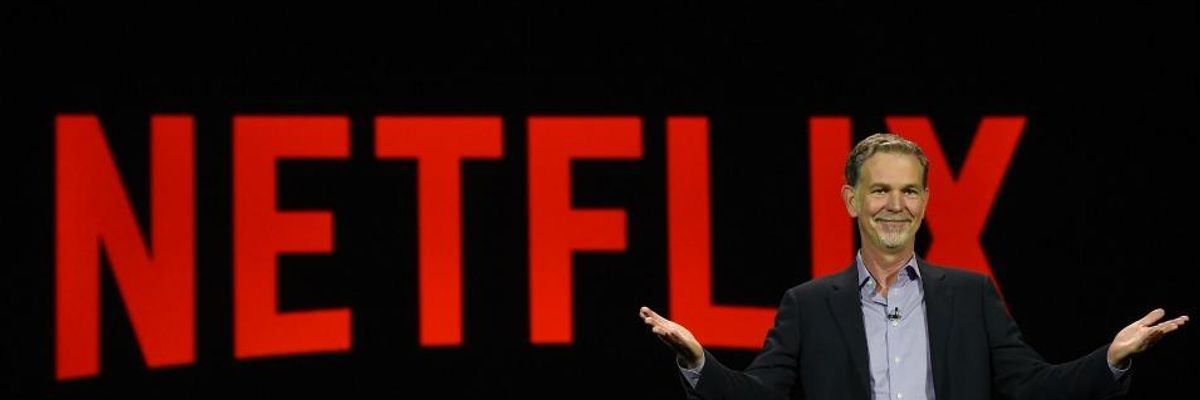
Netflix CEO Reed Hastings delivers a keynote address at CES 2016 at The Venetian Las Vegas on January 6, 2016 in Las Vegas, Nevada. On Friday, Netflix told the FCC it would see the agency "in court" over its order to dismantle net neutrality protections. (Photo: Ethan Miller/Getty Images)
The lobbying group that represents some of the nation's largest companies in Silicon Valley--including Google, Amazon, and Netflix--announced Friday that it would act as "intervernor" in a lawsuit against the FCC's recent decision to dismantle rules that enshrine net neutrality protections that have governed the web since its creation.
After the FCC submitted its final order on Thursday evening, the Internet Association said it would back legal actions to prevent it from going into effect as well as offering support to legislative efforts also underway.
"The final version of Chairman Pai's rule, as expected, dismantles popular net neutrality protections for consumers," said Michael Beckerman, the group's president and CEO, in a statement. "This rule defies the will of a bipartisan majority of Americans and fails to preserve a free and open internet. IA intends to act as an intervenor in judicial action against this order and, along with our member companies, will continue our push to restore strong, enforceable net neutrality protections through a legislative solution."
In a tweet, Netflix said the "Internet is united in defense of #netneutrality." As for the FCC, the popular video-streaming company added, "We will see you in court."
Though not a direct party to any specific lawsuit, Gizmodo explains that acting as a legal intervenor allows the industry group to assert "its right to weigh in on the case in order to protect its members' interests, which would clearly be impeded by disposition of the case."
According to Gizmodo:
The legal battle will take place months from now in a court yet to be determined. The number of litigants is also currently unknown--interested parties have another 50 days or so to file if they wish to join the suit. Among those who've declared their intent to file is Free Press, a pro-net-neutrality advocacy group.
"We'll be going to court soon to challenge the FCC and ramping up pressure on Congress to throw the rules out altogether," Free Press President Craig Aaron told Gizmodo. "[FCC Chairman] Ajit Pai has awakened the public, now Net Neutrality is a kitchen-table issue, and the outcry is only going to get louder."
While a legal battle in the courts is seen as one way to stall or prevent implementation of the FCC's order, which the five-member commission passed along partisan lines last month, net neutrality defenders advocates say the best path to making protections permanent remains the passage of a Congressional Review Act (CRA).
A CRA would reverse the FCC rule changes and once again enshrine net neutrality as a core principle while restoring Title II protections of the Internet under the Telecommunications Act of 1996.

Dear Common Dreams reader, It’s been nearly 30 years since I co-founded Common Dreams with my late wife, Lina Newhouser. We had the radical notion that journalism should serve the public good, not corporate profits. It was clear to us from the outset what it would take to build such a project. No paid advertisements. No corporate sponsors. No millionaire publisher telling us what to think or do. Many people said we wouldn't last a year, but we proved those doubters wrong. Together with a tremendous team of journalists and dedicated staff, we built an independent media outlet free from the constraints of profits and corporate control. Our mission has always been simple: To inform. To inspire. To ignite change for the common good. Building Common Dreams was not easy. Our survival was never guaranteed. When you take on the most powerful forces—Wall Street greed, fossil fuel industry destruction, Big Tech lobbyists, and uber-rich oligarchs who have spent billions upon billions rigging the economy and democracy in their favor—the only bulwark you have is supporters who believe in your work. But here’s the urgent message from me today. It's never been this bad out there. And it's never been this hard to keep us going. At the very moment Common Dreams is most needed, the threats we face are intensifying. We need your support now more than ever. We don't accept corporate advertising and never will. We don't have a paywall because we don't think people should be blocked from critical news based on their ability to pay. Everything we do is funded by the donations of readers like you. When everyone does the little they can afford, we are strong. But if that support retreats or dries up, so do we. Will you donate now to make sure Common Dreams not only survives but thrives? —Craig Brown, Co-founder |
The lobbying group that represents some of the nation's largest companies in Silicon Valley--including Google, Amazon, and Netflix--announced Friday that it would act as "intervernor" in a lawsuit against the FCC's recent decision to dismantle rules that enshrine net neutrality protections that have governed the web since its creation.
After the FCC submitted its final order on Thursday evening, the Internet Association said it would back legal actions to prevent it from going into effect as well as offering support to legislative efforts also underway.
"The final version of Chairman Pai's rule, as expected, dismantles popular net neutrality protections for consumers," said Michael Beckerman, the group's president and CEO, in a statement. "This rule defies the will of a bipartisan majority of Americans and fails to preserve a free and open internet. IA intends to act as an intervenor in judicial action against this order and, along with our member companies, will continue our push to restore strong, enforceable net neutrality protections through a legislative solution."
In a tweet, Netflix said the "Internet is united in defense of #netneutrality." As for the FCC, the popular video-streaming company added, "We will see you in court."
Though not a direct party to any specific lawsuit, Gizmodo explains that acting as a legal intervenor allows the industry group to assert "its right to weigh in on the case in order to protect its members' interests, which would clearly be impeded by disposition of the case."
According to Gizmodo:
The legal battle will take place months from now in a court yet to be determined. The number of litigants is also currently unknown--interested parties have another 50 days or so to file if they wish to join the suit. Among those who've declared their intent to file is Free Press, a pro-net-neutrality advocacy group.
"We'll be going to court soon to challenge the FCC and ramping up pressure on Congress to throw the rules out altogether," Free Press President Craig Aaron told Gizmodo. "[FCC Chairman] Ajit Pai has awakened the public, now Net Neutrality is a kitchen-table issue, and the outcry is only going to get louder."
While a legal battle in the courts is seen as one way to stall or prevent implementation of the FCC's order, which the five-member commission passed along partisan lines last month, net neutrality defenders advocates say the best path to making protections permanent remains the passage of a Congressional Review Act (CRA).
A CRA would reverse the FCC rule changes and once again enshrine net neutrality as a core principle while restoring Title II protections of the Internet under the Telecommunications Act of 1996.

The lobbying group that represents some of the nation's largest companies in Silicon Valley--including Google, Amazon, and Netflix--announced Friday that it would act as "intervernor" in a lawsuit against the FCC's recent decision to dismantle rules that enshrine net neutrality protections that have governed the web since its creation.
After the FCC submitted its final order on Thursday evening, the Internet Association said it would back legal actions to prevent it from going into effect as well as offering support to legislative efforts also underway.
"The final version of Chairman Pai's rule, as expected, dismantles popular net neutrality protections for consumers," said Michael Beckerman, the group's president and CEO, in a statement. "This rule defies the will of a bipartisan majority of Americans and fails to preserve a free and open internet. IA intends to act as an intervenor in judicial action against this order and, along with our member companies, will continue our push to restore strong, enforceable net neutrality protections through a legislative solution."
In a tweet, Netflix said the "Internet is united in defense of #netneutrality." As for the FCC, the popular video-streaming company added, "We will see you in court."
Though not a direct party to any specific lawsuit, Gizmodo explains that acting as a legal intervenor allows the industry group to assert "its right to weigh in on the case in order to protect its members' interests, which would clearly be impeded by disposition of the case."
According to Gizmodo:
The legal battle will take place months from now in a court yet to be determined. The number of litigants is also currently unknown--interested parties have another 50 days or so to file if they wish to join the suit. Among those who've declared their intent to file is Free Press, a pro-net-neutrality advocacy group.
"We'll be going to court soon to challenge the FCC and ramping up pressure on Congress to throw the rules out altogether," Free Press President Craig Aaron told Gizmodo. "[FCC Chairman] Ajit Pai has awakened the public, now Net Neutrality is a kitchen-table issue, and the outcry is only going to get louder."
While a legal battle in the courts is seen as one way to stall or prevent implementation of the FCC's order, which the five-member commission passed along partisan lines last month, net neutrality defenders advocates say the best path to making protections permanent remains the passage of a Congressional Review Act (CRA).
A CRA would reverse the FCC rule changes and once again enshrine net neutrality as a core principle while restoring Title II protections of the Internet under the Telecommunications Act of 1996.