SUBSCRIBE TO OUR FREE NEWSLETTER
Daily news & progressive opinion—funded by the people, not the corporations—delivered straight to your inbox.
5
#000000
#FFFFFF
To donate by check, phone, or other method, see our More Ways to Give page.
Daily news & progressive opinion—funded by the people, not the corporations—delivered straight to your inbox.
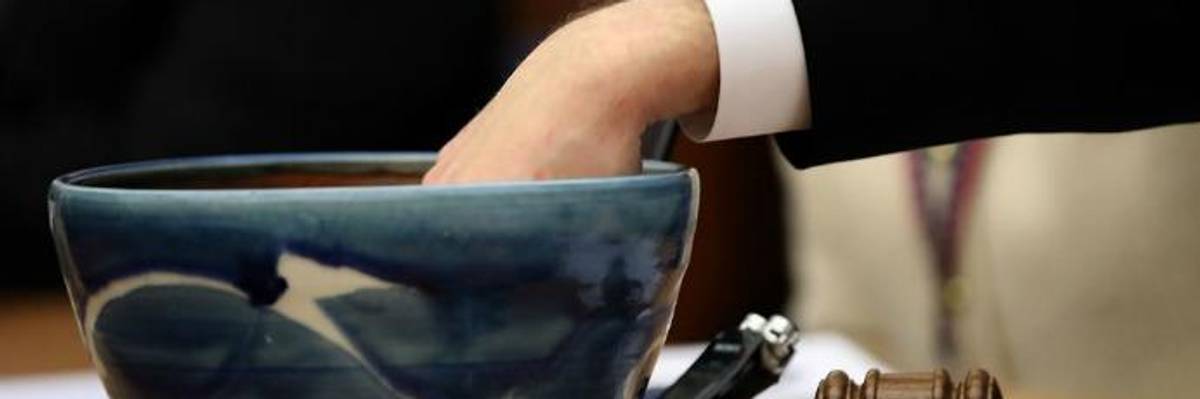
Slips of paper with the names of Virginia House of Delegates candidates Shelly Simonds (D-VA) and David Yancy (R-VA) are drawn from a bowl during a meeting of the Virginia State Board of Elections January 4, 2018 in Richmond, Virginia. (Photo: Win McNamee/Getty Images)
A bizarre and razor-close Virginia House of Delegates election came to a close on Thursday after incumbent Republican David Yancey's name was pulled from an old film canister that was drawn out of a ceramic bowl, giving the GOP a crucial extra seat in the legislature.
The random drawing came after weeks of vote counting and appeals that ultimately resulted in a 11,608-11,608 tie between Yancey and his Democratic opponent, Shelly Simonds.
Buzzfeed's Tasneem Nashrulla, who sardonically described Thursday's drawing as "democracy in action," runs through the timeline:
On Dec. 19, Simonds appeared to be the winner of the race after defeating Yancey by one vote.
On Dec. 20, after Yancey challenged a ballot he said went uncounted, a three-judge panel ruled that the single ballot was in fact a vote for him -- making the race a TIE.
On Dec. 21, James Alcorn, the chairman of the Virginia State Board of Elections, announced that they would draw names to determine the winner of the race on Dec. 27.
However, the drawing was postponed after Simonds challenged the recount vote.
After consideration, the random draw was rescheduled for Jan. 4.
On Thursday, two slips of paper printed with the candidates' names were inserted into film canisters, which were sealed and then shuffled in a ceramic bowl made by a local artist from the Virginia Museum of Fine Arts.
The random result could have monumental consequences for Medicaid expansion in the state, as it gives Republicans a 51-49 advantage in the House of Delegates.
While newly elected Democratic Gov. Ralph Northam campaigned on the promise to expand Medicaid in Virginia, he appeared to qualify this promise in a December interview with the Washington Post, in which he suggested he would work with Republicans in "overhauling" Medicaid in an effort to "better defin[e] eligibility" and "control costs."
The comments were welcomed by Virginia Republicans, but quickly denounced by progressives, who interpreted Northam's nod toward bipartisanship as a needless compromise with the right.
Newly elected Virginia state delegate and democratic socialist Lee Carter was quick to respond to Northam's remarks, saying Medicaid expansion is "the bare minimum."
"A clean Medicaid expansion is the compromise. That's where I'm coming from, that's what I hope he'd be advocating for," Carter added. "I don't think his comments were indicative of that."
Dear Common Dreams reader, It’s been nearly 30 years since I co-founded Common Dreams with my late wife, Lina Newhouser. We had the radical notion that journalism should serve the public good, not corporate profits. It was clear to us from the outset what it would take to build such a project. No paid advertisements. No corporate sponsors. No millionaire publisher telling us what to think or do. Many people said we wouldn't last a year, but we proved those doubters wrong. Together with a tremendous team of journalists and dedicated staff, we built an independent media outlet free from the constraints of profits and corporate control. Our mission has always been simple: To inform. To inspire. To ignite change for the common good. Building Common Dreams was not easy. Our survival was never guaranteed. When you take on the most powerful forces—Wall Street greed, fossil fuel industry destruction, Big Tech lobbyists, and uber-rich oligarchs who have spent billions upon billions rigging the economy and democracy in their favor—the only bulwark you have is supporters who believe in your work. But here’s the urgent message from me today. It's never been this bad out there. And it's never been this hard to keep us going. At the very moment Common Dreams is most needed, the threats we face are intensifying. We need your support now more than ever. We don't accept corporate advertising and never will. We don't have a paywall because we don't think people should be blocked from critical news based on their ability to pay. Everything we do is funded by the donations of readers like you. When everyone does the little they can afford, we are strong. But if that support retreats or dries up, so do we. Will you donate now to make sure Common Dreams not only survives but thrives? —Craig Brown, Co-founder |
A bizarre and razor-close Virginia House of Delegates election came to a close on Thursday after incumbent Republican David Yancey's name was pulled from an old film canister that was drawn out of a ceramic bowl, giving the GOP a crucial extra seat in the legislature.
The random drawing came after weeks of vote counting and appeals that ultimately resulted in a 11,608-11,608 tie between Yancey and his Democratic opponent, Shelly Simonds.
Buzzfeed's Tasneem Nashrulla, who sardonically described Thursday's drawing as "democracy in action," runs through the timeline:
On Dec. 19, Simonds appeared to be the winner of the race after defeating Yancey by one vote.
On Dec. 20, after Yancey challenged a ballot he said went uncounted, a three-judge panel ruled that the single ballot was in fact a vote for him -- making the race a TIE.
On Dec. 21, James Alcorn, the chairman of the Virginia State Board of Elections, announced that they would draw names to determine the winner of the race on Dec. 27.
However, the drawing was postponed after Simonds challenged the recount vote.
After consideration, the random draw was rescheduled for Jan. 4.
On Thursday, two slips of paper printed with the candidates' names were inserted into film canisters, which were sealed and then shuffled in a ceramic bowl made by a local artist from the Virginia Museum of Fine Arts.
The random result could have monumental consequences for Medicaid expansion in the state, as it gives Republicans a 51-49 advantage in the House of Delegates.
While newly elected Democratic Gov. Ralph Northam campaigned on the promise to expand Medicaid in Virginia, he appeared to qualify this promise in a December interview with the Washington Post, in which he suggested he would work with Republicans in "overhauling" Medicaid in an effort to "better defin[e] eligibility" and "control costs."
The comments were welcomed by Virginia Republicans, but quickly denounced by progressives, who interpreted Northam's nod toward bipartisanship as a needless compromise with the right.
Newly elected Virginia state delegate and democratic socialist Lee Carter was quick to respond to Northam's remarks, saying Medicaid expansion is "the bare minimum."
"A clean Medicaid expansion is the compromise. That's where I'm coming from, that's what I hope he'd be advocating for," Carter added. "I don't think his comments were indicative of that."
A bizarre and razor-close Virginia House of Delegates election came to a close on Thursday after incumbent Republican David Yancey's name was pulled from an old film canister that was drawn out of a ceramic bowl, giving the GOP a crucial extra seat in the legislature.
The random drawing came after weeks of vote counting and appeals that ultimately resulted in a 11,608-11,608 tie between Yancey and his Democratic opponent, Shelly Simonds.
Buzzfeed's Tasneem Nashrulla, who sardonically described Thursday's drawing as "democracy in action," runs through the timeline:
On Dec. 19, Simonds appeared to be the winner of the race after defeating Yancey by one vote.
On Dec. 20, after Yancey challenged a ballot he said went uncounted, a three-judge panel ruled that the single ballot was in fact a vote for him -- making the race a TIE.
On Dec. 21, James Alcorn, the chairman of the Virginia State Board of Elections, announced that they would draw names to determine the winner of the race on Dec. 27.
However, the drawing was postponed after Simonds challenged the recount vote.
After consideration, the random draw was rescheduled for Jan. 4.
On Thursday, two slips of paper printed with the candidates' names were inserted into film canisters, which were sealed and then shuffled in a ceramic bowl made by a local artist from the Virginia Museum of Fine Arts.
The random result could have monumental consequences for Medicaid expansion in the state, as it gives Republicans a 51-49 advantage in the House of Delegates.
While newly elected Democratic Gov. Ralph Northam campaigned on the promise to expand Medicaid in Virginia, he appeared to qualify this promise in a December interview with the Washington Post, in which he suggested he would work with Republicans in "overhauling" Medicaid in an effort to "better defin[e] eligibility" and "control costs."
The comments were welcomed by Virginia Republicans, but quickly denounced by progressives, who interpreted Northam's nod toward bipartisanship as a needless compromise with the right.
Newly elected Virginia state delegate and democratic socialist Lee Carter was quick to respond to Northam's remarks, saying Medicaid expansion is "the bare minimum."
"A clean Medicaid expansion is the compromise. That's where I'm coming from, that's what I hope he'd be advocating for," Carter added. "I don't think his comments were indicative of that."