SUBSCRIBE TO OUR FREE NEWSLETTER
Daily news & progressive opinion—funded by the people, not the corporations—delivered straight to your inbox.
5
#000000
#FFFFFF
To donate by check, phone, or other method, see our More Ways to Give page.
Daily news & progressive opinion—funded by the people, not the corporations—delivered straight to your inbox.
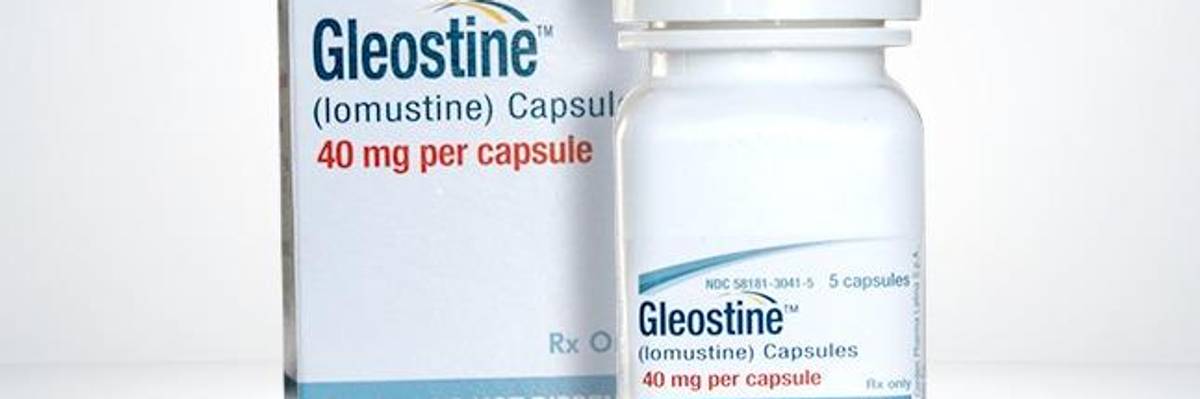
Gleostine, also called lomustine, is a 40-year-old cancer drug used to treat brain tumors and Hodgkin's lymphoma. (Photo: NextSource Pharmaceuticals)
Critics of the pharmaceutical industry have expressed outrage over a Wall Street Journal analysis that found the owner of a 40-year-old cancer drug used to treat brain tumors and Hodgkin's lymphoma has hiked the cost of the medication by 1,400 percent since acquiring it in 2013.
Lomustine, which was introduced in 1976, "has no generic competition, giving seller NextSource Biotechnology LLC significant pricing power," the Journal reports, noting that lomustine is just "one of at least 319 drugs for which U.S. patents have expired but which have no generic copies, according to a list the agency published earlier this month."
While the U.S. Food and Drug Administration is reportedly working to speed up the approval process for generic versions of these drugs, some critics say the report demonstrates a need for a broader overhaul of the nation's healthcare system, with the Robin Hood Tax campaign citing it as evidence for "why we need" Medicare For All, which has been promoted by Sen. Bernie Sanders (I-Vt.) and a growing number of Democrats in Congress.
Some critics compared the hikes to a similar move by Martin Shkreli, the founder of Turing Pharmaceuticals who provoked public condemnation after hiking the price of a life-saving AIDS drug called Daraprim by more than 5,000 percent. (He was later convicted of defrauding investors while he served as head of another drug company.)
NextSource, which rebranded lomustine as Gleostine, defended the hikes in a published statement, claiming that it based the decision to raise prices nine times over just four years "on a number of factors including product development costs, regulatory agency fees, class of product, benefit the treatment delivers to patients, and other determinants."
However, "the price hikes after the change in ownership are similar to what some other companies including Valeant Pharmaceuticals International Inc. and Turing Pharmaceuticals have done in recent years," the Journal notes, detailing how NextSource has repeatedly increased the price of 40-year-old drug:
For many years, lomustine was marketed under the brand name CeeNU by Bristol-Myers Squibb Co., which charged about $50 a capsule for the highest dose, before selling the product in 2013.
Now, the same capsule costs about $768, after nine price increases by a little-known Miami startup, NextSource, which supplies lomustine in a deal with the drug's new owner, manufacturer CordenPharma.
NextSource...most recently raised the price by 12 percent in November, on the heels of a 20 percent increase in August, according to analyses drug-price tracker Truven Health Analytics and Elsevier performed for the Wall Street Journal. Prices also have increased significantly for other doses of the drug.
"This is simply price gouging, period," concluded Henry Friedman, a neuro-oncologist at Duke University who wrote an editorial criticizing the lomustine price hikes earlier this year. "People are not going to be able to afford it, or they're going to pay a lot of money and have financial liability."
Dear Common Dreams reader, It’s been nearly 30 years since I co-founded Common Dreams with my late wife, Lina Newhouser. We had the radical notion that journalism should serve the public good, not corporate profits. It was clear to us from the outset what it would take to build such a project. No paid advertisements. No corporate sponsors. No millionaire publisher telling us what to think or do. Many people said we wouldn't last a year, but we proved those doubters wrong. Together with a tremendous team of journalists and dedicated staff, we built an independent media outlet free from the constraints of profits and corporate control. Our mission has always been simple: To inform. To inspire. To ignite change for the common good. Building Common Dreams was not easy. Our survival was never guaranteed. When you take on the most powerful forces—Wall Street greed, fossil fuel industry destruction, Big Tech lobbyists, and uber-rich oligarchs who have spent billions upon billions rigging the economy and democracy in their favor—the only bulwark you have is supporters who believe in your work. But here’s the urgent message from me today. It's never been this bad out there. And it's never been this hard to keep us going. At the very moment Common Dreams is most needed, the threats we face are intensifying. We need your support now more than ever. We don't accept corporate advertising and never will. We don't have a paywall because we don't think people should be blocked from critical news based on their ability to pay. Everything we do is funded by the donations of readers like you. When everyone does the little they can afford, we are strong. But if that support retreats or dries up, so do we. Will you donate now to make sure Common Dreams not only survives but thrives? —Craig Brown, Co-founder |
Critics of the pharmaceutical industry have expressed outrage over a Wall Street Journal analysis that found the owner of a 40-year-old cancer drug used to treat brain tumors and Hodgkin's lymphoma has hiked the cost of the medication by 1,400 percent since acquiring it in 2013.
Lomustine, which was introduced in 1976, "has no generic competition, giving seller NextSource Biotechnology LLC significant pricing power," the Journal reports, noting that lomustine is just "one of at least 319 drugs for which U.S. patents have expired but which have no generic copies, according to a list the agency published earlier this month."
While the U.S. Food and Drug Administration is reportedly working to speed up the approval process for generic versions of these drugs, some critics say the report demonstrates a need for a broader overhaul of the nation's healthcare system, with the Robin Hood Tax campaign citing it as evidence for "why we need" Medicare For All, which has been promoted by Sen. Bernie Sanders (I-Vt.) and a growing number of Democrats in Congress.
Some critics compared the hikes to a similar move by Martin Shkreli, the founder of Turing Pharmaceuticals who provoked public condemnation after hiking the price of a life-saving AIDS drug called Daraprim by more than 5,000 percent. (He was later convicted of defrauding investors while he served as head of another drug company.)
NextSource, which rebranded lomustine as Gleostine, defended the hikes in a published statement, claiming that it based the decision to raise prices nine times over just four years "on a number of factors including product development costs, regulatory agency fees, class of product, benefit the treatment delivers to patients, and other determinants."
However, "the price hikes after the change in ownership are similar to what some other companies including Valeant Pharmaceuticals International Inc. and Turing Pharmaceuticals have done in recent years," the Journal notes, detailing how NextSource has repeatedly increased the price of 40-year-old drug:
For many years, lomustine was marketed under the brand name CeeNU by Bristol-Myers Squibb Co., which charged about $50 a capsule for the highest dose, before selling the product in 2013.
Now, the same capsule costs about $768, after nine price increases by a little-known Miami startup, NextSource, which supplies lomustine in a deal with the drug's new owner, manufacturer CordenPharma.
NextSource...most recently raised the price by 12 percent in November, on the heels of a 20 percent increase in August, according to analyses drug-price tracker Truven Health Analytics and Elsevier performed for the Wall Street Journal. Prices also have increased significantly for other doses of the drug.
"This is simply price gouging, period," concluded Henry Friedman, a neuro-oncologist at Duke University who wrote an editorial criticizing the lomustine price hikes earlier this year. "People are not going to be able to afford it, or they're going to pay a lot of money and have financial liability."
Critics of the pharmaceutical industry have expressed outrage over a Wall Street Journal analysis that found the owner of a 40-year-old cancer drug used to treat brain tumors and Hodgkin's lymphoma has hiked the cost of the medication by 1,400 percent since acquiring it in 2013.
Lomustine, which was introduced in 1976, "has no generic competition, giving seller NextSource Biotechnology LLC significant pricing power," the Journal reports, noting that lomustine is just "one of at least 319 drugs for which U.S. patents have expired but which have no generic copies, according to a list the agency published earlier this month."
While the U.S. Food and Drug Administration is reportedly working to speed up the approval process for generic versions of these drugs, some critics say the report demonstrates a need for a broader overhaul of the nation's healthcare system, with the Robin Hood Tax campaign citing it as evidence for "why we need" Medicare For All, which has been promoted by Sen. Bernie Sanders (I-Vt.) and a growing number of Democrats in Congress.
Some critics compared the hikes to a similar move by Martin Shkreli, the founder of Turing Pharmaceuticals who provoked public condemnation after hiking the price of a life-saving AIDS drug called Daraprim by more than 5,000 percent. (He was later convicted of defrauding investors while he served as head of another drug company.)
NextSource, which rebranded lomustine as Gleostine, defended the hikes in a published statement, claiming that it based the decision to raise prices nine times over just four years "on a number of factors including product development costs, regulatory agency fees, class of product, benefit the treatment delivers to patients, and other determinants."
However, "the price hikes after the change in ownership are similar to what some other companies including Valeant Pharmaceuticals International Inc. and Turing Pharmaceuticals have done in recent years," the Journal notes, detailing how NextSource has repeatedly increased the price of 40-year-old drug:
For many years, lomustine was marketed under the brand name CeeNU by Bristol-Myers Squibb Co., which charged about $50 a capsule for the highest dose, before selling the product in 2013.
Now, the same capsule costs about $768, after nine price increases by a little-known Miami startup, NextSource, which supplies lomustine in a deal with the drug's new owner, manufacturer CordenPharma.
NextSource...most recently raised the price by 12 percent in November, on the heels of a 20 percent increase in August, according to analyses drug-price tracker Truven Health Analytics and Elsevier performed for the Wall Street Journal. Prices also have increased significantly for other doses of the drug.
"This is simply price gouging, period," concluded Henry Friedman, a neuro-oncologist at Duke University who wrote an editorial criticizing the lomustine price hikes earlier this year. "People are not going to be able to afford it, or they're going to pay a lot of money and have financial liability."