SUBSCRIBE TO OUR FREE NEWSLETTER
Daily news & progressive opinion—funded by the people, not the corporations—delivered straight to your inbox.
5
#000000
#FFFFFF
To donate by check, phone, or other method, see our More Ways to Give page.
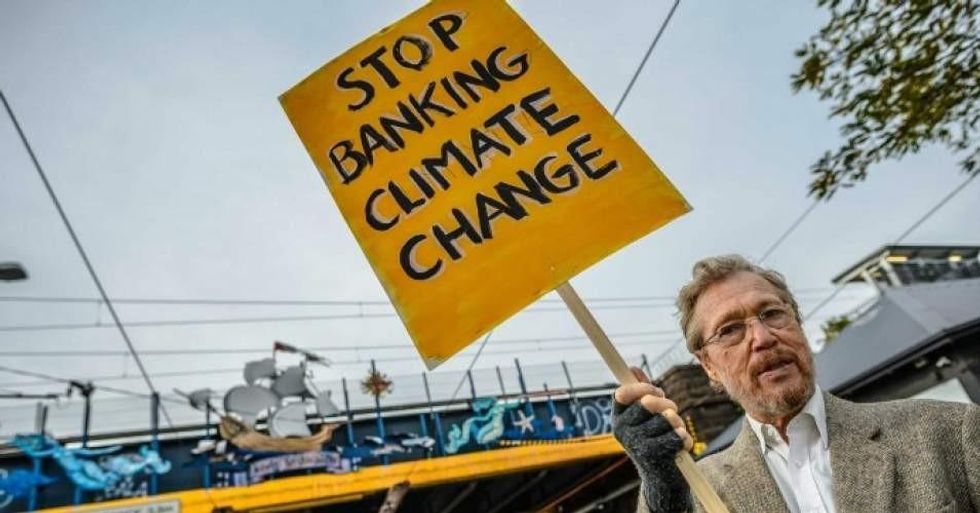
Scores of leading global economists this week demanded an end to the funding of fossil fuel projects and called for a massive increase to investments in renewables, saying "it will take unprecedented actions to limit the worst consequences of our dependence on oil, coal, and gas."
The declaration, signed by economists including James Galbraith, Juliet Schor, Jeffrey Sachs, and Yanis Varoufasis, "affirms that it is the urgent responsibility and moral obligation of public and private investors and development institutions to lead in putting an end to fossil fuel development."
The case for "keeping it in the ground" is clear, they write, given that the potential carbon from already developed fossil fuel projects will push the planet to beyond a so-called safe level of warming.
"Thus, not only are new exploration and new production incompatible with limiting global warming to well below 2oC (and as close to 1.5oC as possible), but many existing projects will need to be phased-out faster than their natural decline. Simply put: there is no more room for new fossil fuel infrastructure and therefore no case for ongoing investment," the declaration states.
Instead, they write, "let us all prioritize the tremendous investment opportunities for a 100 percent renewable future that support healthy economies while protecting workers, communities, and the ecological limits of a finite planet."
"It's time to stop wasting public money on dirty fossil fuels and invest it instead in a sustainable future."
--Tim Jackson, University of SurreySuch a future offers a promise of "a new economic paradigm of prosperity and equity," they write.
The declaration was released ahead of the One Planet summit, convened by French President Emmanuel Macron, taking place two years after the historic Paris climate accord was reached. Trump will not attend, but the global leaders who do will ostensibly energize the push for continued climate action, though it was organized in part by the World Bank Group, which continues to fund dirty energy.
"It is time for European leaders, especially President Macron, who understands the threat posed to our planet by Donald Trump's climate change denial, to help smash our economies' reliance on fossil fuel subsidies and investment," said Varoufakis. "Not one more penny or cent can go to coal, oil, or gas subsidies."
A mass mobilization with that message is set to take place in Paris on Dec. 12, the day of the summit.
"If our leaders remain hesitant to put their full support behind green investments, despite it making economic sense," said signatory Tim Jackson of the University of Surrey, "I would like to remind them that they have enormous public support. It's time to stop wasting public money on dirty fossil fuels and invest it instead in a sustainable future."
Scores of leading global economists this week demanded an end to the funding of fossil fuel projects and called for a massive increase to investments in renewables, saying "it will take unprecedented actions to limit the worst consequences of our dependence on oil, coal, and gas."
The declaration, signed by economists including James Galbraith, Juliet Schor, Jeffrey Sachs, and Yanis Varoufasis, "affirms that it is the urgent responsibility and moral obligation of public and private investors and development institutions to lead in putting an end to fossil fuel development."
The case for "keeping it in the ground" is clear, they write, given that the potential carbon from already developed fossil fuel projects will push the planet to beyond a so-called safe level of warming.
"Thus, not only are new exploration and new production incompatible with limiting global warming to well below 2oC (and as close to 1.5oC as possible), but many existing projects will need to be phased-out faster than their natural decline. Simply put: there is no more room for new fossil fuel infrastructure and therefore no case for ongoing investment," the declaration states.
Instead, they write, "let us all prioritize the tremendous investment opportunities for a 100 percent renewable future that support healthy economies while protecting workers, communities, and the ecological limits of a finite planet."
"It's time to stop wasting public money on dirty fossil fuels and invest it instead in a sustainable future."
--Tim Jackson, University of SurreySuch a future offers a promise of "a new economic paradigm of prosperity and equity," they write.
The declaration was released ahead of the One Planet summit, convened by French President Emmanuel Macron, taking place two years after the historic Paris climate accord was reached. Trump will not attend, but the global leaders who do will ostensibly energize the push for continued climate action, though it was organized in part by the World Bank Group, which continues to fund dirty energy.
"It is time for European leaders, especially President Macron, who understands the threat posed to our planet by Donald Trump's climate change denial, to help smash our economies' reliance on fossil fuel subsidies and investment," said Varoufakis. "Not one more penny or cent can go to coal, oil, or gas subsidies."
A mass mobilization with that message is set to take place in Paris on Dec. 12, the day of the summit.
"If our leaders remain hesitant to put their full support behind green investments, despite it making economic sense," said signatory Tim Jackson of the University of Surrey, "I would like to remind them that they have enormous public support. It's time to stop wasting public money on dirty fossil fuels and invest it instead in a sustainable future."
Scores of leading global economists this week demanded an end to the funding of fossil fuel projects and called for a massive increase to investments in renewables, saying "it will take unprecedented actions to limit the worst consequences of our dependence on oil, coal, and gas."
The declaration, signed by economists including James Galbraith, Juliet Schor, Jeffrey Sachs, and Yanis Varoufasis, "affirms that it is the urgent responsibility and moral obligation of public and private investors and development institutions to lead in putting an end to fossil fuel development."
The case for "keeping it in the ground" is clear, they write, given that the potential carbon from already developed fossil fuel projects will push the planet to beyond a so-called safe level of warming.
"Thus, not only are new exploration and new production incompatible with limiting global warming to well below 2oC (and as close to 1.5oC as possible), but many existing projects will need to be phased-out faster than their natural decline. Simply put: there is no more room for new fossil fuel infrastructure and therefore no case for ongoing investment," the declaration states.
Instead, they write, "let us all prioritize the tremendous investment opportunities for a 100 percent renewable future that support healthy economies while protecting workers, communities, and the ecological limits of a finite planet."
"It's time to stop wasting public money on dirty fossil fuels and invest it instead in a sustainable future."
--Tim Jackson, University of SurreySuch a future offers a promise of "a new economic paradigm of prosperity and equity," they write.
The declaration was released ahead of the One Planet summit, convened by French President Emmanuel Macron, taking place two years after the historic Paris climate accord was reached. Trump will not attend, but the global leaders who do will ostensibly energize the push for continued climate action, though it was organized in part by the World Bank Group, which continues to fund dirty energy.
"It is time for European leaders, especially President Macron, who understands the threat posed to our planet by Donald Trump's climate change denial, to help smash our economies' reliance on fossil fuel subsidies and investment," said Varoufakis. "Not one more penny or cent can go to coal, oil, or gas subsidies."
A mass mobilization with that message is set to take place in Paris on Dec. 12, the day of the summit.
"If our leaders remain hesitant to put their full support behind green investments, despite it making economic sense," said signatory Tim Jackson of the University of Surrey, "I would like to remind them that they have enormous public support. It's time to stop wasting public money on dirty fossil fuels and invest it instead in a sustainable future."