

SUBSCRIBE TO OUR FREE NEWSLETTER
Daily news & progressive opinion—funded by the people, not the corporations—delivered straight to your inbox.
5
#000000
#FFFFFF
To donate by check, phone, or other method, see our More Ways to Give page.
Daily news & progressive opinion—funded by the people, not the corporations—delivered straight to your inbox.
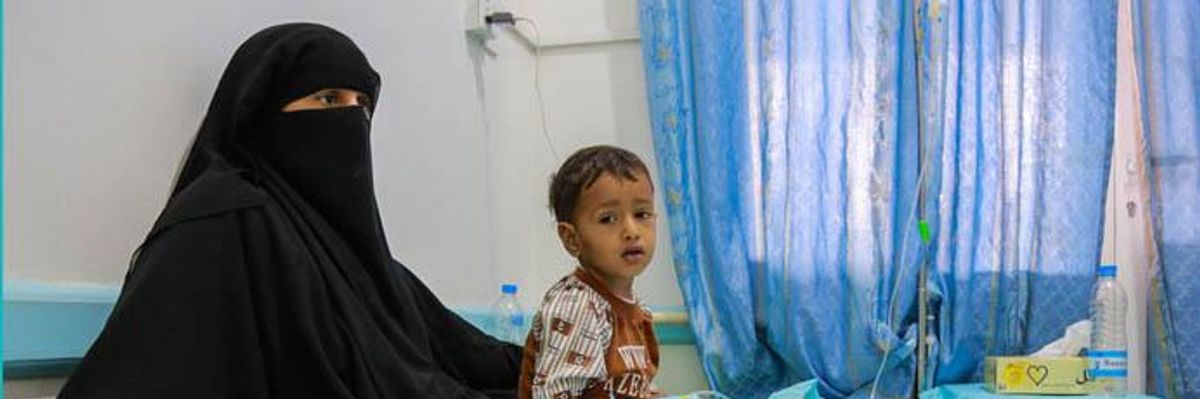
The Saudi blockade that has continued for weeks has kept much-needed food and medical aid from a civilian population in the throes of a cholera outbreak. (Photo: Ciberpasquinero Virtual/Flickr/cc)
As aid groups remain cut off from Yemen--despite an intensifying humanitarian crisis and a promise from Saudi Arabia on Wednesday to lift the blockade--in a statement released Friday, the Trump White House ignored the United States' complicity in the Saudi-led coalition's blockade while reiterating U.S. support for the coalition in the ongoing war.
The statement praised Saudi Arabia and the coalition for "reopening Hudaydah port and Sanaa International Airport to allow the urgent flow of humanitarian aid to the people of Yemen"--even though, as the Guardian reported Friday, "aid agencies said Saudi Arabia has not fulfilled its promise to reopen humanitarian aid corridors into northern Yemen, leaving the main aid lifeline closed for tens of thousands of starving people."
Although the White House statement declared "the magnitude of suffering in Yemen requires all parties to this conflict to focus on assistance to those in need," it also said, "We remain committed to supporting Saudi Arabia and all of our Gulf partners against the Iranian Islamic Revolutionary Guard Corps' aggression."
The United States has fueled the civil war that began two years ago in Yemen between government forces and the Houthi movement--assisting the Saudi-led coalition with a bombing campaign and providing Saudi Arabia with intelligence. Both the U.S. and European nations have been widely criticized for continuing to provide the Saudi-led coalition with military support to carpet-bomb Yemeni civilians, even in recent days, as the Saudi Arabia has blocked aid agencies from offering food and medical assistance amid famine-like conditions and a cholera epidemic.
The blockade, which began on earlier this month, has exacerbated the country's twin crises, which have resulted from the civil war. At least a million people were expected to be affected by the cholera epidemic by the end of the year, while the alarming food shortage has been called the worst the world has seen in decades, according to the United Nations humanitarian chief.
Jamie McGoldrick, the U.N. humanitarian coordinator for Yemen, recognized the Saudi's safety concerns which led to the blockade, but insisted "that has to be balanced against the scale of the crisis, the threat of famine and the 17 million lives dependent on humanitarian assistance, and the requirement for fuel so as to be able to pump clean water for 4 million people."
"With the port blocked, it makes life very precarious," McGoldrick told the Guardian. "We are very worried that the gains we have made on cholera and food scarcity are being reversed."
The White House statement on Friday comes as media critics charge that mainstream U.S. news outlets are highlighting the humanitarian concerns in Yemen while also ignoring U.S. complicity in the conflict. "As momentum builds in Congress, animated by grassroots anti-war activists, to push back against the war and hold U.S. lawmakers accountable, how the U.S. contributes to the death and disease in the Arabian peninsula is of urgent political import," Adam Johnson of FAIR wrote earlier this week.
Johnson specifically criticized a CBS News "60 Minutes" episosde that "took a deep dive into the humanitarian crisis in Yemen, and did not once mention the direct role the United States played in creating, perpetuating, and prolonging a crisis that's left over 10,000 civilians dead, 2 million displaced, and an estimated 1 million with cholera," and concluded, "By erasing the U.S. role in the war, CBS producers obscure for viewers the most effective way they can end the war: by pressuring their own lawmakers to stop supporting it."
Johnson has also offered critiques of the Yemen coverage on Twitter:
Dear Common Dreams reader, It’s been nearly 30 years since I co-founded Common Dreams with my late wife, Lina Newhouser. We had the radical notion that journalism should serve the public good, not corporate profits. It was clear to us from the outset what it would take to build such a project. No paid advertisements. No corporate sponsors. No millionaire publisher telling us what to think or do. Many people said we wouldn't last a year, but we proved those doubters wrong. Together with a tremendous team of journalists and dedicated staff, we built an independent media outlet free from the constraints of profits and corporate control. Our mission has always been simple: To inform. To inspire. To ignite change for the common good. Building Common Dreams was not easy. Our survival was never guaranteed. When you take on the most powerful forces—Wall Street greed, fossil fuel industry destruction, Big Tech lobbyists, and uber-rich oligarchs who have spent billions upon billions rigging the economy and democracy in their favor—the only bulwark you have is supporters who believe in your work. But here’s the urgent message from me today. It's never been this bad out there. And it's never been this hard to keep us going. At the very moment Common Dreams is most needed, the threats we face are intensifying. We need your support now more than ever. We don't accept corporate advertising and never will. We don't have a paywall because we don't think people should be blocked from critical news based on their ability to pay. Everything we do is funded by the donations of readers like you. When everyone does the little they can afford, we are strong. But if that support retreats or dries up, so do we. Will you donate now to make sure Common Dreams not only survives but thrives? —Craig Brown, Co-founder |
As aid groups remain cut off from Yemen--despite an intensifying humanitarian crisis and a promise from Saudi Arabia on Wednesday to lift the blockade--in a statement released Friday, the Trump White House ignored the United States' complicity in the Saudi-led coalition's blockade while reiterating U.S. support for the coalition in the ongoing war.
The statement praised Saudi Arabia and the coalition for "reopening Hudaydah port and Sanaa International Airport to allow the urgent flow of humanitarian aid to the people of Yemen"--even though, as the Guardian reported Friday, "aid agencies said Saudi Arabia has not fulfilled its promise to reopen humanitarian aid corridors into northern Yemen, leaving the main aid lifeline closed for tens of thousands of starving people."
Although the White House statement declared "the magnitude of suffering in Yemen requires all parties to this conflict to focus on assistance to those in need," it also said, "We remain committed to supporting Saudi Arabia and all of our Gulf partners against the Iranian Islamic Revolutionary Guard Corps' aggression."
The United States has fueled the civil war that began two years ago in Yemen between government forces and the Houthi movement--assisting the Saudi-led coalition with a bombing campaign and providing Saudi Arabia with intelligence. Both the U.S. and European nations have been widely criticized for continuing to provide the Saudi-led coalition with military support to carpet-bomb Yemeni civilians, even in recent days, as the Saudi Arabia has blocked aid agencies from offering food and medical assistance amid famine-like conditions and a cholera epidemic.
The blockade, which began on earlier this month, has exacerbated the country's twin crises, which have resulted from the civil war. At least a million people were expected to be affected by the cholera epidemic by the end of the year, while the alarming food shortage has been called the worst the world has seen in decades, according to the United Nations humanitarian chief.
Jamie McGoldrick, the U.N. humanitarian coordinator for Yemen, recognized the Saudi's safety concerns which led to the blockade, but insisted "that has to be balanced against the scale of the crisis, the threat of famine and the 17 million lives dependent on humanitarian assistance, and the requirement for fuel so as to be able to pump clean water for 4 million people."
"With the port blocked, it makes life very precarious," McGoldrick told the Guardian. "We are very worried that the gains we have made on cholera and food scarcity are being reversed."
The White House statement on Friday comes as media critics charge that mainstream U.S. news outlets are highlighting the humanitarian concerns in Yemen while also ignoring U.S. complicity in the conflict. "As momentum builds in Congress, animated by grassroots anti-war activists, to push back against the war and hold U.S. lawmakers accountable, how the U.S. contributes to the death and disease in the Arabian peninsula is of urgent political import," Adam Johnson of FAIR wrote earlier this week.
Johnson specifically criticized a CBS News "60 Minutes" episosde that "took a deep dive into the humanitarian crisis in Yemen, and did not once mention the direct role the United States played in creating, perpetuating, and prolonging a crisis that's left over 10,000 civilians dead, 2 million displaced, and an estimated 1 million with cholera," and concluded, "By erasing the U.S. role in the war, CBS producers obscure for viewers the most effective way they can end the war: by pressuring their own lawmakers to stop supporting it."
Johnson has also offered critiques of the Yemen coverage on Twitter:
As aid groups remain cut off from Yemen--despite an intensifying humanitarian crisis and a promise from Saudi Arabia on Wednesday to lift the blockade--in a statement released Friday, the Trump White House ignored the United States' complicity in the Saudi-led coalition's blockade while reiterating U.S. support for the coalition in the ongoing war.
The statement praised Saudi Arabia and the coalition for "reopening Hudaydah port and Sanaa International Airport to allow the urgent flow of humanitarian aid to the people of Yemen"--even though, as the Guardian reported Friday, "aid agencies said Saudi Arabia has not fulfilled its promise to reopen humanitarian aid corridors into northern Yemen, leaving the main aid lifeline closed for tens of thousands of starving people."
Although the White House statement declared "the magnitude of suffering in Yemen requires all parties to this conflict to focus on assistance to those in need," it also said, "We remain committed to supporting Saudi Arabia and all of our Gulf partners against the Iranian Islamic Revolutionary Guard Corps' aggression."
The United States has fueled the civil war that began two years ago in Yemen between government forces and the Houthi movement--assisting the Saudi-led coalition with a bombing campaign and providing Saudi Arabia with intelligence. Both the U.S. and European nations have been widely criticized for continuing to provide the Saudi-led coalition with military support to carpet-bomb Yemeni civilians, even in recent days, as the Saudi Arabia has blocked aid agencies from offering food and medical assistance amid famine-like conditions and a cholera epidemic.
The blockade, which began on earlier this month, has exacerbated the country's twin crises, which have resulted from the civil war. At least a million people were expected to be affected by the cholera epidemic by the end of the year, while the alarming food shortage has been called the worst the world has seen in decades, according to the United Nations humanitarian chief.
Jamie McGoldrick, the U.N. humanitarian coordinator for Yemen, recognized the Saudi's safety concerns which led to the blockade, but insisted "that has to be balanced against the scale of the crisis, the threat of famine and the 17 million lives dependent on humanitarian assistance, and the requirement for fuel so as to be able to pump clean water for 4 million people."
"With the port blocked, it makes life very precarious," McGoldrick told the Guardian. "We are very worried that the gains we have made on cholera and food scarcity are being reversed."
The White House statement on Friday comes as media critics charge that mainstream U.S. news outlets are highlighting the humanitarian concerns in Yemen while also ignoring U.S. complicity in the conflict. "As momentum builds in Congress, animated by grassroots anti-war activists, to push back against the war and hold U.S. lawmakers accountable, how the U.S. contributes to the death and disease in the Arabian peninsula is of urgent political import," Adam Johnson of FAIR wrote earlier this week.
Johnson specifically criticized a CBS News "60 Minutes" episosde that "took a deep dive into the humanitarian crisis in Yemen, and did not once mention the direct role the United States played in creating, perpetuating, and prolonging a crisis that's left over 10,000 civilians dead, 2 million displaced, and an estimated 1 million with cholera," and concluded, "By erasing the U.S. role in the war, CBS producers obscure for viewers the most effective way they can end the war: by pressuring their own lawmakers to stop supporting it."
Johnson has also offered critiques of the Yemen coverage on Twitter:

