

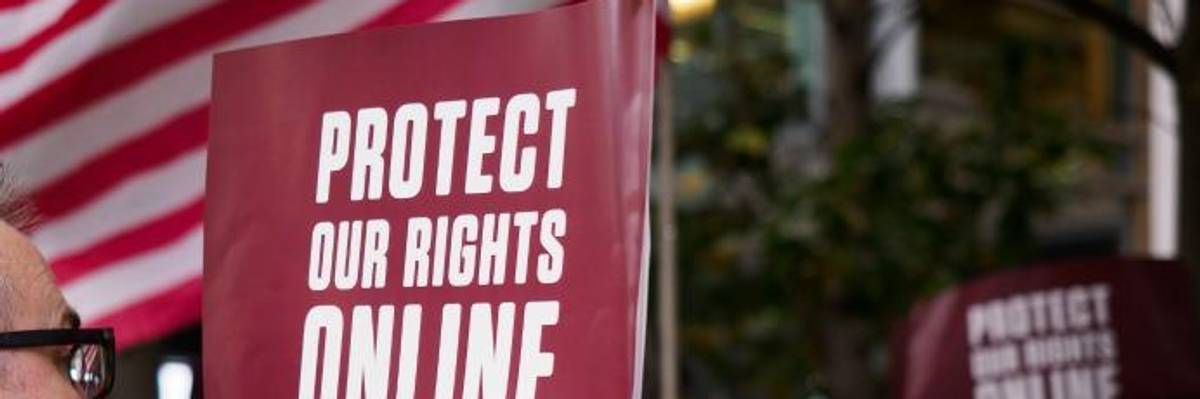
A man holds up a sign supporting internet rights at a rally in San Francisco, California. (Photo: Credo Action/Flickr/cc)
FCC Under Fire for Ignoring 'Massive Scheme to Corrupt' Net Neutrality Comment Process
Amid widespread outrage over the agency's proposed internet rule changes, NY Attorney General Eric Schneiderman's says chairman has refused to cooperate with probe into fake posts
In an open letter to Federal Communications Commission (FCC) Chairman Ajit Pai, New York State Attorney General Eric Schneiderman slammed the agency for ignoring "a massive scheme to corrupt" the mandatory public comment process for Pai's plan to dismantle net neutrality protections with new rules officially unveiled on Tuesday.
"The FCC has refused multiple requests for crucial evidence in its sole possession that is vital to permit that law enforcement investigation to proceed."
--Eric Schneiderman, New York Attorney General
While open internet advocates have for months campaigned against Pai's plan to turn over the web to corporate control, which often included form letters for the public comment process, Schneiderman launched an investigation after submissions started appearing from supposed supporters of the plan with personal information of people who said they had not submitted any comments.
"For six months my office has been investigating who perpetrated a massive scheme to corrupt the FCC's notice and comment process through the misuse of enormous numbers of real New Yorkers' and other Americans' identities," Schneiderman writes on Medium. "Such conduct likely violates state law -- yet the FCC has refused multiple requests for crucial evidence in its sole possession that is vital to permit that law enforcement investigation to proceed."
Schneiderman continues:
My office analyzed the fake comments and found that tens of thousands of New Yorkers may have had their identities misused in this way. (Indeed, analysis showed that, in all, hundreds of thousands of Americans likely were victimized in the same way, including tens of thousands per state in California, Georgia, Missouri, Ohio, Pennsylvania, Texas, and possibly others.)....
This investigation isn't about the substantive issues concerning net neutrality. For my part, I have long publicly advocated for strong net neutrality rules under the Title II of the Communications Act, and studies show that the overwhelming majority of Americans who took the time to write public comments to the FCC about the issue feel the same way while a very small minority favor repeal.
But this isn't about that. It's about the right to control one's own identity and prevent the corruption of a process designed to solicit the opinion of real people and institutions. Misuse of identity online by the hundreds of thousands should concern everyone -- for and against net neutrality, New Yorker or Texan, Democrat or Republican.
Urging the FCC to reconsider its decision to refuse to assist with his investigation, Schneiderman concludes, "If law enforcement can't investigate and (where appropriate) prosecute when it happens on this scale, the door is open for it to happen again and again."
While defenders of the internet are mobilizing to stop the FCC changes from going through, the vote is now scheduled for December 14.
On Wednesday, a fresh wave of calls for reconsidering the plan (pdf) had activists and rights groups urging Americans to contact their congressional representatives, while lawmakers reiterated their support for protecting net neutrality:
An Urgent Message From Our Co-Founder
Dear Common Dreams reader, It’s been nearly 30 years since I co-founded Common Dreams with my late wife, Lina Newhouser. We had the radical notion that journalism should serve the public good, not corporate profits. It was clear to us from the outset what it would take to build such a project. No paid advertisements. No corporate sponsors. No millionaire publisher telling us what to think or do. Many people said we wouldn't last a year, but we proved those doubters wrong. Together with a tremendous team of journalists and dedicated staff, we built an independent media outlet free from the constraints of profits and corporate control. Our mission has always been simple: To inform. To inspire. To ignite change for the common good. Building Common Dreams was not easy. Our survival was never guaranteed. When you take on the most powerful forces—Wall Street greed, fossil fuel industry destruction, Big Tech lobbyists, and uber-rich oligarchs who have spent billions upon billions rigging the economy and democracy in their favor—the only bulwark you have is supporters who believe in your work. But here’s the urgent message from me today. It's never been this bad out there. And it's never been this hard to keep us going. At the very moment Common Dreams is most needed, the threats we face are intensifying. We need your support now more than ever. We don't accept corporate advertising and never will. We don't have a paywall because we don't think people should be blocked from critical news based on their ability to pay. Everything we do is funded by the donations of readers like you. When everyone does the little they can afford, we are strong. But if that support retreats or dries up, so do we. Will you donate now to make sure Common Dreams not only survives but thrives? —Craig Brown, Co-founder |
In an open letter to Federal Communications Commission (FCC) Chairman Ajit Pai, New York State Attorney General Eric Schneiderman slammed the agency for ignoring "a massive scheme to corrupt" the mandatory public comment process for Pai's plan to dismantle net neutrality protections with new rules officially unveiled on Tuesday.
"The FCC has refused multiple requests for crucial evidence in its sole possession that is vital to permit that law enforcement investigation to proceed."
--Eric Schneiderman, New York Attorney General
While open internet advocates have for months campaigned against Pai's plan to turn over the web to corporate control, which often included form letters for the public comment process, Schneiderman launched an investigation after submissions started appearing from supposed supporters of the plan with personal information of people who said they had not submitted any comments.
"For six months my office has been investigating who perpetrated a massive scheme to corrupt the FCC's notice and comment process through the misuse of enormous numbers of real New Yorkers' and other Americans' identities," Schneiderman writes on Medium. "Such conduct likely violates state law -- yet the FCC has refused multiple requests for crucial evidence in its sole possession that is vital to permit that law enforcement investigation to proceed."
Schneiderman continues:
My office analyzed the fake comments and found that tens of thousands of New Yorkers may have had their identities misused in this way. (Indeed, analysis showed that, in all, hundreds of thousands of Americans likely were victimized in the same way, including tens of thousands per state in California, Georgia, Missouri, Ohio, Pennsylvania, Texas, and possibly others.)....
This investigation isn't about the substantive issues concerning net neutrality. For my part, I have long publicly advocated for strong net neutrality rules under the Title II of the Communications Act, and studies show that the overwhelming majority of Americans who took the time to write public comments to the FCC about the issue feel the same way while a very small minority favor repeal.
But this isn't about that. It's about the right to control one's own identity and prevent the corruption of a process designed to solicit the opinion of real people and institutions. Misuse of identity online by the hundreds of thousands should concern everyone -- for and against net neutrality, New Yorker or Texan, Democrat or Republican.
Urging the FCC to reconsider its decision to refuse to assist with his investigation, Schneiderman concludes, "If law enforcement can't investigate and (where appropriate) prosecute when it happens on this scale, the door is open for it to happen again and again."
While defenders of the internet are mobilizing to stop the FCC changes from going through, the vote is now scheduled for December 14.
On Wednesday, a fresh wave of calls for reconsidering the plan (pdf) had activists and rights groups urging Americans to contact their congressional representatives, while lawmakers reiterated their support for protecting net neutrality:
In an open letter to Federal Communications Commission (FCC) Chairman Ajit Pai, New York State Attorney General Eric Schneiderman slammed the agency for ignoring "a massive scheme to corrupt" the mandatory public comment process for Pai's plan to dismantle net neutrality protections with new rules officially unveiled on Tuesday.
"The FCC has refused multiple requests for crucial evidence in its sole possession that is vital to permit that law enforcement investigation to proceed."
--Eric Schneiderman, New York Attorney General
While open internet advocates have for months campaigned against Pai's plan to turn over the web to corporate control, which often included form letters for the public comment process, Schneiderman launched an investigation after submissions started appearing from supposed supporters of the plan with personal information of people who said they had not submitted any comments.
"For six months my office has been investigating who perpetrated a massive scheme to corrupt the FCC's notice and comment process through the misuse of enormous numbers of real New Yorkers' and other Americans' identities," Schneiderman writes on Medium. "Such conduct likely violates state law -- yet the FCC has refused multiple requests for crucial evidence in its sole possession that is vital to permit that law enforcement investigation to proceed."
Schneiderman continues:
My office analyzed the fake comments and found that tens of thousands of New Yorkers may have had their identities misused in this way. (Indeed, analysis showed that, in all, hundreds of thousands of Americans likely were victimized in the same way, including tens of thousands per state in California, Georgia, Missouri, Ohio, Pennsylvania, Texas, and possibly others.)....
This investigation isn't about the substantive issues concerning net neutrality. For my part, I have long publicly advocated for strong net neutrality rules under the Title II of the Communications Act, and studies show that the overwhelming majority of Americans who took the time to write public comments to the FCC about the issue feel the same way while a very small minority favor repeal.
But this isn't about that. It's about the right to control one's own identity and prevent the corruption of a process designed to solicit the opinion of real people and institutions. Misuse of identity online by the hundreds of thousands should concern everyone -- for and against net neutrality, New Yorker or Texan, Democrat or Republican.
Urging the FCC to reconsider its decision to refuse to assist with his investigation, Schneiderman concludes, "If law enforcement can't investigate and (where appropriate) prosecute when it happens on this scale, the door is open for it to happen again and again."
While defenders of the internet are mobilizing to stop the FCC changes from going through, the vote is now scheduled for December 14.
On Wednesday, a fresh wave of calls for reconsidering the plan (pdf) had activists and rights groups urging Americans to contact their congressional representatives, while lawmakers reiterated their support for protecting net neutrality: