SUBSCRIBE TO OUR FREE NEWSLETTER
Daily news & progressive opinion—funded by the people, not the corporations—delivered straight to your inbox.
5
#000000
#FFFFFF
To donate by check, phone, or other method, see our More Ways to Give page.
Daily news & progressive opinion—funded by the people, not the corporations—delivered straight to your inbox.
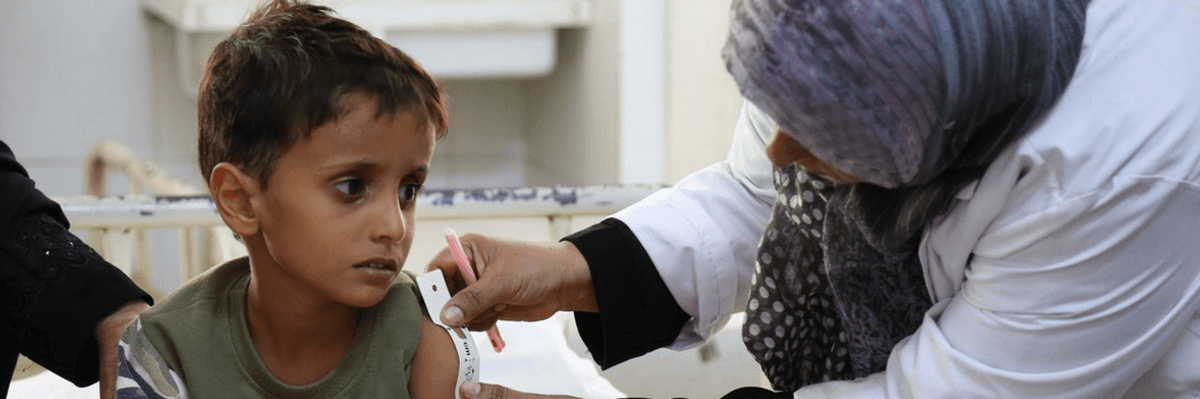
A Saudi-imposed blockade in Yemen, in the midst of a civil war that's gone on for two years, has left civilians without medicine, food, and clean water, exacerbating the famine and cholera epidemic that have developed there in recent months. (Photo: @nfcinereporter/Twitter)
Fourteen international aid agencies on Friday expressed that they were "appalled" by the global community's complacency regarding the humanitarian crisis unfolding in Yemen, and called for a resolution to the civil war that's gone on for two years--while in its own statement, Amnesty International called for an end to complicity in the conflict from the U.S. and its allies.
"This is not the time for carefully balanced statements," read a statement signed by groups including the International Rescue Committee, Oxfam, and Relief International. "The choice is between resolution, or complicity in the suffering; there is no third option."
"The U.S.A., U.K., and France must immediately cease supplying arms to the Saudi Arabia-led coalition fighting in Yemen, which is impeding humanitarian assistance of items indispensable to the survival of civilians," declared Amnesty International.
The current famine and cholera epidemic in Yemen have both been exacerbated by a blockade that the Saudi-led coalition supporting government forces escalated 12 days ago.
"The international community must break its shameful silence and use all possible means to lift the blockade on Yemen immediately."--International Rescue Committee
Sanitation and water systems in the country had already been bombed out of commission before the blockade, which has now made it impossible for aid agencies to get a wide range of badly-needed supplies and services to the civilians who need them.
UNICEF reported on Friday that it has only enough of a diphtheria vaccine to last 15 more days. "If this vaccine is not brought in, one million children will be at risk of preventable diseases," the groups wrote.
The country is also experiencing a fuel shortage which has led to scarce clean water and has forced hospitals to close some wards while struggling to care for a civilian population in the midst of the worst cholera outbreak on record, with over a million cases expected by the end of the year, as well as "the largest famine the world has seen for many decades," according to the United Nations Emergency Relief Coordinator.
"The international community must break its shameful silence and use all possible means to lift the blockade on Yemen immediately," said the relief groups in their statement. "Hodeidah port, that serviced 80 percent of all imports, and Sana'a airport, needs to be reopened to let in urgently needed shipments of food, fuel, and medicines. Every day the blockade lasts means thousands of Yemenis will suffer from hunger and preventable diseases. Millions could die in a historic famine if the blockade continues indefinitely."
"The U.S.A., U.K., and France must immediately cease supplying arms to the Saudi Arabia-led coalition fighting in Yemen, which is impeding humanitarian assistance of items indispensable to the survival of civilians."--Amnesty International
On Thursday, the World Health Organization, UNICEF, and World Food Program issued their own urgent plea for an end to the blockade, saying, "The clock is ticking and stocks of medical, food, and other humanitarian supplies are already running low. The cost of this blockade is being measured in the number of lives that are lost."
Friday's statement came days after Sen. Chris Murphy (D-Conn.) criticized the U.S. government in a speech on the Senate floor for its support of the Saudi coalition.
"The United States is part of this coalition. The bombing campaign that has caused the cholera outbreak could not happen without us," said Murphy.
Dear Common Dreams reader, It’s been nearly 30 years since I co-founded Common Dreams with my late wife, Lina Newhouser. We had the radical notion that journalism should serve the public good, not corporate profits. It was clear to us from the outset what it would take to build such a project. No paid advertisements. No corporate sponsors. No millionaire publisher telling us what to think or do. Many people said we wouldn't last a year, but we proved those doubters wrong. Together with a tremendous team of journalists and dedicated staff, we built an independent media outlet free from the constraints of profits and corporate control. Our mission has always been simple: To inform. To inspire. To ignite change for the common good. Building Common Dreams was not easy. Our survival was never guaranteed. When you take on the most powerful forces—Wall Street greed, fossil fuel industry destruction, Big Tech lobbyists, and uber-rich oligarchs who have spent billions upon billions rigging the economy and democracy in their favor—the only bulwark you have is supporters who believe in your work. But here’s the urgent message from me today. It's never been this bad out there. And it's never been this hard to keep us going. At the very moment Common Dreams is most needed, the threats we face are intensifying. We need your support now more than ever. We don't accept corporate advertising and never will. We don't have a paywall because we don't think people should be blocked from critical news based on their ability to pay. Everything we do is funded by the donations of readers like you. When everyone does the little they can afford, we are strong. But if that support retreats or dries up, so do we. Will you donate now to make sure Common Dreams not only survives but thrives? —Craig Brown, Co-founder |
Fourteen international aid agencies on Friday expressed that they were "appalled" by the global community's complacency regarding the humanitarian crisis unfolding in Yemen, and called for a resolution to the civil war that's gone on for two years--while in its own statement, Amnesty International called for an end to complicity in the conflict from the U.S. and its allies.
"This is not the time for carefully balanced statements," read a statement signed by groups including the International Rescue Committee, Oxfam, and Relief International. "The choice is between resolution, or complicity in the suffering; there is no third option."
"The U.S.A., U.K., and France must immediately cease supplying arms to the Saudi Arabia-led coalition fighting in Yemen, which is impeding humanitarian assistance of items indispensable to the survival of civilians," declared Amnesty International.
The current famine and cholera epidemic in Yemen have both been exacerbated by a blockade that the Saudi-led coalition supporting government forces escalated 12 days ago.
"The international community must break its shameful silence and use all possible means to lift the blockade on Yemen immediately."--International Rescue Committee
Sanitation and water systems in the country had already been bombed out of commission before the blockade, which has now made it impossible for aid agencies to get a wide range of badly-needed supplies and services to the civilians who need them.
UNICEF reported on Friday that it has only enough of a diphtheria vaccine to last 15 more days. "If this vaccine is not brought in, one million children will be at risk of preventable diseases," the groups wrote.
The country is also experiencing a fuel shortage which has led to scarce clean water and has forced hospitals to close some wards while struggling to care for a civilian population in the midst of the worst cholera outbreak on record, with over a million cases expected by the end of the year, as well as "the largest famine the world has seen for many decades," according to the United Nations Emergency Relief Coordinator.
"The international community must break its shameful silence and use all possible means to lift the blockade on Yemen immediately," said the relief groups in their statement. "Hodeidah port, that serviced 80 percent of all imports, and Sana'a airport, needs to be reopened to let in urgently needed shipments of food, fuel, and medicines. Every day the blockade lasts means thousands of Yemenis will suffer from hunger and preventable diseases. Millions could die in a historic famine if the blockade continues indefinitely."
"The U.S.A., U.K., and France must immediately cease supplying arms to the Saudi Arabia-led coalition fighting in Yemen, which is impeding humanitarian assistance of items indispensable to the survival of civilians."--Amnesty International
On Thursday, the World Health Organization, UNICEF, and World Food Program issued their own urgent plea for an end to the blockade, saying, "The clock is ticking and stocks of medical, food, and other humanitarian supplies are already running low. The cost of this blockade is being measured in the number of lives that are lost."
Friday's statement came days after Sen. Chris Murphy (D-Conn.) criticized the U.S. government in a speech on the Senate floor for its support of the Saudi coalition.
"The United States is part of this coalition. The bombing campaign that has caused the cholera outbreak could not happen without us," said Murphy.
Fourteen international aid agencies on Friday expressed that they were "appalled" by the global community's complacency regarding the humanitarian crisis unfolding in Yemen, and called for a resolution to the civil war that's gone on for two years--while in its own statement, Amnesty International called for an end to complicity in the conflict from the U.S. and its allies.
"This is not the time for carefully balanced statements," read a statement signed by groups including the International Rescue Committee, Oxfam, and Relief International. "The choice is between resolution, or complicity in the suffering; there is no third option."
"The U.S.A., U.K., and France must immediately cease supplying arms to the Saudi Arabia-led coalition fighting in Yemen, which is impeding humanitarian assistance of items indispensable to the survival of civilians," declared Amnesty International.
The current famine and cholera epidemic in Yemen have both been exacerbated by a blockade that the Saudi-led coalition supporting government forces escalated 12 days ago.
"The international community must break its shameful silence and use all possible means to lift the blockade on Yemen immediately."--International Rescue Committee
Sanitation and water systems in the country had already been bombed out of commission before the blockade, which has now made it impossible for aid agencies to get a wide range of badly-needed supplies and services to the civilians who need them.
UNICEF reported on Friday that it has only enough of a diphtheria vaccine to last 15 more days. "If this vaccine is not brought in, one million children will be at risk of preventable diseases," the groups wrote.
The country is also experiencing a fuel shortage which has led to scarce clean water and has forced hospitals to close some wards while struggling to care for a civilian population in the midst of the worst cholera outbreak on record, with over a million cases expected by the end of the year, as well as "the largest famine the world has seen for many decades," according to the United Nations Emergency Relief Coordinator.
"The international community must break its shameful silence and use all possible means to lift the blockade on Yemen immediately," said the relief groups in their statement. "Hodeidah port, that serviced 80 percent of all imports, and Sana'a airport, needs to be reopened to let in urgently needed shipments of food, fuel, and medicines. Every day the blockade lasts means thousands of Yemenis will suffer from hunger and preventable diseases. Millions could die in a historic famine if the blockade continues indefinitely."
"The U.S.A., U.K., and France must immediately cease supplying arms to the Saudi Arabia-led coalition fighting in Yemen, which is impeding humanitarian assistance of items indispensable to the survival of civilians."--Amnesty International
On Thursday, the World Health Organization, UNICEF, and World Food Program issued their own urgent plea for an end to the blockade, saying, "The clock is ticking and stocks of medical, food, and other humanitarian supplies are already running low. The cost of this blockade is being measured in the number of lives that are lost."
Friday's statement came days after Sen. Chris Murphy (D-Conn.) criticized the U.S. government in a speech on the Senate floor for its support of the Saudi coalition.
"The United States is part of this coalition. The bombing campaign that has caused the cholera outbreak could not happen without us," said Murphy.