SUBSCRIBE TO OUR FREE NEWSLETTER
Daily news & progressive opinion—funded by the people, not the corporations—delivered straight to your inbox.
5
#000000
#FFFFFF
To donate by check, phone, or other method, see our More Ways to Give page.
Daily news & progressive opinion—funded by the people, not the corporations—delivered straight to your inbox.
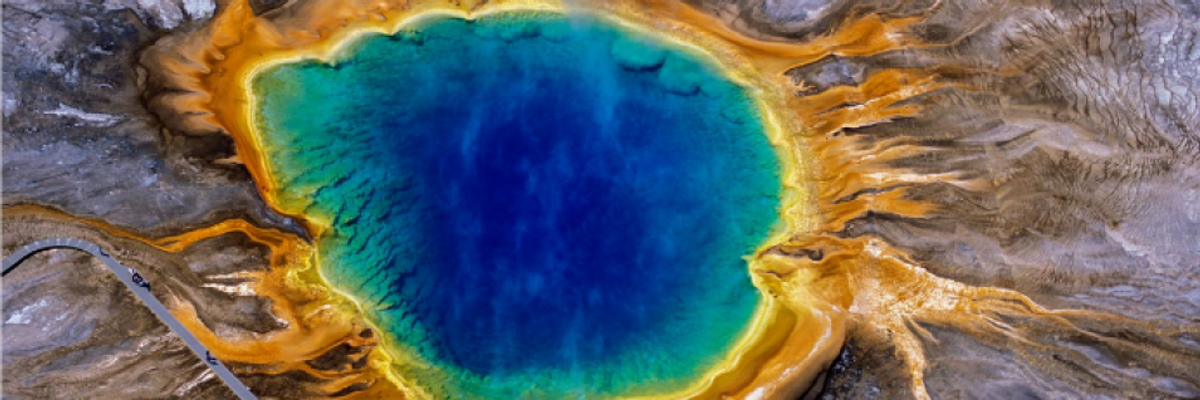
"This story will help you stop worrying about Trump for a moment," wrote MoveOn.org's Ben Wikler. (Photo: Tom Murphy/National Geographic Creative)
Yes, Donald Trump is president. And yes, he has access to the nuclear codes--a fact that has become all too vivid in recent weeks. But many allowed themselves to forget, if only for a brief moment, about the man in the White House on Thursday to hone their attention on what is potentially an even more horrifying development. As USA Today reported, new research indicates that the supervolcano resting beneath Yellowstone National Park "may blow sooner than thought, an eruption that could wipe out life on the planet."
"We are all just living at the mercy of the super volcano under Yellowstone. Puts things into perspective doesn't it?"
--Josh Fox
USA Today's Matthew Diebel notes that Arizona State University researchers have "analyzed minerals in fossilized ash from the most recent mega-eruption and found changes in temperature and composition that had only taken a few decades. Until now, the magazine reported, geologists had thought it would take centuries for the supervolcano to make the transition."
"The discovery, which was presented at a recent volcanology conference, comes on top of a 2011 study that found that ground above the magma reservoir in Yellowstone had bulged by about 10 inches in seven years," Diebel adds.
Scientists believe that the volcano's last supereruption took place around 631,000 years ago. As the New York Times notes, researchers "suspect that a supereruption scars the planet every 100,000 years, causing many to ask when we can next expect such an explosive planet-changing event."
Though no one is attempting to put a time frame on the next eruption, Hannah Shamloo of Arizona State University observed that it is "shocking how little time is required to take a volcanic system from being quiet and sitting there to the edge of an eruption."
Amid the perpetual chaos of the American news cycle and the looming threat of war between nuclear-armed nations, commentators on social media met the possibly dire new research with a mixture of alarm and somber humor.
"We are all just living at the mercy of the super volcano under Yellowstone," concluded director and environmentalist Josh Fox. "Puts things into perspective doesn't it?"
Dear Common Dreams reader, It’s been nearly 30 years since I co-founded Common Dreams with my late wife, Lina Newhouser. We had the radical notion that journalism should serve the public good, not corporate profits. It was clear to us from the outset what it would take to build such a project. No paid advertisements. No corporate sponsors. No millionaire publisher telling us what to think or do. Many people said we wouldn't last a year, but we proved those doubters wrong. Together with a tremendous team of journalists and dedicated staff, we built an independent media outlet free from the constraints of profits and corporate control. Our mission has always been simple: To inform. To inspire. To ignite change for the common good. Building Common Dreams was not easy. Our survival was never guaranteed. When you take on the most powerful forces—Wall Street greed, fossil fuel industry destruction, Big Tech lobbyists, and uber-rich oligarchs who have spent billions upon billions rigging the economy and democracy in their favor—the only bulwark you have is supporters who believe in your work. But here’s the urgent message from me today. It's never been this bad out there. And it's never been this hard to keep us going. At the very moment Common Dreams is most needed, the threats we face are intensifying. We need your support now more than ever. We don't accept corporate advertising and never will. We don't have a paywall because we don't think people should be blocked from critical news based on their ability to pay. Everything we do is funded by the donations of readers like you. When everyone does the little they can afford, we are strong. But if that support retreats or dries up, so do we. Will you donate now to make sure Common Dreams not only survives but thrives? —Craig Brown, Co-founder |
Yes, Donald Trump is president. And yes, he has access to the nuclear codes--a fact that has become all too vivid in recent weeks. But many allowed themselves to forget, if only for a brief moment, about the man in the White House on Thursday to hone their attention on what is potentially an even more horrifying development. As USA Today reported, new research indicates that the supervolcano resting beneath Yellowstone National Park "may blow sooner than thought, an eruption that could wipe out life on the planet."
"We are all just living at the mercy of the super volcano under Yellowstone. Puts things into perspective doesn't it?"
--Josh Fox
USA Today's Matthew Diebel notes that Arizona State University researchers have "analyzed minerals in fossilized ash from the most recent mega-eruption and found changes in temperature and composition that had only taken a few decades. Until now, the magazine reported, geologists had thought it would take centuries for the supervolcano to make the transition."
"The discovery, which was presented at a recent volcanology conference, comes on top of a 2011 study that found that ground above the magma reservoir in Yellowstone had bulged by about 10 inches in seven years," Diebel adds.
Scientists believe that the volcano's last supereruption took place around 631,000 years ago. As the New York Times notes, researchers "suspect that a supereruption scars the planet every 100,000 years, causing many to ask when we can next expect such an explosive planet-changing event."
Though no one is attempting to put a time frame on the next eruption, Hannah Shamloo of Arizona State University observed that it is "shocking how little time is required to take a volcanic system from being quiet and sitting there to the edge of an eruption."
Amid the perpetual chaos of the American news cycle and the looming threat of war between nuclear-armed nations, commentators on social media met the possibly dire new research with a mixture of alarm and somber humor.
"We are all just living at the mercy of the super volcano under Yellowstone," concluded director and environmentalist Josh Fox. "Puts things into perspective doesn't it?"
Yes, Donald Trump is president. And yes, he has access to the nuclear codes--a fact that has become all too vivid in recent weeks. But many allowed themselves to forget, if only for a brief moment, about the man in the White House on Thursday to hone their attention on what is potentially an even more horrifying development. As USA Today reported, new research indicates that the supervolcano resting beneath Yellowstone National Park "may blow sooner than thought, an eruption that could wipe out life on the planet."
"We are all just living at the mercy of the super volcano under Yellowstone. Puts things into perspective doesn't it?"
--Josh Fox
USA Today's Matthew Diebel notes that Arizona State University researchers have "analyzed minerals in fossilized ash from the most recent mega-eruption and found changes in temperature and composition that had only taken a few decades. Until now, the magazine reported, geologists had thought it would take centuries for the supervolcano to make the transition."
"The discovery, which was presented at a recent volcanology conference, comes on top of a 2011 study that found that ground above the magma reservoir in Yellowstone had bulged by about 10 inches in seven years," Diebel adds.
Scientists believe that the volcano's last supereruption took place around 631,000 years ago. As the New York Times notes, researchers "suspect that a supereruption scars the planet every 100,000 years, causing many to ask when we can next expect such an explosive planet-changing event."
Though no one is attempting to put a time frame on the next eruption, Hannah Shamloo of Arizona State University observed that it is "shocking how little time is required to take a volcanic system from being quiet and sitting there to the edge of an eruption."
Amid the perpetual chaos of the American news cycle and the looming threat of war between nuclear-armed nations, commentators on social media met the possibly dire new research with a mixture of alarm and somber humor.
"We are all just living at the mercy of the super volcano under Yellowstone," concluded director and environmentalist Josh Fox. "Puts things into perspective doesn't it?"