SUBSCRIBE TO OUR FREE NEWSLETTER
Daily news & progressive opinion—funded by the people, not the corporations—delivered straight to your inbox.
5
#000000
#FFFFFF
To donate by check, phone, or other method, see our More Ways to Give page.
Daily news & progressive opinion—funded by the people, not the corporations—delivered straight to your inbox.
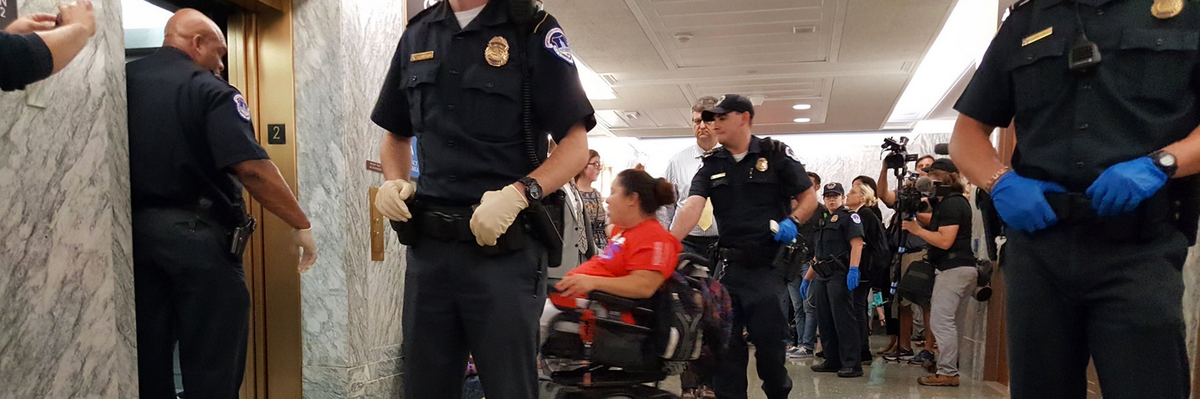
The disability rights group ADAPT has led efforts to defeat several Republican attempts to repeal the ACA, including the Graham-Cassidy bill, which hundreds of members protested against on Monday. (Photo: MsKellyMHayes/Twitter)
More than 200 members of the disability rights group ADAPT forced lawmakers to delay their hearing on the latest Republican attempt to repeal the Affordable Care Act on Monday. Protesters started lining up outside the hearing room in the Dirksen Senate Office Building at 6:00am; the hearing was not scheduled to begin until 2:00pm.
Organizers estimated that about 100 people were arrested by Capitol Hill police, who had formed their own line outside the hearing room Monday morning.
The national organization tweeted throughout the morning as protesters waited for the hearing to begin. Demonstrators had traveled from all over the country to demand that senators vote against the bill, which would end cost-sharing subsidies that make healthcare premiums affordable for lower-income Americans, and cut federal funds for states that expanded Medicaid under the ACA.
These would be replaced by block grants, which the Center for Budget and Policy Priorities has called "inadequate," adding at the bill "would cause many millions of people to lose coverage, radically restructure and deeply cut Medicaid, eliminate or weaken protections for people with pre-existing conditions, and increase out-of-pocket costs for individual market consumers."
The non-partisan Congressional Budget Office was expected to release their analysis of the bill's economic impact Monday afternoon, but did not have time to determine the coverage losses that would result from the bill's passage, before the Senate's Saturday voting deadline. The Brookings Institution estimated that like Republicans' previous attempts to repeal the ACA, the Graham-Cassidy bill would eliminate coverage for 32 million Americans over the next decade.
The Senate Finance Committee hearing, led by chairman Orrin Hatch (R-Utah) and featuring testimonies by the bill's co-sponsors, Sens. Lindsey Graham (R-S.C.) and Bill Cassidy (R-La.), was held to consider the bill along with changes made to it over the weekend, particularly extra funds that were included in the legislation for Maine, Alaska, Kentucky, Arizona, and Texas -- all states with senators who have expressed doubts about the proposal.
While waiting for the hearing room to open, protesters shared with reporters their reasons for protesting Graham-Cassidy.
ADAPT reported shortly before the hearing's scheduled start time that police were not allowing people in wheelchairs into the hearing room.
Hatch delayed the hearing as dozens of protesters entered the room, and Capitol police officers began arresting people. Amid the pandemonium, Cassidy was seen yawning.
As news of the arrests spread, many expressed support for ADAPT on social media.
Dear Common Dreams reader, It’s been nearly 30 years since I co-founded Common Dreams with my late wife, Lina Newhouser. We had the radical notion that journalism should serve the public good, not corporate profits. It was clear to us from the outset what it would take to build such a project. No paid advertisements. No corporate sponsors. No millionaire publisher telling us what to think or do. Many people said we wouldn't last a year, but we proved those doubters wrong. Together with a tremendous team of journalists and dedicated staff, we built an independent media outlet free from the constraints of profits and corporate control. Our mission has always been simple: To inform. To inspire. To ignite change for the common good. Building Common Dreams was not easy. Our survival was never guaranteed. When you take on the most powerful forces—Wall Street greed, fossil fuel industry destruction, Big Tech lobbyists, and uber-rich oligarchs who have spent billions upon billions rigging the economy and democracy in their favor—the only bulwark you have is supporters who believe in your work. But here’s the urgent message from me today. It's never been this bad out there. And it's never been this hard to keep us going. At the very moment Common Dreams is most needed, the threats we face are intensifying. We need your support now more than ever. We don't accept corporate advertising and never will. We don't have a paywall because we don't think people should be blocked from critical news based on their ability to pay. Everything we do is funded by the donations of readers like you. When everyone does the little they can afford, we are strong. But if that support retreats or dries up, so do we. Will you donate now to make sure Common Dreams not only survives but thrives? —Craig Brown, Co-founder |
More than 200 members of the disability rights group ADAPT forced lawmakers to delay their hearing on the latest Republican attempt to repeal the Affordable Care Act on Monday. Protesters started lining up outside the hearing room in the Dirksen Senate Office Building at 6:00am; the hearing was not scheduled to begin until 2:00pm.
Organizers estimated that about 100 people were arrested by Capitol Hill police, who had formed their own line outside the hearing room Monday morning.
The national organization tweeted throughout the morning as protesters waited for the hearing to begin. Demonstrators had traveled from all over the country to demand that senators vote against the bill, which would end cost-sharing subsidies that make healthcare premiums affordable for lower-income Americans, and cut federal funds for states that expanded Medicaid under the ACA.
These would be replaced by block grants, which the Center for Budget and Policy Priorities has called "inadequate," adding at the bill "would cause many millions of people to lose coverage, radically restructure and deeply cut Medicaid, eliminate or weaken protections for people with pre-existing conditions, and increase out-of-pocket costs for individual market consumers."
The non-partisan Congressional Budget Office was expected to release their analysis of the bill's economic impact Monday afternoon, but did not have time to determine the coverage losses that would result from the bill's passage, before the Senate's Saturday voting deadline. The Brookings Institution estimated that like Republicans' previous attempts to repeal the ACA, the Graham-Cassidy bill would eliminate coverage for 32 million Americans over the next decade.
The Senate Finance Committee hearing, led by chairman Orrin Hatch (R-Utah) and featuring testimonies by the bill's co-sponsors, Sens. Lindsey Graham (R-S.C.) and Bill Cassidy (R-La.), was held to consider the bill along with changes made to it over the weekend, particularly extra funds that were included in the legislation for Maine, Alaska, Kentucky, Arizona, and Texas -- all states with senators who have expressed doubts about the proposal.
While waiting for the hearing room to open, protesters shared with reporters their reasons for protesting Graham-Cassidy.
ADAPT reported shortly before the hearing's scheduled start time that police were not allowing people in wheelchairs into the hearing room.
Hatch delayed the hearing as dozens of protesters entered the room, and Capitol police officers began arresting people. Amid the pandemonium, Cassidy was seen yawning.
As news of the arrests spread, many expressed support for ADAPT on social media.
More than 200 members of the disability rights group ADAPT forced lawmakers to delay their hearing on the latest Republican attempt to repeal the Affordable Care Act on Monday. Protesters started lining up outside the hearing room in the Dirksen Senate Office Building at 6:00am; the hearing was not scheduled to begin until 2:00pm.
Organizers estimated that about 100 people were arrested by Capitol Hill police, who had formed their own line outside the hearing room Monday morning.
The national organization tweeted throughout the morning as protesters waited for the hearing to begin. Demonstrators had traveled from all over the country to demand that senators vote against the bill, which would end cost-sharing subsidies that make healthcare premiums affordable for lower-income Americans, and cut federal funds for states that expanded Medicaid under the ACA.
These would be replaced by block grants, which the Center for Budget and Policy Priorities has called "inadequate," adding at the bill "would cause many millions of people to lose coverage, radically restructure and deeply cut Medicaid, eliminate or weaken protections for people with pre-existing conditions, and increase out-of-pocket costs for individual market consumers."
The non-partisan Congressional Budget Office was expected to release their analysis of the bill's economic impact Monday afternoon, but did not have time to determine the coverage losses that would result from the bill's passage, before the Senate's Saturday voting deadline. The Brookings Institution estimated that like Republicans' previous attempts to repeal the ACA, the Graham-Cassidy bill would eliminate coverage for 32 million Americans over the next decade.
The Senate Finance Committee hearing, led by chairman Orrin Hatch (R-Utah) and featuring testimonies by the bill's co-sponsors, Sens. Lindsey Graham (R-S.C.) and Bill Cassidy (R-La.), was held to consider the bill along with changes made to it over the weekend, particularly extra funds that were included in the legislation for Maine, Alaska, Kentucky, Arizona, and Texas -- all states with senators who have expressed doubts about the proposal.
While waiting for the hearing room to open, protesters shared with reporters their reasons for protesting Graham-Cassidy.
ADAPT reported shortly before the hearing's scheduled start time that police were not allowing people in wheelchairs into the hearing room.
Hatch delayed the hearing as dozens of protesters entered the room, and Capitol police officers began arresting people. Amid the pandemonium, Cassidy was seen yawning.
As news of the arrests spread, many expressed support for ADAPT on social media.